I’m tired of being happy for other people / I wanna be happy for myself


I’m tired of being happy for other people

I know that makes me selfish

Or maybe human

It’s not that I don’t want other folks to thrive / I do

I love seeing the joy in your faces


& celebrating your wins

& I want us all to get ours


Get what we have worked for so hard

Get free

But I want to be happy


I want to be seen

Recognized


Someone say I know how hard it is for you


Someone say What you are doing matters


And maybe that makes me selfish


Or human


To want this


To want more for myself

To want space to breathe & expand

The voice in my head say


You can’t want that because someone else don’t have it

When I wish for a shower with a soaking tub


Big enough to hold my chair


When I wish for a house with some land


Big enough that I can walk without bruising


For a bed that doesn’t fuck my back up

A chair I can sit in & write for hours


For friends big enough to hold me


& alla my contradictions


When I don’t want to be seen


But I want to be


Big enough to be witnessed


& maybe all that makes me selfish


& so I am


But I’m tired of being happy for other people


I wanna be happy for myself


on success, protecting Black women, and 'what you pay attention to grows'

I'm in the midst of writing the proposal for MAGICAL DEPRESSIVE REALISM and I've been thinking about mainstream success, what it does to your perspective, what it requires you forsake and leave behind.

In the social media microwave background are murmurings about Black Lives Matter Global Network CEO Patrisse Khan-Cullors being called in by the families of the dead Black folks whose names the organization used to "build power", and her recent interview with Marc Lamont Hill essentially refusing their requests for accountability. Her high-profile friends rushing to her side, claiming they are acting in the name of love for all Black women, in defense of all Black women. Some of those high-profile friends are writers, artists, and organizers I love—if from afar—and respect, whose work has inspired me and changed the trajectory of my own. And none of them, as far as I can tell, are directly addressing the very valid grievances raised by the families of Mike Brown, Tamir Rice, and others whose deaths laid the foundation for BLMGN's mainstream success and at the very least bolstered Khan-Cullors' influence and prestige.

It's really making me think, is it damn near impossible to remain rooted in a set of values that centers the most marginalized once you achieve a certain level of success? Or is it that so many of the folks in our communities who get to that level were already middle class or white adjacent to begin with?

As a Black person who was mostly raised by a white parent, I know that I must be ever-vigilant in examining my own reactions to and understandings of situations. The same goes for my class background. Raised on the stoop of the middle class and paying rent with credit, I am constantly learning how good I had it compared to a family with no access to credit and no extended family with savings. It sounds like Khan-Cullors, raised in Van Nuys, had a similar upbringing as my cousins out in Pacoima, CA. My cousins are Black middle class, nothing fancy, but also way better off than many others. Yet I'm sure they have horrible stories to tell, ways they could claim purchase to the gravy train of Black death, if they wanted.

Living in LA, I've heard things about Dignity and Power Now, Khan-Cullors first organization here in the Los Angeles area. They have a reputation, at least in disabled community, of not compensating appropriately for labor requested. Former BLM LA members—disabled working-class cultural worker Walela Nehanda is an example—have spoken out about their dismissive treatment by Khan-Cullors and Melina Abdullah, a professor at Cal State LA and leader within BLM LA. Ferguson activist and media director for Planting Justice Ashley Yates has long been drawing attention to the abuses within BLMGN, particularly their handling of sexual assault accusations against one of their members by Yates herself.

None of this is new and none of it originated in right-wing media. Like everything else, white people noticed calling BLMGN out was trending in Black circles and decided to capitalize on it. And it's a cute swerve to finally come out and say something about it after all that's gone down, and then claim the whole thing is a right-wing op.

It's the elite playbook, really, and it makes sense that it's being used by folks who've gained some level of mainstream success. To get to the point where you're regularly bumping elbows with celebrities, especially as a fat Black queer person, you have to have begun to believe in their bullshit to some extent. More importantly, their bullshit has to have rubbed off on you.

And perhaps most importantly, you have to have shut out the folks who would take you by the shoulders and shake some sense back into you. Those folks are, too often, the same ones you had to use to get where you've landed. Folks like Nehanda and Yates. Folks like the parents of murdered Black people, like Samaria Rice and Mike Brown Sr., and the grassroots BLM activists who support them.

Generations of Black middle class academics, writers, and artists have interpreted the experience of the Black underclass into profit and refused accountability for it. This isn't the first time it's happened, and as long as folks think protecting Black women means protecting their right to acquire wealth by any means, it damn sure won't be the last. The constant social media gaslighting around Black abundance, acting like any critique of earnings is an attack against all Black folks' right to be comfortable, is white supremacist capitalism internalized. Folks are using the same arguments billionaires deploy to justify why they deserve their wealth, just draping it in kente cloth. If you add shine to your name off saying the names of dead Black folks, I'm sorry, but you are engaging in exploitation unless their survivors are also living in abundance.

And that's something I see too: the conflation of white supremacist attacks against Black activists in general and Khan-Cullors, Tamika Mallory, and others in particular with the legitimate critiques of BLM chapter members and the families of those murdered by police. Yes, some people making noise do want these high-profile activists dead, do want them to suffer in poverty. But many others are folks who are directly invested in the struggle, who have been on the ground doing work in BLM's name, or people like me who were inspired by the way the phrase "Black Lives Matter" seemed to separate the chaff of white folks real quick. I mean, we have two Black Lives Matter stickers on our car, so it's not like I was ever anti-BLM or anti-PKC! I'm still not. I'm just anti-evading the communities you say you want to lift up and build power for.

I know there's only so much you can do to control the ways people use your name, your ideas, your image. I want to offer generosity to these activists, consider that they did not willingly participate in the their uplifting to a position of community leadership. But I also know it's possible to limit your success, to turn down invitations, to donate speaking fees or suggest a different speaker with an experience that needs centering. In my own career, I've had many opportunities to speak on the Black experience, bolstering my own profile in the process, that I've turned down.

It might have more to do with my neurodivergence-fueled affinity for fairness and my general disdain for celebrity, but as someone who straddles the borders of many marginalized identities, I am very conscious of the space I take up. I want the same level of conscientiousness from those who have taken up the mantle of community leader. Particularly if that's not a mantle the community you're trying to lead has handed you. I don't think, even if you feel this way, that being "divinely called" to this work is a valid excuse for evading calls to accountability. That's a very individualist mindset. If you are called, it's to serve the people, not the other way around. Demands that we ignore these families' cries for redress sound to me like we're being expected to serve our leaders, who are in turn serving white supremacist capitalism.

Anyway, there's this saying of adrienne maree brown's, one of the aforementioned writers who've rallied to Khan-Cullors' defense while either ignoring or completely mischaracterizing what Mike Brown Sr. and Samaria Rice and all the grassroots BLM activists are saying. The saying is, "What you/we pay attention to grows." She repeated the saying in a recent blog post, which was actually a recent speech she gave at Tulane University, defending Khan-Cullors against these supposed right-wing attacks. I used to nod along in the way I nod along to other movement platitudes like that, i.e., "The power of the people is stronger than the people in power." In the latter case, when I drill down into that saying I find all sorts of nuance, like yes, the power of the people is potentially stronger, but the people in power have riot gear and tanks, so we've got to be more specific—if we were all aligned, all working towards liberation strategically and diligently, then our power can overcome theirs.

Today I found myself at last reacting to the simplicity of "What we pay attention to grows" as brown sought to divert our attention from the struggle of poor and working-class Black families inviting their self-installed leaders to accountability and towards the struggle of being a high profile Black middle class activist. I realized my experience with gardening does not bear the phrase out as a truism. Sometimes what we pay attention to rots and dies. It depends on the quality of the attention.

I think these celebrity activists and movement writers with a high profile have been receiving low-quality attention. Too much water. Adoration absent honest critique, attention that can look and feel like it is helping you grow but is actually cutting off your oxygen supply, dooming you to suffocate in stagnant ideas. When the families of Black folks murdered by police are calling you in and you can't step off your pedestal (which you claim you don't want in the first place) long enough to acknowledge what they're saying? Your root system is gone.

I just... am so disappointed. I had to write about it. If only so I remember, so that if I'm ever in a position to disappoint others in this way, I can avoid it.

be as the phoenix


(reposted from instagram for accessibility)


The phoenix. A brilliantly colored bird that burns to ash only to rise again & fly away home in an ever-repeating cycle. A resurrectionist, practiced in the craft of making themselves whole after tearing themselves apart. A kindred spirit to those of us with brains that like to upend things.


While many cultures describe an immortal bird that is associated with the sun (i.e. the Chinese fenghuang), the myth of a bird that rises from the ashes is thought to originate with the ancient Egyptians. Bennu, a bird who represents the soul of the sun god Ra, is described as living 500 years before dying in a blaze and rising again to carry the ashes of its ancestral self to Heliopolis. This cycle of death-birth-rebirth repeats until the end of time.


Where the phoenix myth appears, it is used as evidence of the cyclical nature of existence, of our resilience as humans who can die little deaths and still continue on. For me, I see the phoenix myth as instructive of a way of being, a practice: fall apart, come together again, repeat.


As a disabled, multiply neurodivergent person, and as someone who experiences extreme emotional states and altered realities, I find that the human-made world in its current configuration can be too much to bear, too often. Sometimes I can’t move, speak, or process information. Sometimes I just need to detach myself from reality and let all the laundry build up and gnash and wail and moan until there’s nothing left in me.


I fall apart in slow motion sometimes, over a period of weeks, months, years. But always, I come back to reality, gather my ashes, fly home.


Falling apart is a practice. An honoring of the cyclical nature of the self. We need to be able to fall apart safely, but too often, we must fear the repercussions. Falling apart can mean missing work, missing meals, missing rent. Falling apart can get you institutionalized. Falling apart in front of the wrong people can be a death sentence, especially if you are Black. And still, falling apart in safe spaces is how I survive.


I know from experience that the emotions I fear might break me will pass through me like a wave if I lean into them. I know that I can remain tethered to shore by my love and breath and purpose, that I will not disappear into the vast ocean of myself if I allow these realities to unfold. I know that I am capable of incredible feats of magic: I have put myself back together again multiple times despite believing myself irrecoverable.


Right now I am in the process of slowly falling apart again. The world itself seems to be slowly falling apart, and it is overwhelming. It feels like we will not arise from this, that this may be a final disintegration. But I remember having felt this way before and risen the next day. I know that how it feels in the midst of a transformation is not reflective of the final result. I know that no matter how uncertain we might be about the outcome, we can still share wisdom with each other, we can still engage in acts of love and communion and resistance. We have worth even as we are coming undone.


---


As the phoenix burns, does it suffer silently? Or does it cry out, pleading for respite from its fate? Nothing in the mythologies I’ve read mentions the torment a phoenix must endure, but I can imagine, because the deaths I myself have experienced were not gentle.


The death our society is experiencing is not a painless one, either. And a resurrection from the ashes of whatever is left when this is over will also need us to curse and toil. But there is always joy to be had, and celebration. As long as we remain within the cycle. As long as we live to rise again.


Creating space/time to fall apart safely within will help make sure we do.


If you feel like falling apart... lessons from the phoenix


  • Set up an emergency plan, a mad map (check out pubs by @fireweedcollective), and/or a psychiatric advance directive, so if anyone catches you mid-collapse they'll know what to do.

  • Talk to roommates or family about your needs. If you're close enough, explain to them that you're dealing with x mental health struggle and you need some spacetime to just let things out, so please don't worry, and you'll check in when it's over. If you're not close, just tell them weird stuff will be going on in your room/space/etc. for x hours/days/weeks, and you need them to be chill about it and not call the cops.

  • Depending how long you plan to be a mess, make a plan to check in periodically with friends, whether online or IRL, or family, so they know you're still alive.

  • Find a space where it's safe to cry, scream, throw things, dance naked, whatever you need to let this move through you. Do this for however long you need to/are able to. If self-harm is a concern, remove things from the space you might use to hurt yourself (ask for help with this if needed and available). The closer you can get to creating a space where you can completely abandon societal norms around behavior and masking your crazy, the better.

  • When it's over, baby yourself back together. Order takeout if you're hungry, get in a warm shower or bath, masturbate, do art, watch trash online. Whatever best eases you into this reality. Don't plan too much for the days after a scheduled collapse if you can avoid it. Let the tender edges of your self heal over first.

  • Integrate time to fall apart into your routine if you can. Once a day, once a week, once a month, however often you need. Allowing yourself to feel and experience what you must suppress to get through everyday life is a powerful tool for self-preservation.


when nothing has to give but your back


is this depression?


it's anticipatory grief


it's the loss of a future


it's here-and-now grief


it's a pandemic


it's anger for having seen this coming


it's despair for our chances of surviving


it's regret for all i couldn't do 


it's fear for my loved ones


it's deep ambivalence about being alive


it's exhaustion like a thirst in my bones


it's numbness


it's a muting of life


it's an iron veil


it's a yoke around my neck


it's amorphous


it's inescapable


it's my new normal


it's all i got 


discern the difference between an end and the end


(reposted from instagram for accessibility)


TW: death, suicide attempts, hospitalization, r*pe, IPV, police violence


--


This moment in time feels like The End for a lot of us. The myriad crises we are facing—white supremacist fascism, climate chaos, ever-mounting COVID-19 deaths and infections —loom apocalyptic, cataclysmic.


Every day is a universe unto itself, yet somehow we string them together, continue putting one foot in front of the other on the long march towards what feels like an ultimate doom.


--


I want to honor the reality and gravity of our collective situation. We haven't taken nearly enough space for grief, for feeling these tectonic shifts in ourselves and our human-made world.


A huge chunk of our population has fallen ill and perished within a few months. Black maGes continue to be murdered by police and intimate partners, strangers, anyone. Our country seems on the brink of civil war. For those folks who have died, who will die, this moment is The End.


But for the rest of us, it is not. It is An End. There is a distinct difference.


--


An End for my personal world has looked like memories of childhood rape flooding back to me in the middle of a school assembly at ten years old.


An End, for me, has also looked like courting The End by swallowing enough pills to kill me multiple times, and being forcibly incarcerated in psychiatric facilities as punishment.


My world has been shattered and remade multiple times, like the Earth in its infancy. And like the Earth, I am continually changing, unfinished. I will meet An End again, just as surely as another cataclysmic meteor will hit this planet in the next billion years.


But: until I die, until The End, I can shift course. I can grow.


--


Sometimes An End looks like someone we love abandoning us, or losing a job, or getting kicked out of school, or losing secure housing. And sometimes, for some of us, those situations do evolve into The End. But sometimes, for some of us, they don’t. 


Our human-made world is in the middle of An End that could very well evolve into The End of our species if we do not change course. But for now, we are, gracefully or not so, inhabiting the space of An End. And that space is full of so much promise.


Because after An End, there is A Beginning.


__


Beginnings are difficult times, messy times, but they are hopeful. We have survived a brush with The End. The possibilities for our lives seem endless.

Beginning anything, any new way of living, requires care and cultivation. There will be missteps & stumbles. Sometimes we might seem to go backwards, looping like eddies in a temporal river.


We can look to the rocks below our feet for reassurance.


--


For eons, the infant Earth was bombarded with debris from the still-coalescing solar system. Our moon was carved from the Earth's flesh by a direct hit from another baby planet. After the Earth re-formed itself, it was tilted on its axis, but still here.


(Do you know that feeling?)


Our planet has nurtured life and then watched it nearly die off. It has frozen over and thawed, taken multiple asteroids to the chin, and endured millenia-long volcanic eruptions. Whole worlds have ended and begun anew.


And after all that upheaval? We are here, today, enjoying this world, this Earth, this beauty. Snow-capped mountains and savannahs and rainforests and glaciers. The expansive ocean. Our pockmarked moon at its fullest.


--


When I feel my anxiety rising, when I am depressed by the weight of human and non-human suffering and death, I allow myself to feel it. I cry as if I am an expression of collective grief.


Then, I situate myself in deep time. Geologic time. The scale at which the earth moves. I remind myself that this is not The End of The World, it is An End of This World.


And we can still shape A Beginning.


A question of time


Where are you allowing the false urgency of consensus reality to overwhelm your senses?


How can you place yourself or humanity in a broader context (i.e., deep time) to let some pressure off?


Why are you convinced that the past should be past? Who taught you the future must remain forever out of today's reach?


How might allowing yourself to live within a better future today make it more possible for us to achieve collectively?


choose your reality


(reposted from instagram for accessibility)


cw: MENTAL ILLNESS, MED WITHDRAWAL


--


Consensus reality is a postmodern concept, based in the idea that reality is inherently subjective. What we all “agree” is real, is real. That means “reality” is highly influenced by systems of oppression.


We are currently living within multiple consensus realities. The dominant, liberal/neoliberal consensus reality is the WSSCAIP (White Supremacist Settler Colonialist Ableist Imperialist cisheteroPatriarchy), which has us grinding ceaselessly yet somehow still at each other’s necks for scraps, and which is responsible for: the destruction of the planet, the colonization and genocide of the Indigenous peoples of Turtle Island and around the world, the enslavement, colonization, and genocide of African peoples, etc.


There are fascist/alt-right/neoconservative realities which derive from the main consensus reality but are invented fantasies, branches in the timeline. QAnon, for example, believes instead of cishetpatriarchs and capitalists, the world is run by a pedophile cult. Fox News taught us climate change is a hoax, and that COVID-19 isn’t real/was engineered by China, etc.


I clearly don’t agree with the realness of any of that shit. I agree that the WSSCAIP exists, yes. But is it part of what i consider my reality? Not exactly.


--


What’s real to me? What we human animals need to survive and keep our bodymindsouls thriving. What the non-human animals need to survive and thrive. What plant people need to survive and thrive.  The relationships between all of us, all the things on this Earth of this Earth. The Earth itself, the Sun, the Moon, the relationship between our world and the universe.  Those things are real to me.


Some background: I'm a crazy person. I was diagnosed with a bunch of so-called mental illnesses (bipolar/schizoaffective, DID, BPD, GAD, PTSD, some other stuff) when I was younger, and I was on all sorts of meds for decades. And then later when I was older, I realized they were fucking up my brain and I had to come off them.* It took seven years to withdraw. I had to learn how to deal not only with my underlying craziness but also the craziness that arose in me from the withdrawal fucking up my brain chemistry even more. I faced what i thought was my end numerous times. Slowly, surely, I felt into a way of generative living with my crazy.


I've been calling the framework I built around my crazy magical depressive realism, a way of living in the lineage of liberatory madnesses.


--


Being a magical depressive realist means acknowledging the true, destructive nature of the multiple consensus realities I navigate while, to the best of my capacity, living in and building towards alternate realities. Realities where things that are real are sacred.


It also means accepting and honoring that there are some experiences and affective states that are real, that are created in concert with my bodymindsoul, but somehow exist outside of the bounds of shared reality, and cannot be easily contained by diagnostic labels or symptom profiles, or productively managed by biomedical model-based treatment strategies.


I accept & honor these states & experiences by no longer trying to suppress them in conformance to the WSSCAIP, by caring for myself, allowing my community and pod to care for me, and seeking treatments I can access and that work well for me.


By embodying magical depressive realism I commit to reconciling my personal realities, the universes I hold inside myself, with the realities of others, where appropriate, in order to avoid harm. I am constantly reconciling my reality with the realities of living day-to-day in a world that is hostile to liberation.


At the same time, I do not abide the pathologization of my (our) personal realities and "negative" human emotions/experiences under the WSSCAIP. I respect the lessons depression, dissociation, and other altered states of being have to teach us about our world.


I understand that magical depressive realism is a radical idea in a world where bipolar, ADHD, psychosis, dissociation, BPD, and other so-called mental illnesses are demonized and blamed for lost productivity and profits, for failed relationships and missed opportunities, for the antics of a white supremacist U.S. president. Our ways of being are inconsistent with capitalism. Our existence is resistance. I want us to refuse to compromise our well-being to gain acceptability or access. Our bodymindsouls are too precious to be mined for resource.


__


If you, too, have had your way of being pathologized, I invite you to choose your reality.


Will it be the biomedical reality, the reality of the WSSCAIP, where you are an aberration, a "broken brain", a useless eater?


Will it be the reality of liberatory madnesses and magical depressive realism, where you can harness the insights our ways of being offer us, to aid in collectively changing the world?


Or will you embrace an altogether different reality, your own unique way of moving towards liberation?


Sources: embodied wisdom, black feminist theory, the sociology of mental illness (ex. Creating Mental Illness by Allen v. Horwitz, ), my ancestors, & so much more.


                  *not the right path for everyone - do what works best for you


self-love, universal love, and this material existence: a valentine to humanity


i want to talk a bit about love and what it means to me on this day for lovers.

love, to me, is inherent to the structure of this universe. hell, even the multiverse potentially, but this universe for sure. i say this because we are able to exist here. the laws of physics arranged themselves into a ruleset that allows the formation of complex life. to my mind that is evidence that our universe is at least capable of love, if not composed of it entirely. and if we are made of the same stuff as the stars, as the universe, are we not also meant to love and be loved by each other? are we not also meant to link ourselves together into constellations of care?


love is the dark matter that holds us together. evil is that which turns us away from love, away from each other. there is no epic battle between anthropomorphized god-creatures that we must choose sides in. there is only the choice to come together and love each other or embrace the systems that are keeping us apart.

when i look at the world as it is currently constructed, i feel a deep sense of mourning. we have been forced so far away from the truth of love. the truth that we are here because we are loved. these systems that we live under---capitalism, white supremacy, colonialism, ableism, imperialism, cisheteropatriarchy---are designed to institutionalize evil, to make us forget we are born loved. to make us hate each other and ourselves. they convince us that we must learn to love ourselves despite all odds, or that we must seek love from a partner or a friend, and that we are only worthy of that love if we've attained a certain level of social acceptability or popularity or enlightenment. but universal love is accessible to all of us, all the time. it is in the air we breathe, the water we drink, the plants and animals we consume for food. we are here because this universe loved us enough to shape itself into something we can inhabit.

in my own spiritual practice i call the universe god, and in a sense that is correct. the universe is so much more powerful than i am, so much more intricate and unknowable, that it might as well be a god. but what i am really invoking with my reference to deity is the idea that love is a force, that the universe itself is a force, and that if we can tap into its love energy we can make magic happen. when we organize together and dream together and work every day at loving each other we are making magic happen. we are counteracting the forces of evil that drive us into our silos of individualism and achievement.

it is from those same silos of individualism and achievement that we are encouraged to love ourselves. self-love is a capitalist substitute for universal love. it is impossible to feel loved consistently in a world built to separate our souls from our minds and bodies, but self-love tells you that you must somehow overcome all the structures set up to separate you from your ability to tap into divinity on your own. that if you only love yourself enough none of it will matter, and if you cannot love yourself you must spend the rest of your life learning how. but universal love tells you that this is all wrong. universal love reminds you that what prevents you from loving is not your flawed psyche, or a lack of will, but the systems of oppression that were constructed to keep you mired in hate.

universal love asks you to look at the earth, at your mere existence on it, and use this as evidence that you are loved.

this philosophy is not dependent on a belief in divinity or magic. if you aren't about the woo, i understand. but you are reading this, and you are alive. outside of all the bullshit of the human world, life is a gift. it is a result of a specific set of circumstances that may or may not have occurred outside of our universe. i choose to see this confluence of randomness as evidence of love in action.

i believe love is the strongest force in the universe, stronger than gravity or nuclear attraction or even change. when we are tapped into a sense of universal love we are capable of so much. we are capable of dismantling capitalism and colonialism, halting climate change, transforming the world into a place where we can all feel loved and cared for. we can articulate our needs and support others in getting their own met, without shame and bitterness. we can see beyond our immediate crises and into a future where we aren't making decisions based on the lesser of two evils.

my own magic is centered on harnessing universal love, on bringing people into a mental space where they can realize their divinity and go forward knowing they are loved. and most importantly, knowing they are capable of focusing that love into a transformative force for social change.

on this day of commercial romance and beyond, i encourage you to root yourself in such love. with every single breath.


the decade of transformation (towards reclaiming my birthright finale)

like all journeys in life, the path to becoming is never linear. bumps in the road can make me shrink to protect against their impact. but here, near the end of the decade, i am leaning into the largeness of myself. i am remembering that vulnerability and authenticity are also protective.

#

this decade began for me with a small death. the marriage i was in ended after nearly ten years, and i had been laid off the year before. with long-term unemployment made feasible due to the governmental generosity extended after the housing crisis, i had time to think and fornicate and make little moves towards becoming myself more fully. i became a writer-writer, you know, the kind that gets paid. i spent summers on the beach sunning my fat body, celebrating my gloriousness, loving queer friends and femmes, going to conferences and parties. i could visualize my future from there: writing a book, touring the west coast, visiting friends in the east and touring there, dedicating the rest of my life to doing nothing but what i was born to do.

but instead--or rather, first--i had to dedicate my life to recovering my self.

i began withdrawing from all my psychiatric medications in the second year of the decade, a process that would take the next six years. during that time i dated a bunch, got another job, went back to college, met my current partner, saw my first article in print, lost another job, got pregnant and incredibly sick and had my first abortion, had the house we were staying in go into foreclosure, moved into a new apartment, grew my own food for a year, became more disabled, became more radical, and became more of my artist self. and somehow, i did all that while weathering the severe emotional and cognitive shifts that came with removing those substances from my neurochemistry.

in the last year of the decade, i graduated from ucla with a degree in sociology. i've been unemployed ever since. it has been trying, but it has also afforded me the reflection time necessary to finish the transformation that began in 2010.

#

the last two years of this decade were the first i've spent without psychiatric medication influencing my neurochemistry in 23 years. i feel whole, a strange sensation for someone whose self has been so defined by the places where it was broken. i might still be a little broken, but i am not lost.

part of coming into my wholeness has been recognizing the places where i have cut myself away to become more acceptable to someone else, and reclaiming those parts. my marriage ended because our way of being together hadn't been truly satisfying for years, in part because i cut away too much of myself. its ending opened the door for me to understand why i had allowed that destruction of self to occur. the journey towards understanding it has taken me backward through childhood and adolescent trauma i thought had been resolved and forward into ceaselessly advocating for my whole ass, grown human being intimacy needs. i have told my partner some really scary, really vulnerable things about my gender and my sexuality and my trauma and how all those things are wrapped up, things that i feared might end our relationship. i have leaped forward in asking for changes in our relationship structure with nothing but my faith in his love--and in my ability to be okay alone if i need to be--to guide me.

i am surely being rewarded for the pain i endured at the hands of men, for the universe to send me this man as a gift, this human so kind and open in heart, so willing to shift and grow and change with me.

#

out of necessity, this decade i've cultivated an ongoing practice of radical self-love and ferociously transformative justice-making, and i have been reborn in the process. my tether to the divine has been strengthened. i am re-infused with purpose, reconnected to my sensuality. i am so excited for 2020, for my fortieth birthday and beyond, for writing books and touring and fucking and loving on all the magnificence in the universe. for building something durable and rich with my partner. for growing and learning and spending time with plants and animals and feral people. for magick. for letting go of every single thing that doesn't serve the divine, everything that pushes us further away from loving each other and ourselves and the universe.

happy 2020 y'all! it's gonna be amazing, you'll see.

a solstice/new year intention-setting ritual

i am on a makeshift writer's retreat at our out-of-town friends' home in the mountains of glendale, california. last night, wind gusted against the house, kept me up half-wondering if someone was trying to break in. this afternoon, the rain stopped, and tonight, the wind has calmed down some, but it is still freezing. 50 degrees and breezy. blessedly, they have central heat, which i have cranked up past the point of financial/environmental sustainability because they love me and i know they would want me to be warm, and i love myself and i know that one night with one house doing the most as far as emitting co2 isn't going to tip the planet past the point of no return. i mean, we're probably there already.

not as much physical writing has been accomplished as i might have liked, but so much psychic writing has been accomplished. reflection and solitude are crucial for me to access the sacredness within myself that allows me to create. i love our home, but it is small, and it requires care, so it can sometimes be difficult to cultivate long periods of time in which i can just sit and reflect and journal and then write about what i have learned, or translate that lesson into art. particularly when i am depressed or vulnerable to become it, i need hours and hours of consecutive, simultaneous alone and quiet time before the emotions and experiences that trouble me can be documented and moved through. that's pretty hard to come by, so i am eternally grateful to our friends for lending me their home, and i am eternally grateful to my partner for taking care of the chores at ours and handling the eventual clean-up here.

this ritual is an oldie but a goodie, dressed up with some oils or herbs. use whatever you have available to make it smell good, cultivate the appropriate energies, and/or attract beneficent entities. the plant helpers you select should promote psychic healing, connecting to spirit/divine, clearing unhelpful energy, and accessing your intuition.

you will need:

paper (preferably brown but i used white printer paper cause they ain't got brown)
pen/pencil
essential oils or herbs (they have the fancy doterra essential oils here so i used those cause luxury lent with love has got to attract abundance)
the oils i used were star anise oil, lavender oil, cinnamon bark oil, rosemary oil, and sandalwood oil.

for 2020, let go of twenty attitudes, beliefs, practices, and/or values that no longer serve you, or that never did.

write each item down on a slip of paper. fold them up and throw them into a bowl. drip essential oils on them until you concoct a fragrance to your liking. (mine was heavy on the cinnamon, lavender, and anise.) use a spoon and stir it up so the oil gets on all the paper. if you're working with whole or ground herbs, shake the bowl a bit.

take the bowl outside and dump the contents onto a pyre or other firesafe surface/receptacle. light that motherfucker up.

as it burns, imagine yourself lighter. imagine each of those beliefs, values, practices, behaviors, etc. vanishing into the welcoming and forgiving vacuum of space, once again becoming part of the universe. a part of the universe far, far away from you.

remind yourself of your power. remind yourself you are loved, you are love. promise yourself you will reach for the heavens and never settle for the earth alone. but also promise yourself you will stay grounded. that you will press bare feet into the dirt even as your head floats among the clouds.

gather the ashes and bury them in the earth.

thank your body, thank the land, thank your ancestors, thank the divine. àse, amen. peace.

may your 2020 be heavy with prosperity, community, and joy. and may you find something of value in whatever darkness comes.

ish I read this week-ish, vol. 2 (december 15, 2019)

Hey hey patrons,

This is the second edition of ish I read this week-ish--and it's actually on time! I had my mea culpas all lined up thinking I'd have to do this tomorrow but here I sit. This will be a shorter edition for two reasons: 1) I've been pretty miserable this week because I've been in a fibro/IBS flare so I haven't been able to read as much, and 2) I'm exhausted right now and this actually takes more spoons than I thought it would when I promised it.

For that reason (#2) I'm thinking about making this the LAST edition of ish I read this week-ish, at least the last scheduled edition. I might want to share stuff I read with y'all (or the public) spontaneously, but this being a regular thing I do feels too much like school and I hope y'all know how much I hate school. Because I really really do. So. Yeah. As I write this, I'm making my decision. Instead of doing this feature I'll post 2 more of my poems every month. That way everything I do here is at least something I love.

Ok, now that that's settled, I hope you're all having a great weekend. Here's some ish I read this week.

When the Chant Comes by Kay Ulanday Barrett (Topside Heliotrope, 2016).

This book was lent to me by a friend in exchange for Audre Lorde's Collected Poems and I feel like it was a fair trade. I loved how disability and longing, pain and joy, death and transformation, queerness and brownness are all wrapped up in each other here as a gift, inseparable. If you are looking for beautiful cathartic writing I highly recommend Barrett's work.

TweetCat: "Stray Cat Breaks Into Zoo, Becomes Best Friends With a Lynx."

OK, I told you it was a light week.

Susan Luckman: "In Our Brutal Modern World, Science Shows Our Brains Need Craft More Than Ever." The Conversation, 28 Jul 2018.

Since I couldn't write and read so much this week I've been doing crafty-type ish and I happened across this article on FB that reinforces why I do it. I find making things with my hands (when my hands aren't also hurting, lol) to be so relaxing and restorative, and finding new in the old is a kind of art. I love cutting up clothes I was about to give away and turning them into something I'll wear for years and sewing fancy accessories that I can't find in stores for cheaper than they'd sell them. And because I'm making things for myself and not selling them I don't have to worry about perfection.

---

That's all they wrote, folks! I'm almost down to knives, so I'm gonna go lay down.

I'll put up a separate post another day reminding y'all about the shift to poems from reading roundups, just to make it canon.

Peace!! xo


ish I read this week(ish), vol. 1 : november 30, 2019

Good afternoon, beloveds!

So, I hadn't picked up a book for a few months before the beginning of this one, depressed and preoccupied with looking for a job as I've been. Around the Witches' New Year I started to move out of that deep oceanic depression and into a cosmic microwave background radiation depression: still here, but less detectable under average conditions. That opened the floodgates for me to finish a whole slew of books I'd been unable to before, making this edition particularly literature-heavy. Enjoy.


The Hidden Life of Trees: What They Feel, How They Communicate—Discoveries from A Secret World by Peter Wohlleben (Greystone Books, 2016).

If I needed more convincing that the human/animal monopoly on sentience is a myth, this book would have pushed me over the edge. As it is, I had my understanding of the Earth as a vast interconnected web of life reinforced by these stories of tree solidarity and family. And I am now immersed in the idea of living on tree time, which is also crip time and CP time and queer time, and trying to hold space for myself to build myself and my body of work slowly. Slow growth equals strength, despite what capitalism might want us to believe. The trees know, y'all.

Care Work: Dreaming Disability Justice by Leah Lakshmi Piepzna-Samarasinha (Arsenal Pulp Press, 2018).

Speaking of crip time. Leah, I am so grateful for this offering of yours. (I know they aren't here, but I'ma speak it to the Universe.) It took me a while to finish this because it is a hard read in ways, as someone who has longed for disability community since I was a crazy achy teenager, because it is full of such beautiful stories of us taking care of each other in the most radical and revolutionary ways. But while I was making my way through those feelings of--let's be honest, jealousy--I was also doing the work of finding and creating that community that I was longing for. Like now, I'm a member of the Los Angeles Spoonie Collective, and I've met so many other amazing disabled activists and friends. That's in part thanks to Leah's work. There is so much goodness in here, on femmes and suicide, on access intimacy, on building disabled community and care networks... just, yeah. Get it if you haven't already. It's on sale right now via the link up top, so hurry!

The Inheritance Trilogy: The Hundred Thousand Kingdoms, The Broken Kingdoms, The Kingdom of Gods, and The Awakened Kingdom, by N.K. Jemisin (Orbit, 2014).

Oh. My. Gods. So. I am a huge fan of N.K. Jemisin's work. We read her short story Walking Awake in my Afrofuturism class at UCLA, and I fell in love with the Broken Earth Trilogy shortly thereafter. I got How Long Til Black Future Month on a Kindle deal and of course loved that, but I'd been broke so I hadn't been able to buy this series or her other duology. But I realized I could check out the e-book from my library recently, so I did, and... oh my gods. I devoured it. The series is about a planet that is kinda Earth-like, but there's gods. Like, in human form, in non-human form, living among them and doing god shit. The mythology is beautiful, especially the idea of the Three: this trinity/godhead that consists of a goddess, a god, and a genderfluid being that can be either a goddess or a god depending on how they feel. I'm not at all doing it justice. You should just read it.

Vanessa Barbara: "Early to Bed, Early to Rise Makes Me Exhausted, Depressed and Sick." The New York Times, 28 Oct 2019.

Mx. Barbara's story is a perfect example of how capitalism forces us to sacrifice our bodies and minds in favor of fitting into an arbitrary 9-to-5 schedule. I don't have delayed sleep phase syndrome, but I do have disabilities that prevent me from being able to get out of the house earlier than noon reliably. I've often lamented how much more productive I'd be if I was allowed to just do what my bodymind needed. This quote sums it up:

Here’s the thing, though. If left to our own devices — if allowed to follow our own biological clocks — we sleep just fine.

Individuals with extreme cases of the syndrome are unable to work conventional jobs. We are also famously unreliable at keeping appointments and participating in diurnal social activities. We learn to make excuses and tell lies. I often say that I work nights, which is true — it’s just not the whole story. Most people respect work-related excuses, but sneer at health conditions they’ve never heard of.

That’s the worst thing about having a circadian rhythm disorder: living in a society that places a moral value on the time your alarm clock goes off. Most cultures emphatically equate early rising with righteousness: As we say in Brazil, “God helps those who wake up early.”


Jessica Jurnigan: "Binding Harm: Generations of Witches Intertwine Rituals and Activism." Bitch Media, 18 Nov 2019.

So, I don't know how I feel about the subjects of this article--Starhawk and Amanda Yates Garcia--because there is so much about white witchcraft that tends to be appropriative. The last time I engaged with Starhawk's work I was in my teens, and much less militant, and I have only heard of Yates Garcia in passing prior to reading this. That said, I was nodding my head YES to so much in this essay. I am a witch because I understand that all systems of oppression are related, because I understand that the continued separation of our bodies from our minds and from Creation is crucial to the colonial-capitalist project. Crip/CP/queer/tree time is in the same radical, anti-oppressive tradition as Yates Garcia's witch time:

Witch time is Earth time—Earth and its relationship to other planets in our solar system, its relationship to the universe… It’s not this urgent schedule based completely on your productivity and your ability to reproduce capital.


See? YES. I am in a constant practice of listening to the Earth, listening to our collective bodymindsoul and my own, and prioritizing those flesh-and-dirt needs over the dictates of ableist capitalism. That is my everyday magic.

--
That's it for this edition, thanks for reading! I hope y'all are having a great weekend.
xo


lessons from scorpio season


i was going to write about all the difficult lessons i'm learning this scorpio season about fluid boundaries and respecting others' wholeness at the same time as you respect your own. but then i crashed back into depression after turning my attention to financial matters again. so instead i'm going to tell you about the darkness, because it teaches us something too.

i have tried to end my life actively twice and passively an uncountable number of times. 6/7 days of the week, give or take, i am in an intentional practice of finding reasons to live. in a world where new reasons not to live manifest on a daily basis, this requires a good deal of my energy and focus. there are nearby things that are reasons to die and far away things that are reasons to die: nearby, financial instability, hunger, and unemployment; far away, climate catastrophe, ableist white supremacist fascism, capitalist ruin. all these things and more weigh on my mind, weigh down my mind so that depression becomes inevitable.

when i look back at each moment i can remember making serious plans to kill myself or actually trying to kill myself i think about whether or not i would regret it if i had died then, if i had missed out on all the events in my life that followed. the answer is invariably no. not because i don't love the people in my life dearly. not because i haven't had good times since. the thing is, i don't think being alive in and of itself is worth anything. i think being alive is worth something if you love your life. i don't love my life a lot of the time. sometimes it feels like i'm always miserable. but i know depression fucks with my sense of balance in that way, so i don't use my proportion of good days to bad when i'm doing the calculus of whether or not my life is worth it. what i do is think about the proportion of struggle to reward. for me. i'm sure other people get something out of me being alive, because out of necessity i have shaped myself into a person that others would enjoy being around. but for me, life is also often way more struggle than reward.

of course things might turn around at some point if i stay alive but the way things are looking now in the context of my life history thus far doesn't bode well for the kinds of extraordinary developments that would have to occur for this to reverse course. plus, i don't have a lot of life left in me. i have multiple disabilities and i am multiply marginalized. every day a new study comes out telling me this or that trait is a risk factor for early death. being Black, being mentally ill, being queer, being fat, being in chronic pain. all these things wear on my bodymind. and accessing the things i need to counteract them is contingent on me having the money to do that. if i can't make or raise money, i am on a path towards death anyway, regardless of if i want it or not.

so i am presented with a choice: use my spoons on trying to keep on top of finances/fundraise OR look for a job OR find a reason to live. because at this point i don't have the spoons for all three. and since i can't always generate reasons to live for myself i am falling into depression way more often. and i am afraid--no, i am not afraid, not anymore. i have accepted the inevitability that if this continues, if i cannot find some kind of work, at some point i will fall in and be unable to pull myself out. i don't want to hurt the people i love, but i cannot control the world. i can only do what is within my capacity.

this is what is real for me right now. nothing else takes up so much space in my life. the specter of death. the futility of trying to find a reason to live as a suicidal person when every day brings your involuntary negation closer. i am angry when i think about how i've fought to survive for so long and i might just die because capitalism. because i fell for a lie, when so many others fall for the same lie and are rewarded.

this is what is real for me right now. i say optimistic things on social media but i don't believe them. i don't really believe the world won't just let me die. i don't believe i have the ability to survive. i am scared and hurt and angry and i feel abandoned and betrayed and bitter.

this is what is real for me right now. people die every day. people are abandoned by their families and communities and societies every day. if there is a god they do not discriminate when distributing suffering among the marginalized and oppressed. if there is a god they seem to favor the rich, the white, the depraved. at least in this realm.

(god, please tell me there is a place where this is made right. please tell me this pain isn't for nothing. please help me understand.)

this is what's real. i don't know how i am going to get through the rest of today, or the rest of the week, or the rest of the month. i have nothing to guide me but a shaky faith in myself as a part of the divine and in the divine themselves. i constantly shift between deep, bone-crushing despair and butterfly-wing-beat-hopefulness. i constantly delude myself to keep going and that's okay. when consensus reality is too harsh sometimes you have to exist in your own.

this is what's real. i can't promise to stay alive because that's not entirely up to me. the world has the ultimate say in my survival. but i promise that i will keep fighting. i promise that i will stare down the darkness until it has said what it needs to say. and if i survive, i promise that i will teach you everything it taught me.


whatever

this isn't about anything, i just need to get some shit down.

still don't have a job/income. i'm in a "hiring process" rn for this remote writing job and i've been putting a lot of my energies towards manifesting that. but it is taking waaaay longer than i think i have the stamina for. i had to turn in a writing sample yesterday and now i'm waiting on the results. i want to believe that i will get the job, but i'm so used to being disappointed i can't let myself think it's REALLY going to happen. i can't visualize myself past this point in my life anymore. i'm so tired. i was manic for a week or two and that powered me through the first part of this "hiring process" but i've been just kind of numb for a few days and now i think i'm moving into legit depression. but even in the mania i wasn't ecstatic or anything. it was more just energy but not the good feeling with it.

my sex drive is nonexistent because to desire sex i would have to feel with my whole self and that isn't something i'm equipped to do rn. plus i'm having a lot of pain in my back and legs and head and guts and it's hard to focus on anything else going on in my body. it's just too much. i'm so exhausted of this world and how hard it is to live in it, and with how many people in it truly believe that this is the way it should be. and i know there is so little i can do to change it. and i have to fight my mind and body and the world and it's just... why. for what?

oh yeah, this is depression.

i haven't even been able to do more social media fundraising because i just don't have the spoons. and if anyone ever tries to tell you that "digital panhandling" is an easy way to make money, punch them in the mouth. just even working up the nerve to say anything about how fucked you are in the first place is labor. and then you have to keep updating totals, reviving the post, making new posts, new stories, all dedicated to how dire your finances are like you didn't already have that in the back or front of your mind at all times. it's just a lot. especially when you're already going through some shit, which you clearly are because you're out here asking for help. anyway. i am very thankful for my friends, who have continued to share and boost even though i'm not pushing it as much as i probably should.

i'm just fatigued, burned out, done. i've had to let go of so many things to be "okay" with where i am now, and a lot of that has been really freeing but a lot of it has been more out of necessity than desire. for example, i've let go of my need to look a certain way because i don't have the money to achieve that look. but it's to the point where some things i let go are actively making my mood worse, like rn my hair is super fucked because i can't retwist it myself anymore due to shoulder/neck pain so i "decided" to just let it freeform but that led to it getting super tangly and painful so i kept putting my hands in it when it was dry, trying to pull stray hairs out of locs that were like on the other side of my head. and now it's SO wack looking, it makes me want to cry. but i can't get it fixed because no money. other shit that impacts my health that i can't fix because no money: our 15 year old mattress is fucking up our backs and hips and shoulders, my desk chair/dining chair is in no way ergonomic and gives me a migraine if i sit in it too long, and the chair i sit in to "relax" is pushing my spine into awful contortions and fucking with my hips/knees.

and part of that stuff is my fault because when we had/have money i don't wanna spend it on boring shit like a mattress or getting my hair fixed or whatever. i wanna buy plants and tattoos and good food and cute stuff. but like, if i had enough money in the first place there wouldn't be this feast or famine mentality over here. i mean, i'm gonna die one day (probably soon, tbh), why shouldn't i enjoy my life and be surrounded and covered in magnificence? it's super hard to convince my mad depressive brain that buying a mattress is gonna make me happier than getting more tats. and like, the fact that good mattresses are so expensive yet getting a better night's sleep puts you at an advantage in life sends me down an anger spiral. same with ergonomic chairs and what not. the folks who can afford all that shit aren't the ones who really need it.

anyway, i digress.

universe, i need this job. i need something unequivocally good to happen, not some shit that i had to make good by spinning it round and round and extracting some lesson out of it. i'm tired of turning lemons into lemonade, tired of finding a silver lining, tired of trying to stay motivated and upbeat in the face of an unrelenting stream of garbage. just let me have this, please. i don't think i have it in me to overcome any more.

I might be starting to hate myself again (not really, but fuck).

TL;DR: Support my work on Patreon.

This isn't going to be anywhere near as coherent as my last little update on post-graduation life, but that's okay. Everything in me would rather not write again until things get better, so just getting these thoughts translated into words is enough right now.

Last time around I said I was going to try to write full-time and I did. For about a week. Turns out I can't take the anxiety, my heart beating out of my chest all day every day. The first day wasn't so bad. I wrote and polished four pitches and started sending them out. I did a little work on my website and Patreon and I tweeted and such to build platform. I felt positive. But after a few rejections I started second-guessing whether or not what I was pitching was even marketable. The time spent on social media, supposedly "platform building", didn't help my anxiety either. By Wednesday of the first week I was in the previously mentioned condition: tachycardia, high BP, whatever. I was hyperaware of my heartbeat and all its seeming inconsistencies. It didn't help that I was drinking black tea every morning to try to be productive and not getting enough sleep because I had to push myself so hard to work eight hours each day.

After that fiasco of a week I decided to start looking for a part-time job again. What I really want and what I have always needed to be creative is stability and it's silly of me to think that at damn near forty and in such a fucked-up time in my life and the planet's that I'd be able to change something so essential about myself. I shut down when money gets funny. Periodt. I can't generate anything when I'm worried about how we're gonna get groceries. I was just trying to make myself feel better about not being able to find a job. This is just a mutation of "if I'm exceptional enough I can succeed". Like I think that oh, I can't find a job so I'll just make a job. When in my whole life has that ever worked? Folks are even less likely to pay me if it's me, you know what I mean? Like, people will give me money to survive and I love them so deeply for that, don't get me wrong. I absolutely do and I don't mean to insult anyone who has supported me financially when I was desperate, or seem ungrateful. I am eternally grateful for your support to support me in this moment (and I know not everyone has the long-term stability to offer more than that). But it feels like most folks--whether it's readers or editors--aren't interested in paying for my work, which would truly sustain me past this moment. I know my writing has changed a lot since 2010, but I do wish that what I'm offering now was considered valuable. Oh well.

(The good femme Shannon Barber wrote about her own experiences with $$$ and feeling like she isn't folks' cup of tea and I feel it so immensely. You should read it here, here, and here.)

Anyway, I have so little energy, so few spoons, it doesn't make sense in my mind to spend them on things that have a low likelihood of success. Freelance writing, especially as a disabled person whose disabilities are exacerbated by uncertainty, instability, and rejection, does not have a high likelihood of success. And the types of shits I think to write about are profoundly unmarketable (by me). And to be honest the kind of writing I want to do right now is not that. So I stopped. If nobody's gonna read my shit anyway I might as well only write what I want, when I want.

But the job search doesn't seem to have a high likelihood of success either.

Since June I've been on three interviews and all of them advertised as part time jobs but ended up preferring someone who would work full-time now or in the future. I don't want to work full time because I want to have energy to write and if I earned the same wage I did BEFORE I WENT TO COLLEGE I really wouldn't need to work full time. Irony of ironies, it seems like I'm gonna be making significantly less than I did before I went back to school to make more money/have more stability. I am so, so, so salty about this shit, y'all. Like, the salt is f e r m e n t i n g the longer I sit here with a college degree and no job.

(And I know I knew it was a scam while I was in it but it just sucks so so bad being in it.)

I can't count how many jobs I've applied to and never heard anything, not even an interview request. Right now I'm playing phone tag with a manager at a call center where I applied to be a rep and it's been so long that I'm suspicious she's somehow figured out I'm Black and is trying to avoid ever actually talking to me. Last Friday I drove for UberEATS for about three hours and made $26. NO ONE tipped. My broke ass makes sure we tip every single time we order anything delivered and I feel guilty because I only do 20% but we don't even have that. I was so mad. Driving gives me migraines especially when there's an additional stress (like time or making money) added to the experience, so I would have liked to make more for three hours of one of my least favorite activities. I might do it again one day this week to see if Friday is just a day assholes tend to order but I am 99.9% sure it's not gonna be a viable source of income. Especially since it really fucked my energy levels over the weekend.

There are so many things I'm amazing at, but I'm in the exact same position right now I was before I went to school: I don't have "legit" experience doing those things, or I don't have the right degree, or I don't have the money to start doing them as a business because you need licenses and other garbage. I'm stuck hoping one of these places I'm applying to realizes how amazing I am and offers me a job. It doesn't seem like it's gonna happen any time soon, and paradoxically the longer it takes the less motivation I feel to keep trying. That is alarming since our financial situation worsens with each day that goes by where I'm not earning money.

The thing is, of course, that I don't really want to work. I want money so I can eat and medicate and buy plants and get tattoos and stuff, but I don't want to have to go into an office every day or write something marketable or deliver food or whatever capitalism has decided is worth getting paid for. I want to do the work in that I want to make art, struggle towards liberation, build community, spend time with my loved ones, worship god, and enjoy my place in nature. Those are some of the most important things in the world, but they don't bring in the cash. Which is why, every day, I question why the fuck I stick around this godforsaken planet.
.
.
.
I'm still here, though.

prosperity and abundance full moon spell

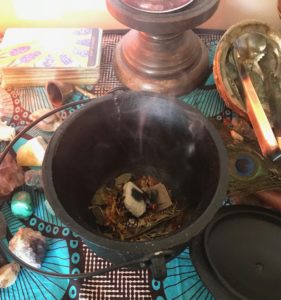
a black cauldron with burning herbs sits among crystals and tarot cards on an altar draped in turquoise ankara fabric. i did this spell last full moon and was pretty sure it hadn't worked. then, on the last day of the moon cycle, it manifested in the most beautiful way: with my community pulling together to support me financially through the last part of the month.

so far, this spell hasn't brought abundance and prosperity in the sense that i have a job or a savings or any stability. but i survived last month, and i will survive this one, and maybe the work i'm continuing to do will produce more bombastic results with time.

--

gather the following ingredients:

* cramp bark for general good luck
* star anise for same
* rosemary to purify capitalist/colonialist connotations of "prosperity"
* hyssop to purify capitalist/colonialist connotations of "abundance"
* sandalwood to grant wishes
* calendula, patchouli oil, cinnamon and chamomile to draw money
* angelica to break the jinx of white supremacy
* sage to reverse the evil of capitalism
* high john oil to draw money and for good luck

grind with mortar and pestle or dedicated coffee grinder and add to cauldron.

write the following (or something like it) on a brown piece of paper:

all earthly blessings will flow to us
the obstacles of colonialism, capitalism, and white supremacy will shatter under our feet
the struggle for survival will abate
a new day of peace, abundance, and joy will grow
from our resistance
and our prayers
universe, we call upon all forces for good
for god
to see us here this full moon night
and grant our request
for respite.
let abundance and prosperity coexist with our determined opposition to capitalist exploitation.
ashe.


fold up the paper and place it along with the herbs in the cauldron. set a lighted charcoal on top of the paper. open a window if you're not outside.

repeat let abundance and prosperity coexist with our resistance to capitalism as many times as you like.

bury the ashes in the earth.

mars' chamomile hibiscus friendship tea

a white sand beach with footprints in it leading to clear ocean water.

this tea is named for my new friend mars, who recently moved to clearwater beach, florida. i made this tea for their going away party and it was so amazing i wanted to share.

9 tsp chamomile flowers
4 tsp hibiscus flowers
2 tsp sweet orange peel
1 tsp holy basil (rama) leaves
1 tsp peppermint leaves
1 whole star anise
1 whole cinnamon stick
1 1/2 cups cane sugar
18 cups water (4 boiling, 16 cold)


bring 4 cups of water to a boil. add herbs and spices to a large mason jar and pour boiling water over them. cover and steep for 10-15 minutes. strain into a large pitcher and stir in sugar until dissolved. add cold water. pour into ice-filled glasses (if desired) and serve with optional straws. can be enjoyed lukewarm or cold.

liberation and protection spell for incarcerated activists


on the day of the hearing, sing:

let no evil come by you,
let no evil come by
you will be set free today,
you will be set free
all our love will guide you,
as you stand calm within the storm
no evil shall come by you,
today you will be bound no more


or whatever words you feel called to sing that invoke collective liberation, breaking chains, uprooting systems of oppression.

as you sing, write the name of whatever system, institution, group, or individual is responsible for the activist's incarceration 3 times on a piece of brown paper bag in black ink. turn the paper 90 degrees and write the activist’s name three times in red ink. fold the paper into a square.

combine dill weed, galangal root, calendula flowers, licorice root, cassia chips, rosemary leaves, eucalyptus leaves, cascara sagrada powder, and sandalwood chips in a cauldron. light charcoal and add to cauldron. place folded name paper on top of charcoal. open a window.

while lighting a rainbow taper candle (any protection candle color will also work), visualize the activist safe, protected, home with their loved ones. sing. let the candle burn to the end.

make sure all plant material in the cauldron has burned. bury ashes and wax in the earth.

wonder at the miracle that is our collective body of loving support and ferocious action.


I used to hate myself and now I hate society: post-graduation reflections and jobless rambling


image showing degree conferral from UCLA: bachelor of arts, sociology, magna cum laudeSociety—other people, systems, institutions, culture—has so much more power over our lives than the average person gives it credit for. Acknowledging its outsized influence is devastating at first, incompatible as it is with a vision of the individual as master of their own destiny, culpable in failure and deserving in success. But there is a freedom in relinquishing our illusions of control. If I am not charge of my destiny, if my class or race or assigned gender or national origin are stronger determinants of my fate than my individual decisions, it matters less what choices I make. I can make the choices society prescribes for me, or I can choose a different path.
A little less than six years ago, I fled back to school hoping that when I finished, I would be able to avoid the stress and disappointment of looking for a job without a college degree. I had just been laid off from my job as a technical support specialist and was already attending community college part time, so it seemed fortuitous, especially since my partner and were talking about me quitting my job and going back to school full time once he found a teaching job. I made the leap and enrolled in a full load of classes at my local community college.

(Society told me going back to school was a respectable choice, the right choice. I should have graduated from college a long time ago, according to chrononormative* standards, anyway, and won’t a college degree give you a leg up in the job market? They can never take your degree away from you, they say, and promise it will all be worth it, all the struggling and debt and biting your tongue.)

There was no way for me to know five years ago that I would be graduating into a job market even more unfriendly to folks like me than I had avoided by entering college in the first place. No way for me to know that I would be made more disabled by my time in academia; definitely no way for me to know that the world as I understood it would effectively be ending in slow motion, that overt and aggressive fascism and white supremacy would be in power all over the world, that the naively hopeful environmental trajectory I thought we were on would be replaced by dire warnings of our dwindling opportunity to halt the inevitable collapse.

But—this is actually an okay place to be, for me. Even if it doesn’t always feel like it. Even if sometimes it hurts so bad I wish I could sink into the molten outer core of the earth. Systems are failing, nakedly, obviously. That means there is no way for me to blame myself. There is no way for me to be exceptional enough to overcome an actual apocalypse. If I learned anything from studying sociology, I learned that.

At last, finally, and in the end, I understand: It’s not me, it’s society.

###

I once believed that higher education was a refuge for the bookish and bright. Being the kind of learner that prefers to absorb a subject through obsessively researching as much as I can on it, I found only misery in elementary and high school. I felt trapped, forced to learn in a regimented way, forced to adhere to conventions set by long-dead colonizers and bootlickers and other types interested in turning children into compliant cogs in a surplus-generating machine. College, I thought, would be different, would be more open to the kaleidoscope of brains humanity contains. Despite having attended college on and off since I was sixteen, I didn’t have enough long-term experience with it to dispel my idealistic beliefs. I was always too crazy to attend class regularly, always withdrawing mid-semester to deal with some emotional upheaval, some mental collapse. And I was so drugged up and indoctrinated into various mainstream viewpoints that I probably wouldn't have noticed the reality of it all even if I had managed to spend any length of time at school.

This time around, though, I noticed. I noticed all the ways higher education operates to exclude folks like me, all the ways it demands exceptionalism in the face of its own mediocrity, all the ways it perpetuates a status quo of ableism, capitalism, cisheteropatriarchy, white supremacy, colonialism, and imperialism. And as I got further into my upper division major work—sociology—I noticed even more. It became too much to bear too many times to count. The small ironies piled up like so much oppressive detritus, my daily commute a recounting of historical and present-day trauma, my thoughts a running tally of injustices: I am currently driving on a freeway system built by displacing poor people of color, past houses big enough to hold every single houseless person I meet on the way, to a campus more concerned with the appearance of diversity than materially improving the lives of its Black or disabled or queer or immigrant students, to learn about the impact of housing discrimination on intergenerational wealth in whites versus Black folks.

I channeled my anger, my outrage and existential despair, let it flavor impassioned papers and pointed presentations, but it felt hollow, was hollow. It meant nothing, and I knew it. I had to endure the slights, had to make do when my disability accommodations were phased out, had to push myself beyond the point of burnout to finish my degree. Because in my mind, if I didn’t, I’d just spent five years and however many tens of thousands of dollars to have my dreams crushed without even getting a receipt. As much as I wanted to be the kind of bitch that says you know what, I’m good and forges their own degreeless path in life—as much as I had effectively been that bitch for the first part of my adult life out of necessity—I felt obligated to finish, not only for myself but for the loved ones who were sacrificing to help me get through school.

To stay motivated, I told myself that I’d find a job quickly once I finished school. I knew this was a fiction, but it was a necessary one—more than once, the specter of graduating and still being unable to find a job almost convinced me to drop out. I pretended as if this degree really would allow me to navigate the job market with ease, picking and choosing from a panoply of well-paying jobs with full benefits, leapfrogging over my un-degreed competition. But even if that were the case, I was using every last bit of my energetic reserves to reach a finish line that had shifted since I started the race, leaving me in no condition to leapfrog over anything. I spent the first few weeks after graduation pretending it was just another summer, trying to recharge a little before I started my job search.

A manic episode lent me the optimism to apply for a dozen or so jobs and write sparkling cover letters to each. The inevitable fibro flare and depression that followed forced me to acknowledge the truth of 2019's job market hellscape. Several of the $15/hr-and-under positions I applied to expected me to do free labor in the form of aptitude tests and their ilk. (For some jobs, I did these, because I felt the position/salary would be worth it, and the tests weren’t too egregious. On others, I declined.) Out of the positions to which I applied, only one has even opened my resume—I’ve received no response from that employer at the time of writing, two weeks later. One job I was particularly excited about, one whose qualifications I greatly exceeded and whose hours and duties perfectly matched my needs, had over a thousand applicants at last update. A few jobs have “moved to the next stage in their hiring process” without my resume even being acknowledged.

I’m pretty sure I’m going to be jobless for a while, if traditional employment is the way I insist on making my living. I can write about it now, find the silver lining in my misfortune, because it’s been a couple weeks and I’m high as fuck. But realizing that I just spent five years under some of the most extreme stress of my life to basically end up worse off than I started broke me for about a week. My always-tenuous commitment to staying in corporeal form dwindled to nonexistence more than once, but I happily do not own anything capable of killing me in a guaranteed manner, so I’m still here.

(Kidding, kind of. As long as the people who love me are here on this planet, I’m staying in solidarity. But things did get pretty pale in my head.)

I cannot Black excellence my way out of being on earth as worlds crumble around me. I cannot young, Black, and gifted my way into insulating myself from climate collapse, into financial security, into overcoming a system built to oppress and exploit folks like me before leaving us to become casualties of their disregard for life. All I can be is open to learning how to live in different ways, how to ride the waves of change such that I can keep my head above water, keep what’s important in sight. And if I can’t keep my head above water, I can learn to take bigger breaths before I go under.

If I could travel through time, I would impart this wisdom to 34-year-old me on the eve of their decision to go back to school. I would whisper in her ear: Do not give in to fear. Leap. You will find you have wings. I don’t know that I would fly, that things would turn out any better if I threw myself into professional writing in 2014 instead of seeking the comfort of official validation, but I might have avoided destroying my health in order to get it. I really thought I needed the legitimacy of a degree. I didn’t. Turns out what I needed was to finally internalize the idea that it’s not me, it’s society. For accomplishing that, at least, perhaps going back to school was worth it. For what it did to my emotional and physical well-being, decidedly, it was not.

###

It’s the end of the world—at least, it’s the beginning of the end of a way of living based in colonialism, ableism, white supremacy, capitalism, imperialism, and cisheteropatriarchy—and that means we don’t have to do things the same way anymore. We never did, but we have even less incentive now that doing things the way we were told to do them has been so starkly revealed as a path to destruction and separation from god, god being that spark of the divine we each hold within us, the glue that binds us to each other and the planet and all beings across the universe. The way of living that tells me that I must depend on a boss or a landlord or a mayor or a president to manage my work, my housing, my community, my people, is the same way of living that has cleaved Indigenous land from Indigenous humans, the same way of living that is rendering the planet uninhabitable for large human populations, the same way of living that I will reject every single day until it has been banished from this earth.

We must reject ways of living that perpetuate systems of oppression if we are to have hope of humanity surviving the catastrophic change that is underway. But since systems of oppression also shape the ways of living we have available to us, this rejection will come with pain and sacrifice, especially for those of us who are subjugated under the same systems. I know this, I been known this, been known revolutionary change is full of what we are taught to perceive as negative emotions and experiences, but that there is growth contained within them. If a little pain, a little discomfort on my part, on our part, could propagate through the system all the way up to the institutional level, could destabilize the systems that oppress us, wouldn’t it be worth it? Especially when—in my experience, at least—pain can be a catalyst for awakening, and a pleasure unto itself.

For me, the desire to be traditionally employed is partially rooted in a genuine concern that my disability might prevent me from being able to manage freelance or self-employed life. Putting the responsibility for finding streams of income on myself and not on some professional who ostensibly knows what they’re doing is a terrifying prospect when I consider how few days out of a month I feel well enough to work on projects. At the same time, I do get shit done despite how I feel. I don’t have to feel good about something in the moment for it to be worthwhile. In fact, the most worthwhile things I’ve done have often been ordeals to get through.

That’s not to say that everything worthwhile must be painful, or that suffering is necessarily productive—I would never endorse that idea. Sometimes, though, the only way we get out of a destructive situation is for it to become untenable, uncomfortable, painful. Sometimes pain is a friend nudging you: Are you safe here?  Is this what you really need? I've been trying to understand what this pain is trying to tell me, this discomfiting space I'm in where I don't know when I'll find work, how I'm going to support myself, where I'm going in life when it comes to career.

Before I got my sociology degree, I might have blamed myself for my inability to find a job. I might have taken the metaphorical whip to my own back, expected that I would be able to make up the gap between economic expectation and reality by hustling, killing myself to meet a capitalist ideal of productivity and employability. Now, I know. It’s not me, it’s society. Trying to be middle class, trying to live up to hegemonic ideals of success, is destructive. What I am feeling is in part the shame of not being able to consume the same disproportionate amount of resources as my parents did, the anguish of believing hard work gets you anywhere, the guilt of having held that ideology against the poor and the houseless and other unfortunate souls I probably thought myself better than, the humiliation of having that ideology thrown back in my face when I cannot succeed under the same terms.

(And when I say I, I mean we. None of us are safe here, and this is the opposite of what we need.)

This job market, this disappointment post-graduation, is painful for me to confront. It’s a bit of the same pain I felt when I came to understand that higher education was not a great equalizer but merely a mechanism to perpetuate the status quo, the same pain I feel when I hear people defend throwing families in cages because they violated some law, the same pain I feel when I see folks saying we can’t take radical action on climate change or abolish prisons or dismantle capitalism because it will cost too much or be unfair to folks who paid off their loans or their debt to society or whatever milquetoast excuse the centrists are offering that day. We insist on adhering to the tenets of a way of life that is killing us. I adhered to them by going back to school, even though I had literally no reason to, was receiving no real benefit besides the false sense of security that comes from doing the right thing. If we just work hard enough. If we get a degree. If we are exceptional. If we go high when they go low, if we open a business in a disadvantaged community for three years, if we are silent as the waves of change crash upon us, as the inexorable tide of exploitation pulls us under, we might become one of the lucky ones.

The past is the past. I made my choice, I went back to school, I graduated. But now, I intend to break away, take a different path than the one society prescribes for me. A scarier path, but maybe a more realistic path. A path that I forge myself, with guidance from others who have navigated this chaos longer than I have, successfully. I want to write full-time, or as full-time as my bodymind allows. It isn’t my first choice to make writing my primary source of income—it is partially a function of the reality of the job market—and I may end up needing to find part-time work to supplement my income after all. The more I think about it, though, the more I believe that making writing my full-time job is at least something worthwhile for me to attempt. Writing is where I see myself doing the most good on this planet, and despite the awful state of publishing, I think I have a chance—however tiny—at my version of success. It will be hard. It will involve a lot of rejection and crying jags and questioning whether I ought to just peace myself out and avoid all the misery. It could also be the most amazing thing I’ve ever done. The way I find community. The way I build community and leave a legacy of work for the folks who live after I’m gone. I have nothing to lose, anyway. We have nothing to lose but a world that would see us in chains again.

It’s not you, it’s society. And society is in shambles. What would you do if there was nothing holding you back, if you had nothing left to lose, if everything you thought you knew turned out to be a lie? What will you do now, at the beginning of the end of this world?


* Elizabeth Freeman, Time Binds: Queer Temporalities, Queer Histories. Duke University Press. 2010.


on whims of vengeful starlight

Night stars are benevolent, unlike the pitiless lord of the day. Under the moon's placid gaze, Sesylie can pull off her goggles and drink in as much ultraviolet as the heavens will grant her. Lest her absence become contested, she resists the urge to wander and sprawl on the chalky jigsaw flats of the Barren. The last time she did, the crisp air tempted her to sleep and she woke to Nyria raising Sol in search of her. If she stays close to the mottled obsidian guarding the mouth of the launch cave, she can trawl the waters of her mind in peace.

As she samples the wavelengths, she considers their source. Any one of these gentle lights might contain a dying moan of radiation that would end the world once and for all. But she can't hold it against them. Though her upbringing was steeped in Berai superstition, she doubts stars have will beyond a desire to burn bright as they can with what they've been given. In that, she has sympathy for the little sun, not hot or dense enough in life to become explosive or exotic in death. No wonder it lashes her people with its tongue of fire, its withering light. It feels the sting of not measuring up.

Maybe sympathy isn't the word for what Sesylie feels. Empathy might be more like it. Yes, though it will take everyone she loves from her--has already taken everyone she loves, in a way--she feels a kinship with the sun above all stars. She knows all too well what it's like to question your place in the cosmos.

#

Inside the crystal-lined cave, the humid air is thick with anticipation. Sesylie sinks into the embrace of the vessel as Meroan explains yet again what she can expect of her journey.

"I wish we'd been able to build in a readout, a control panel, something in here so you'd know if you were going off course," he says. He picks at the vessel's acrylicine walls, his dark eyes narrow. "This thing is a piece of fesh. Should have spent more time digging around the Domes for parts."

"It's fine, Mero," she says. "It will work. You risked enough getting what you did."

"Under any other star..." Meroan shakes his head and stops before he finishes the adage. "Anyway, I know, I know we've gone over this--but you have to stay focused when the engines are on. You get sucked into one of your spirals and there's no telling where you'll end up. Or when."

"Mmm," she says, gazing over his smooth brown head at the amethyst formation on the wall. It's amethyst in name only now. Just the palest hint of blotchy lavender distinguishes it from clear quartz. Another casualty of the sun.


((... read the rest at Patreon for $1/mo))

we should be rioting in the streets but instead i'm updating my resume: on business as usual at the end of the world

everything from then on out was going through the motions.
everything from going to work every day to saving for the future to breathing was
a charade performed as defense against the inevitable
a tired eye closed to the light of the oncoming train
a battered heart numb to the cries of the victimized child
a weary soul creaking under the weight of the world
and choosing the path of least resistance.
yet we could not cease going through the motions,
could not stop the motion of the machine grinding towards us
with the threat of growling bellies and chattering teeth.
a few of us figured out that we could stop the motion of the earth
blot out the sun with the moon
compel every human into the street
if we imagined it together.
but most of us were too tired from work
to work on aligning the stars for revolution.
so we waited,
and plotted,
and planned B
all the while praying
for the rest to get as tired
as we were.


    -- Excerpt from journal of an anonymous Appendage of the Queer Disabled Black Femme Tactical Liberation Body, Third Division (Western Turtle Island).

Towards reclaiming my birthright, part 2: divest from cure, control, & contain


I've experienced the world in the way I do for as long as I can remember, but it wasn't until I was fourteen that I was officially diagnosed with depression and later bipolar disorder (along with assorted goodies like dissociative identity disorder and panic disorder and PTSD and and and). I'm off psychiatric medication, and for the most part I don't find my panoply of diagnoses useful anymore, but they were a part of my journey at one point.

It was also around this time--maybe a little before, maybe a little after, my memory of my childhood is hazy--that I was diagnosed with two other disabling conditions: irritable bowel syndrome and fibromyalgia. I've had digestive struggles since I was very young. I can recall missing a lot of school due to stomachaches that were almost certainly a result of internalized stress and trauma. The fibromyalgia did not manifest itself until I was in my teens, but it came on strong when it did. I needed to use a cane to walk for a long time. (Along with all this, I had extremely debilitating menstrual pain that seemed to take up a majority of the month, I developed PCOS as a consequence of being treated with valproic acid during puberty, and I had various other issues crop up--like sleep disorders and RLS--due to the psych meds.)

My teenage years were mental and physical hell, some of it a byproduct of my not possessing the framework to understand the societal underpinnings of why I was experiencing the things I was, some of it a direct result of my divergent mind and body. I was taught to blame my hellish existence solely on my mind and body. The treatments I was given focused on correcting supposed imbalances in my brain or building tolerance in my body to things I felt I shouldn't have to tolerate. I eventually got balanced enough or good enough at pushing past the pain that I could get off disability and get a job and tolerate injustice for a paycheck. And I thought I was as close to cured as I could possibly be; I was approximating normal, at least.

When my life fell apart and I along with it, I again sought cure. I thought psychiatric medication was the reason for all my disability, and if I could just get that out of my system, cleanse my system with enough detox and healthy living, I wouldn't be in constant pain, wouldn't feel like I needed to curl up in bed after a couple hours awake, wouldn't feel every single worry in my muscles and joints or every single piece of food pass through my digestive tract.

(That wasn't the case, either. I'm still very much in pain, very much beholden to my body's need to eliminate fully every morning before I'm able to comfortably start my day, and very much inhibited by overwhelming fatigue on most days.)

Here's the thing: until 2017 or so, I'm pretty sure I saw my disability as something I could overcome. Much like all the other characteristics I talked about--my race, my gender, my body size--I saw my disability as something conquerable if I was just exceptional enough. I'm not saying I would have ever verbalized this, and I certainly didn't think it about other folks. But internalization runs deep, is insidious. Uprooting hegemonic thought patterns takes a lifetime, because they are forever changing and adapting as you change and adapt.

It took withdrawing from psych meds and confronting the continual presence of my disabilities to force me to reckon with their permanence. This reckoning is ongoing. I still sometimes find myself looking back at some mythical time before I became disabled, or looking forward to a time when I might be some shade of healthy, that is to say, less sick. And when I envision me as my best self, too often it's a vision of myself being productive and able-bodied enough to perform activities like running or cleaning my entire house. The goal is to get to a place where my best self isn't molded by ableist values. I want to make plans for the future that don't center on the pain abating or my moods stabilizing.

I've realized that up until recently, I was attempting to do one of three things to my disabilities: cure, control, or contain. When cure seemed out of the question, I sought containment through rebellion and self-destruction or control through meds and adopting abled culture; when containment and control became untenable, I set my sights on cure through withdrawing from psych meds and convincing myself my disability was an artifact of their effects. Cure, control, contain is the model for cancer treatment, deadly and alien as we know it, and I knew my disabilities similarly. I hadn't considered that they were inseparable parts of me, and might have something to offer other than suffering and eventual death.

That these parts of me are disfavored by white supremacist imperialist capitalist patriarchy is not a reflection of their true worth. The parts of me that achieve academically or generate income or do sports aren't better than the parts of me that were too depressed to finish an assignment on time or that were on SSI or that couldn't walk without a cane. I don't need to isolate and berate the so-called deficient parts of me to protect the virtuous parts. All together they make me who I am, and I am glorious because of my disability, not in spite of it.

---


Now I have the language, the frame through which to extricate the struggles I experience due to ableism and the struggles I experience due to physical or psychological pain. I no longer look at my mind and body as something to be overcome. I'm learning to interact with my bodymindsoul in a tender way, to listen and consider and ask for consent, and not to judge or reprimand when I can't perform in some way that ableist society has demanded. I'm lowering my expectations, because I wasn't put on this earth to be productive, and I don't see the point in playing along. What society has to offer me in exchange for breaking myself at its feet isn't worth the blood spilled.

My disabilities are foundational to how I navigate the world. Having limited energy shapes my view of what is truly necessary to spend one's time on, and thus dictates my priorities--growing love and nourishing spirit. My mental illnesses have shaped my understanding of the nature of reality: the relative abundance of sorrow and the rarity of true joy, and how important it is to protect the latter when it crops up. If it weren't for these supposed impediments, I would likely have spent my life pursuing goals set for me by society rather than building a life guided by transformative love principles and seeking pleasure.

I truly believe my disabilities have something to teach me about how to live wholly in this world, something precious. I need only agree to stop trying to fit them in an ableist box, stop trying to make them small or acceptable or part of an inspirational narrative of overcoming that ties up neat in a bow with me as the cured crazy person at the end.

End-of-winter updates and things

It's been pretty somber in the Fierce household this fall and winter. I would say I'm approaching burnout, but I know that boundary was crossed long ago. I'm fueled by sunk-cost fallacy at this point. I don't want to be in school anymore, haven't wanted to be for some time. Me doing something I absolutely loathe, day in and day out, can't help but set the tone for how my partner feels, the household aura poisoned by my thinly veiled rage.

I'd already decided by the end of last academic year that I didn't want to get a Ph. D. in sociology because of my inability to reconcile the exclusionary nature of academia with my belief in divesting as much as possible from structures that produce and perpetuate inequality. For a while I planned on getting an MFA so I could spend the next few years writing and not having to deal with the shambles of my finances. (I went back to school full-time after having been laid off in 2014, and I have a bunch of credit card debt that I haven't been paying because we don't have the money for both of us to have good credit.) But I don't need to go to school to write, and I don't need to buy further in to the lie that higher education is a means to break down structural barriers. Why go further into undischargeable debt? So I can assimilate into a system that would much rather I not participate in the first place, a system that will put up innumerable obstacles to ensure I only make it if I've proven myself exceptional? Nah. Being exceptional is the opposite of being free. (I still gotta convince my anxiety of this.)

Over the hot, depressed, miserable summer I even considered leaving UCLA without finishing my bachelor's. After agonizing over it, taking into account how much work and sacrifice went into me being here not only on my part but on my family's, I finally settled on just not giving a shit about grades anymore. I figured GPA means nothing when I'm 99.9999% sure I'm never going to want to set foot on a university campus again once I'm done with this degree. As a result, I've pulled back a lot when it comes to studying and reading. That freed up some time for me, but I'm so broke or anxious or depressed or exhausted or achy that I can't enjoy it. Whenever I do something I want to do, something that would normally bring me joy, there's this buzzing in the back of my head reminding me that I should be reading or working on some paper or whatever for school. Right now I have two final projects I need to start, and I'm writing this. Oops.

I tell myself that it is participating in a system I no longer believe in that is driving my mood instability, my fibro flares, my chronic IBS issues. But there's a deeper truth that I elide with this narrative, the truth that the world--at least the man-made part of it--is in itself a system I no longer believe in. I still haven't figured out how to live with that in a generative way, but I am looking forward to spending the rest of my life working on it. I still think things will get better for me once I get out of school. I also know there will be new struggles and obstacles to overcome.

person with locks and light skin in blue and purple dragon pajamas I've been wearing this dragon onesie all fall/winter. Yes, even outside.
In other news, I've been writing poetry and fiction, trying to improve so I can one day produce something publishable at the pro level. I have a lot of self-doubt about my writing skill. I've gotten over it to a certain extent when it comes to nonfiction, which I (inaccurately) see as "not creative". When it comes to "creative writing", though, I falter. I know good writing when I read it, but my feelings on my own writing are tied up in my doubt. Not to mention the mindfuck that is grandiosity in mania and self-loathing in depression. Meaning, when I read my writing while manic, I think it's amazing, but when I read it while depressed, I think it's straight trash. I've had walking depression for like, a year, so it's been hard to accurately judge my work during that time. I'm trying to be generous and not force myself to write when I'm so depressed I hate everything I've ever produced, especially since I have to save some energy for my schoolwork.

On the theme of saving energy, I deleted all the social media apps from my phone, so if you've been trying to get my attention on Facebook or Instagram, I apologize (but I doubt my absence has been greatly missed since I wasn't active much to begin with!). I can't help looking at web Twitter every now and then, though. Hey, I also deleted the news app, so I gotta go somewhere to keep up with the latest political fuckery and the dankest memes.

Spiritually I haven't had energy to do all the work I'd like to; I've mainly just been celebrating full moons and pulling tarot cards when I need direct messages from god. I haven't been able to keep up with my studies on that front since I transferred from community college, to be quite honest. Haven't been able to move my body regularly or eat the way I want to either. I'm sure the lack of psychic and physical nourishment is contributing to this pervasive feeling I have that I'm dying. Being in chronic pain doesn't help that either! My "rational" mind tells me I'm not dying any faster than I was before I started school, but the way my body feels... it's hard to dispel that belief. The fact that I've felt like I'm dying for the past year and I haven't died yet is probably an indication that whatever I'm feeling, it's not a result of my body being riddled with cancer or something. I am really looking forward to going back to my old doctors once I get a job with some decent insurance, though. (I'm especially looking forward to going back to acupuncture once I have a job.) I don't have the energy to deal with all the obstacles Medi-Cal puts up to getting good care, but I do need to spend some time working through my issues with someone who is paid enough to act like they want to find a solution.

Anyway, this has gotten long and disjointed, and as I said, I should be working on finals. Will probably be on radio silence until spring break. Stay strong during this Mercury retrograde & assorted upheaval, y'all.

P.S. Happy tropical Aries, sidereal Pisces season in advance--my 39th birthday is in twenty days.

Some thoughts on craziness and meds


CW: mental illness, suicide


This week Kanye West and Chance the Rapper's manager and some other folks decided to share a few thoughts on mental illness and medications that were less than ringing endorsements of the latter. In the midst of a Twitter rant against two other artists, Kanye mentioned that he's not taking medication anymore because he felt it hindered his creativity; seemingly as a response to the backlash against that statement, Chance's manager tweeted that folks should try lifestyle changes before taking psychiatric medication and referred to his own experience becoming addicted to doctor-prescribed Xanax for anxiety. 


At first I was just going to let it ride and not say anything, because it's Kanye and I don't particularly like him or what he has to say lately. On this point, though, I felt where he was coming from. In the 20 years before I began withdrawing from all my psych meds, I also felt my creativity drain away. Yes, it was eventually replaced with the ability to hold down a steady job and maintain some level of stability on my meds that didn't require me going in to the hospital every year to have them readjusted. But I mourned that loss, and I had to learn to accept a reformulated version of myself: one who was not a prolific writer, who didn't use writing as a form of creative expression but merely as a tool to document my mood states from day to day.


Anyway, I was going to let it ride until my timeline started to clog up with other folks with mental illness (I won't call them crazy, since I'm not sure they would take kindly to the reclaiming of that label) exhorting other folks to take their meds and completely dismissing what Kanye said. And then when Chance's manager said their piece, it ramped up even more. It became overwhelming, confrontive, all that stuff--especially when people started trying to pathologize Kanye's reaction to meds as resulting from "medication resistance", and his Twitter rant as being evidence of his "rapid cycling". It just reminded me that as someone who still has a severe mental health diagnosis somewhere in the system, I won't be taken seriously because I'm not taking psychiatric medication. 


Which is absolutely wild to me, because for the first half of my life I wasn't taken seriously because I was taking psych drugs. 


Back in the 90s, when I first started writing about my mental illness in 'zines and online, mental health awareness seemed to be at absolute zero. Barely anyone was really talking about it in any real way in popular culture, and those who were, were usually white and upper/middle class (a la Elizabeth Wurtzel and Susanna Kaysen). I was all about the personal being political, so I felt revolutionary being a Black girl talking about my crazy openly and without shame.


I opined about my broken brain's inability to produce a "normal" level of serotonin or norepinephrine or dopamine. I wholeheartedly accepted the medical model and in fact, in one 'zine I wrote when I was a teen, I took it to its logical extreme by comparing folks' unwillingness to allow me to commit suicide with denying a terminally ill cancer patient access to euthanasia. I thought this was logical because the doctors were telling me I would have to take a med cocktail composed of dozens of meds for the rest of my life just to maintain my marginal existence.  


I never guessed that I'd be on the other side nearly 25 years later, disagreeing with folks whose arguments are based in the same logic. Or AGREEING with motherfuckers who advocate lifestyle changes before starting on psych meds. 


Now, that last part is way controversial and I don't fuck with saying anything of the sort on social media because it requires over 280 characters to articulate my feelings on the matter. But I do think that in an ideal society doctors would try nondrug treatments for mental illness first, because those treatments don't scramble your brain chemistry. And I think our belief that meds are the first line of defense is rooted in capitalism's productivity edict (which necessitates that recovery from mental health crises be quick) and the decades-long project the psychiatric establishment has engaged in to promote the chemical imbalance myth (in order to convince the public their discipline is as scientific as others in the medical field).


But I also know that we don't live in an ideal society, and people don't always have the time or spoons or resources to engage in nondrug treatment. I want people to be able to relieve their suffering by whatever means they need, whether that's via psychiatric drugs or therapy or recreational drugs or exercise or massage or sex or nothing at all. Life is hard, and everyone is different. That's why I'm not out here demanding that we stop prescribing medication across the board. But I see way too many folks doing the opposite and demanding that talk of medication only be positive to avoid scaring people away from getting the help they need, and that isn't realistic. People need to know what they're getting into. They need to be able to make informed decisions. And dismissing those who've had negative side effects from meds (like a loss of creativity) isn't facilitating informed consent among psychiatric consumers.


(I'm not even going to get into how many of us enter the mental health enterprise under coercive circumstances--as children and teens, as adults under 72-hour holds, etc.)


So yeah, I've been thinking about this a lot over the past few days, and I decided I'm gonna start trying to pitch some essays to outlets about this stuff*. Because I don't see my experience represented in the current discourse on mental illness and I think it is a valuable one.  There are so many others who were harmed by psychiatric meds, and who have written about this stuff for years with little mainstream recognition. I want to help bring attention to this. Not because I want everyone to give up their meds, but because I want to offer a counterpoint. I'm not speaking out of turn; this is and has been my life since I was a teen. If there's one thing in this world I know, it's what it's like to be crazy. And what it's like to survive, every day, a mind that wants me to die.


(P.S. - I didn't cite anything here because this is just a quick blog, but do please Google stuff if you think I'm a conspiracy theorist or making things up about psychiatry or whatever. Eventually I want to upload a lot of the material I have on the sociology of mental illness, because I think everyone should have access to this stuff. But today is not that day. Sorry!)


* Edited December 23, 2018 to say: I've realized I probably don't have the emotional energy to handle the amount of rejection this would (and already has) result(ed) in, and so I may or may not do this, after all. I gotta save my rejection spoons for fiction.

Half as much (pt. 6)

“Goodnight, Jennifer.” Mother stands in the bedroom doorway, made ghostly in the waxing crescent moonlight, her shadow further darkening the dim hall behind her.

“Goodnight, Mother,” Amara says from bed, turning away from the door as Mother shuts it behind her.

Amara breathes shallowly, listening as Mother pads down the hall towards her and Father’s room. She doesn’t treat herself to a full, deep breath until she hears the heavy click of their door latching. Then she takes in all the air she wants, drinking it in greedily. She releases it in one rushing exhale, imagining herself contained within that breath, imagining herself riding that breath home.

After tonight, Goddess willing, she won’t have to imagine anymore. Won’t have to eat Mother’s sandpaper cooking—she started to be able to taste whatever they put in her food to control her, so now she can’t even enjoy it—won’t have to go to school with those wack ass self-hating Negroes happily playing at being white folks, waiting to get tortured and eaten by a bunch of ancient racist demons. She still can’t believe most of them knew the trade-off before they did the spell. Some of them even hired someone to do the spell for them. Amara rubs her shoulders and pulls the blanket up closer to her chin; she still hasn’t forgiven herself for being so careless in who she took advice from.

But at least I wasn’t betrayed by a friend like Janet was, she thinks, shivering.

Janet knew what she was getting into as far as giving up her family, and that was fine with her. They’d disowned her when they went through her room while she was away at college and discovered she was not only a lesbian, but a witch. Her dark eyes flashed when she told the story, but they were moist, too; Amara could tell there was a tender scar behind her hard, angry words. The members of my coven got me through it, Janet told Amara with an edge, and then they delivered me into the mouth of the actual devil.

What they told Janet was that she’d get a new family, new skin, a new existence—but not that her new existence would be as cattle in a psychic fattening pen. She’s had to figure that out for herself over the ten-odd-years she’s been here, by snooping and surviving, the latter being accomplished through cultivating the proper ratio between compliance and resistance. They’re picky as hell, she told Amara, and they like their meat a certain way. They’re willing to wait.

The last time they fed on one of their human livestock was Janet’s fifth year here. She counts the years by the moons; she has a sketchbook filled with its changing faces. It was a full moon when they strung up and filleted her friend Crystal, who had skipped school every day for the last month and tried to stab both her parents. After they stripped her bones, they cooked her flesh along with that of the year’s valedictorian, salutatorian, and Homecoming Court.

Janet decided then that she needed to buy herself time. Crystal had been the only other one there with a lick of sense, and that’s pretty much why she started acting out. If Janet could manage to keep her shit together longer, she’d force them to wait in the hopes of getting that perfect savory cut. She imagined their feathers and fur dropping like dandruff as they rubbed their hands together in anticipation of the medley of flavors her brand of racial trauma might produce.

And so for five years since she watched Crystal die she’s been here, sometimes rebelling, mostly conforming, and letting the sourness of acquiescence permeate every bit of her.

Amara smiles and flips onto her other side. She and Janet are a good team, despite the fifteen-year age difference. They ran into each other at school the day after Amara’s confidence was shaken to its foundations by her encounter with the man-thing in the woods. Janet offered her a story of survival, inspiration, hope even. And Amara returned the favor by offering Janet a more immediate way out.

That awful night a week ago, after Amara snuck back in the window and buried herself under the covers, after she tried and failed and finally succeeded in pushing the image of the beast wearing her father’s face out of her head, she dreamt of her mother. Her mother, and herself—but not her, something wearing her body and wanting very much for her mother to suffer, wanting it so much that the strength of its hunger terrified her. The conversation was garbled, but she heard herself say one thing clearly—

I can make her feel anything that happens to this body

—before the hunger filled her eyes with red, overwhelming her, and she woke up almost hyperventilating. But when she caught her breath, she had her escape plan, although she didn’t grasp that until she talked to Janet and everything clicked into place.

Amara climbs out of bed and begins to get dressed. She remembers the chill she got last time she ventured out to those woods with just a sweatshirt on and grabs a heavy parka out of the closet, then thinks better of it and tosses it on the floor of the closet. No point in not being cold, she thinks with an audible snort. Instead, she snatches a thin hoodie from under the bed and throws it on over her t-shirt and jeans.

Even though she can’t claim that she’s absolutely sure what they’re about to do will succeed, if succeed is defined as bring her home to her mother, Amara feels absolutely calm. If she’s honest with herself, she knows that her definition of success is flexible; it mainly involves not existing wherever she is right now, and this plan seems likely to accomplish that, at least. If she ends up just straight dead and not back home, hey, at least she went out on her own terms and not while being eaten.

Glass fogs with hot breath as Amara unlatches the window and hoists the bottom pane over the top. She stops for a second and listens to make sure Mother and Father didn’t stir, then continues out the window, onto the middling branches of the jacaranda, a quick shimmy down the trunk and then to solid ground.

The night is crisp and clear, a black velvet garnish for the slivered moon. Janet is standing down the street a ways, out front of her house, in the opposite direction of the woods. Amara waves and Janet starts walking in her direction.

“You ready?” Janet says when she reaches Amara.

Amara nods. “Ready as I’m gonna be.”

Janet gives her a sympathetic grin. “It can’t hurt worse than being eaten alive, boo,” she says as they start walking towards the woods.

Amara glances at her sidelong. Her mousy brown hair is piled on top of her head in a neat bun; a leaf pokes out of the top, an escapee from the nearly identical jacaranda on Janet’s captors’ front lawn. “True. But I’m not sure how much of an upgrade it is.”

They listen to each other breathe and step until they get to the edge of the woods, where Janet stops and turns to Amara.

“To be real, it might be about the same,” she says, “but at least this way might lead to me being myself again.”

A long, slow nod from Amara as she switches on her flashlight, and then the two begin to walk again, towards whatever kind of freedom lay ahead.

Part 5 | Part 1


Inspired by the film Wake (Bree Newsome), the novel The Good House (Tananarive Due), the short story “Wet Pain” (Terence Taylor), and, I'm sure, Toni Morrison's The Bluest Eye.

The shape of a memory: surviving sexual abuse outside the bounds of rationality

I don't remember the first time I was raped, but I know it happened.

I don't recall when the memory was lost. I can't answer #WhyIDidntReport.

I do recall remembering exactly what happened, in re-traumatizingly clear detail, two years later: in the middle of an assembly at school on reporting sexual abuse. And then, I did report. Loudly. In the form of a high-pitched yet guttural scream that seemed to have gathered strength from the time the memory sat dormant in my brain.

Around me, other children--other girls, as far as my ten year old self could tell--had also begun to cry (although none quite so spectacularly as I, unfortunately for my social life). The administration at my private Christian school created an after-school support group for all of us. It lasted for six months or so before either they or we decided it wasn't worth the effort, wasn't worth re-dredging up our memories over and over with no real resolution. So eventually I forgot, again. At least, I thought I did. But I never really forgot.

I went through a tumultuous adolescence marked with mental instability, self-destructive behavior, and questionable relationships with men and masculine-identified folks. Standard survivor fare; I won't bore you with those details. What I will say about that time is that I never fully recovered the memory again. I recovered more of it. For instance, during a particularly intense overnight therapy session at a residential treatment facility when I was sixteen, I remembered again where the rape took place, and I remembered penetration. But still, the full awareness of it was, mercifully, kept from me by my psyche.

When I was nineteen I was raped again, and I remember everything about it. It destroyed me, psychologically, but it didn't reveal the memory of what happened when I was eight. It did, however, induce all sorts of PTSD and dissociative identity issues that forced me to confront my unprocessed trauma. I went into intensive therapy with EMDR, a course that lasted for about seven years. I managed to reintegrate myself, despite not having access to the actual memory of what occurred when I was eight.

Even without details, I can see the shape of the memory. Bordering the gnawing, gaping gaps in the record, there are some clear lines. I remember my excitement over an older white boy thinking this ugly Black duckling was pretty. How good that felt after the years of bullying and torment I endured. How cool I thought I was when we hung out on the jungle gym and flipped other kids off. Him calling me at my house: me, giggling, my mom, hearing me, asking who I was talking to.

And I remember...a nonlinear empty space. (And something involving the lunch tables, something involving something of his inside something of mine. I don't try to pin down specifics; I truly consider it a gift that I can't recall what happened anymore.)

Then, I remember my head down in my folded arms after school, crying. A note from him in my third grade yearbook that I think said something about how ugly my hairy armpits were but I could never tell because I scratched it out immediately after I first read it. My grades dropping, my interest in life degrading; partially because I'm not a fan of standardized education, but mainly because my mind was occupied with blaming myself for whatever happened in that empty space. And later, of course, there is the aforementioned mental instability.

---

What have I learned from this culture about survivorhood and memory? From watching season after season of SVU, from watching now two women in my lifetime testify that a potential Supreme Court justice sexually assaulted them, from the Mike Tyson trial, the Cosby trial, the Very Special Episodes of various sitcoms and dramas? What is important, when you are raped, after a rape? Remember as much detail as you can. (Remember, even, what you were wearing.) Remember not to take a shower, so your body can remember what they left on you, and you can prove this has happened. Remember to try to leave some memory of yourself on them, a scratch, some DNA, some irrefutable scientific proof. And if you can't? If you didn't? If your brain's split-second decision when it realized you were under threat was to shift you into a different state of consciousness while the trauma occurs so you cannot remember the trauma outside of that state? If instead of smells and sounds and sensations there's just an ominous void where a part of your childhood should be?

What can you do when you're doomed to know, but never remember?

It took me a long time to come to terms with the fact that I am a survivor of childhood rape. In fact, I didn't come to terms with it fully until I was raped again. Part of the reason I had difficulty in validating my experience has to do with the importance memory holds in legitimizing one's status as a survivor, which in turn derives from a cisheteropatriarchal, white supremacist prioritization of the rational and material over the emotional and the spiritual.

When it comes to sharing experiences of rape, we love details; we love when someone's juicy underbelly of trauma is served up raw for the re-devouring. Narrative structure is important, too. (Make sure it fits the range of acceptable assaults. Make sure you're weren't fucking them consensually first or laughing with them first or drinking with them first or flirting with them first. Make sure you're white, nondisabled, cishet, thin, and attractive.) If you've got physical evidence, bruises, bleeding, we'll of course take those, maybe rub some salt in those wounds for good measure. And you've always got to have the corroborating witnesses, preferably of the highest caliber (so not your drunk ex-BFF who's consensually banging her boyfriend in an adjacent hotel bed and oblivious to your screams).

But when you just straight can't remember? When your evidence consists solely of a promising life dashed upon the rocks and an empty space? There's no empowerment to be found there. No statute of limitations to beat out. Neither our society's system of justice nor the current pop cultural/political moment occurring around sexual assault readily accommodate the slippery nature of trauma memory.

I'm reminded of the difficulty I had in claiming a political identity as a survivor now, in this moment of #MeToo reckoning, with the development of newer hashtags such as #WhyIDidntReport. So many of our methods of personal resistance against rape culture focus on storytelling, splaying your experiential guts onto a screen of various sizes as a form of empowerment. I do absolutely support survivors who want to tell their stories. But as someone who doesn't particularly want to feed more bodies to the prison industrial complex, and as someone who remembers the name of their rapist but no details in one instance and a bunch of details but no name in the other, I haven't participated. What would I say? I keep looking out on my feeds to see if any of the stories resemble mine, an empty space; none so far yet.

The confirmation fight over Brett Kavanaugh was re-traumatizing for me, as it was for so many other survivors. In my case, it stirred up some latent feelings of inauthenticity. In Dr. Ford's testimony, she leaned on the Western medical-scientific view of memory as primary in determining legitimacy as a survivor, basically stating that she knew she was assaulted by Brett Kavanaugh because of how traumatic memories encode themselves in the hippocampus. I know I was raped because of how the memory encoded itself into everything else in my life. Could I testify, if my childhood rapist were somehow nominated to some public position? Could I sit in front of that kangaroo court and try to plead my broken life against my rapist's hippocampus?

(This is one reason why I'm an abolitionist. I don't believe our current paradigm of justice can account for all the ways one can testify. My testimony is embodied, and so my vision of feminist justice involves a de-centering of narrative testimony, particularly when it comes to rape and sexual assault.)

Our (U.S.) society associates forms of knowledge gleaned outside a rational-scientific framework with femininity and Otherness, thus rendering them inferior in a cisheteropatriarchal white supremacist context. Our society is also a rape culture, and so no amount of remembering in perfect detail will ensure that a rapist is brought to what passes for justice here. So why should I, or you, dredge up our trauma on demand and offer it to an uncaring society with no guarantee of return on our investment? Why prop up the idea that a survivor’s memory is ever worth anything under heterosexist patriarchy?

Again, I don't want to discourage survivors from telling their stories. I only want us to consider what we accomplish, who is excluded when we emphasize this tactic, and what ideas we're reifying. Even in the best of circumstances memory can be unreliable, and constructing a homogeneous experience of survivorhood is impossible. There are survivors who remember every last detail, who know but cannot remember, whose memories are completely intact but organized nonlinearly, and whose understanding of themselves as having experienced sexual assault is shaped by the impression the event had on their life rather than any recollection of vivid details of the assault. Some of us contain all these and more. A feminist survivors' movement must de-center the rational-scientific paradigm and consider all the ways we can know we were harmed, or risk perpetuating cisheteropatriarchal oppression.

Half as much (pt. 5)

Under a waning crescent moon, Amara is in the woods, dipping her hand into a black plastic garbage bag and plucking out tiny cafeteria packets of salt; ripping them open with her teeth and shaking them out until their combined contents form a thick, unbroken circle. She shuts her eyes and speaks under captured breath the words she’s been unable to erase from her memory since she first saw them.

Eyes open.

Pop?

But this is no more her father than it was her uncle Tad, no more a fortuitous family reunion than the dinner with Mother and Father she suffered through earlier was a return to nuclear normalcy. It has her father’s face, but it smells of sulfur and drops feathers and fur as it approaches Amara standing still and proud in the circle.

“This is wrong,” Amara insists, when he stops in front of her and glowers. “I didn’t want all this. I didn’t want a whole new life. I just wanted new skin. Put me back, now.” She folds her arms across her chest, daring him to deny her.

His—its—flat blue eyes take on a bit of luster. Its ruddy peach cheeks spread into a gaping, toothsome grin. It grasps its cloaked stomach with a furry, clawed hand and begins to laugh, a thundering laugh that shakes each molecule of Amara’s confidence. The man-thing lets his laughter trail off into drips and drabs before he speaks.

“Well, Jennifer. You’ve been white for a day and you’ve already mastered demanding a refund.” A laugh bubbles to the surface again. “But I’m afraid we don’t have a return policy. Was that not—" it snorts, stumbles into a giggle, stops itself—"clear when you decided to perform the spell? Did you not—as they say, do your research? Tsk, tsk.” The mouth that was her father’s, that once comforted her with kisses and bad jokes when she skinned her knees rollerblading, that told her that the coily hair she hated so much was indeed beautiful; now that mouth wears the most fiendish sneer Amara has ever seen. A foul smell fills her nostrils and dives down her throat, making her gag and water.

“No,” she says, quietly. “Actually, I didn’t. I just thought you’d make me white, and I’d get to go home to my Mama, and then our lives would stop being such a shitshow.” A creeping realization spreads over her: I’m not getting out of this alive. Mama is gonna be alone. Tears well up in her eyes.

“Ah,” it says, pacing the outside of the salt circle, shuddering pieces of itself onto the forest floor. “Well, we get some of your kind, too. The reckless kind. We like to think it’s that bit of us you’ve got in you.” That sneer again. “Mostly our guests come looking for the package deal. They go pretty quickly. They don’t have much substance for us to really gnaw on—they’re starved, you know—and their meat has a taste. Like lemon dishwater, or diluted vinegar. We love the defiant ones, the ones who’ve convinced themselves that they’re different, that they’re doing something good and right and pure. Their resistance is so tart on our tongues, we taste it in their marrow. We savor it in their blood. We scoop out whole chunks of pride from their skulls and use it to season the meat of the ones soured with self-loathing.”

It stops pacing and bends down, stretching its neck across the salt to square its face across from hers. “I wonder how you’ll taste, in the end.” It smiles softly, her father’s smile.

Part 4 | Part 6


Inspired by the film Wake (Bree Newsome), the novel The Good House (Tananarive Due), the short story “Wet Pain” (Terence Taylor), and, I'm sure, Toni Morrison's The Bluest Eye.

Half as much (pt. 4)

Patrice Leah Brown, Esq. holds a steaming cup of ginseng tea in one smooth brown manicured hand and scans her maroon At-A-Glance with the other. Someone had the nerve to schedule meetings at 12:30 p.m. and 4 p.m. She shakes her head and considers canceling before she looks closer and sees that the meetings are with members of her Mothers in Action group, and they’re written in a messy version of her own handwriting. Her head drops back and her mouth opens, releasing an involuntary groan. I probably scribbled this in the car.  She takes another sip of tea and clicks the button on her phone to check the time. 7:30 a.m. Where is that girl?

“Amara! Breakfast is getting cold!”

She listens and hears nothing. No movement, no response.

“AMARA! Get down here!”

She listens again. There’s a truck passing on the uneven asphalt outside, a car alarm blaring in the distance, and birds chirping outside the kitchen window, but still nothing from Amara’s room upstairs.

Patrice rolls her eyes and sets her tea cup down on the maple tabletop. I bet she snuck out last night. Again. I’m so tired of playing warden. She pushes back the slatted maple chair, preparing for a battle.

Then she hears the door to Amara’s room open, and footsteps thunder down the stairs.

A beige-skinned girl with smoky hazel eyes, long kinky brown hair pulled up into a puff, a broad, flat nose, and full lips lands in front of the breakfast nook, wearing a black scoop neck t-shirt and ripped jeans, grinning at Patrice.

“There you are. How did you get ready so quiet? And quick.” Patrice squints at her.

“It wasn’t that quiet.” The girl smiles at Patrice and sits down at the table across from her.

Patrice gives her a you’re-trying-me look, but says, “Fine then. You’ve got about 6 minutes before the bus gets here. You better eat those grits. You can warm them up in the microwave if they’re too cold for you.”

The girl smiles at Patrice and begins to devour the cold grits with abandon.

Patrice raises her eyebrows in shock. She expected some sighs and groans followed by a minute at the microwave and 5 minutes of pretending to eat.

“Is there any more?” The girl wipes her mouth with the back of her hand and burps a little.

“Amara, you know good and damn well I make two servings of grits every morning! If you wanted extra you should have woken up. ”

“I did,” the girl says. “I just wasn’t here.”

“Well you need to be here, then.”

The girl tilts her head to the side, automaton-like.

Patrice sighs. “You know, Amara, when you get home from school, we’re gonna have a talk. You’ve been sneaking out, your grades are slipping, and you’re acting damn strange lately. I know you’ve never really wanted to talk about the pain you’ve got to be feeling over your father dying, but I can’t abide this acting out anymore.”

The girl leans over the table towards Patrice with wild eyes. “I want to talk about the pain.” Her tone resides somewhere between earnestness and insatiable hunger.

Patrice is taken aback. Is she really ready to open up? She’s thrown herself into activism, but her daughter has been grieving in tortured silence. She’s tried so many times to get through to her, but her grief has been a fortress. Now, maybe, it’s showing cracks?

“We will, honey. When you get home.” Patrice smiles. “But now, you’ve gotta get to the bus stop.”

The girl closes her eyes and inhales deeply for a minute. She licks her lips and opens her eyes, letting out her breath. “Later?”

“Yes, later.” Patrice gives her a quizzical look. “Are you alright, baby?”

“I’m alright.” She grins. “I’ll see you later.” She pushes back the chair and stands.

“Have a good day, baby.”

“I will.” The girl stops at the front door, selects a pair of sneakers from a pile next to the doormat, and slips them on. She looks at the deadbolt on the door for a few seconds, confused, before she reaches out and touches it. When it turns, she beams. She unlocks the bottom lock, throws open the door, and walks through it with both arms slightly lifted and stretched out to her sides as if she expects to take off flying. Once through, she turns robotically and grabs the door, closing it behind her.

Patrice shakes her head. What is going on with this girl now? She picks up her cup and takes another sip of tea.

Aside from telling her what she’d wanted to hear for months, Amara was acting uncanny. There’s no doubt about that. And even in the telling her what she wanted to hear, there was uncanniness. Why did she stare at her like that when she said it? And when had her daughter ever been excited about eating grits, much less cold grits?

She’s probably on drugs. Weed or someshit. Or maybe she’s pregnant. Patrice shudders.

Her rational, Harvard-assimilated mind tells her she should finish getting ready and ignore what just happened until they both get home. She should ask Amara what’s up; treat her like an adult, gain her trust, talk it out. Just bring it up along with the sneaking out and the grades, all sweet and understanding-like.

But her gut tells her she needs to go now, posthaste, and tear through Amara’s room until she finds the source of the uncanniness. So she puts her teacup down, pushes the chair back, and starts up the stairs.

When she enters the hallway to their bedrooms, she can see the door to Amara’s room is still ajar. Patrice spots something on the ground in the doorway, something dark. When she gets closer, she identifies it as a clump of black feathers, topped with a small tuft of grey-black fur. She’s got animals in here now?

Patrice pushes the door open. A breeze forces the blinds over Amara’s open window into the room with a clang; her heartbeat accelerates for a good minute. She surveys the room and finds another clump of feathers and fur on Amara’s unmade bed, but nothing alive.

She shrugs. She must have brought one of her little friends in here. Maybe they were wearing some funky outfit.

Patrice sets her sights on Amara’s big oak dresser first. Two of the six plastic-handled drawers are open; she zeroes in on those and starts to rustle through Amara’s clothing looking for objects of ill repute: condoms, birth control, drugs, or paraphernalia. She finds none of the first three types, but does discover some items that her parental instincts tell her falls squarely within the bounds of the last category. Except she doesn’t think this has to do with drugs. She doesn’t know what it has to do with precisely, but every bone in her body tells her it’s nothing her child should be mixed up in.

In the first open drawer, she finds a carved wooden box containing various animal bones, a vial enclosing a viscous red substance she doesn’t want to believe is blood, several glass canisters full of fragrant plant material, an alligator foot, a Venus of Willendorf figurine, several crystals, and a deck of tarot cards. In the second open drawer, she finds a bag of salt, a white pillar candle carved with swastikas and encrusted with aromatic herbs and oils, a piece of brown paper bag with something written on it she recognizes as Greek, and a lock of her daughter’s hair tied with a sprig of rosemary.

A few of Patrice’s older relatives used to mess with a little bit of hoodoo, so she knows some of these things are used in fixing mojos. Harmless. But there’s something about the paper. Not just that it’s a brown paper with writing on it, because that isn’t unusual, and not even that Amara is writing in Greek, because, well, of course there’s the Internet. No, it’s something about the letters themselves, about allowing her eyes to rest on them. They seem to jump off the paper and into Patrice’s flesh, delivering a nearly bone-shattering chill.

What the hell are you mixed up in, Amara?

Patrice closes up the drawers and moves on, to Amara’s desk. The computer monitor is black, but the power light is yellow; the low hum of the tower under the desk confirms the machine is merely sleeping. She moves the mouse and the computer whirs to life. The monitor lights up and Windows invites user “Amara” to enter her password.

She interlaces her fingers and stretches out both arms, cracking her knuckles like the hackers in the movies. She chuckles. Who am I kidding. I’m just gonna guess.

Patrice makes a few elementary guesses—consecutive numbers, birthdays—before getting into combinations of dead pets and zip codes. She hits the jackpot with Pete’s nickname for Amara, the last two digits of his birth year and her first pet’s name. The screen rewards her with a welcome and a spinning wheel. I would talk to her about password security if I didn’t want to be able to do this again.

Once the computer finishes loading the desktop, Patrice goes straight for the Google Chrome icon on the taskbar. The Internet is the root of all evil—or at least a lot of it, she thinks—so she’s pretty sure whatever Amara got mixed up in started there.

The browser asks her if she’d like to reopen old tabs. Patrice clicks “yes”. Ten tabs array themselves along the top of the screen. The active tab begins to load ‘http://occultconnection.net/blacksmagic’.

“Oh, shit,” Patrice says aloud when the site loads. A large banner at the top advertises psychic readings. The garish header graphic announces the site as the Occult Connection Messageboards featuring Blacks’ Magic. Along the top of the post listing, a red notification icon indicates the logged in user has new messages. Patrice clicks on the link.

On the next screen is a long list of messages, most of them from a user named “BlkMagic28”, sent over the last few weeks. Patrice selects the newest message from them, sent this morning at 12:30 a.m.

“so did it work?”

Patrice’s eyes fly open. Did what work?

She clicks the next most recent message from BlkMagic28, sent yesterday evening at 5 p.m.

OK. I kinda can’t believe you’re gonna do it. But i feel you. it is rough.

lookslike it might rain btw. You should get out there before midnight, anyway. Don’t take an umbrella, they scare easy. good luck. ;)”

Her heart starts to pound out of her chest. What did Amara do? She scrolls through the reply, looking for Amara’s response, hoping to get some glimpse of her daughter’s thought process, but it’s gone—excised, she would say—as are all Amara’s sent messages. What the hell—

The half-shut bedroom door flies all the way open, hitting the rubber doorstop with a crash. Patrice jumps and jerks around to see her daughter standing in the doorway, gripping the doorknob. Her head is bowed; her eyes look out over the bridge of her nose and up at Patrice with pure malice.

“Mama, you know how Jerome got himself killed, and then Daddy became a lousy fucking drunk and splattered himself and Uncle Tad all over I-5?” Not-Amara coos in a thick vibrato.

A chill runs down Patrice’s spine. She’s never heard Amara call her father Daddy, and she hasn’t heard her say a single negative thing about him since he died, even in anger. This isn’t Amara, maybe. But that’s crazy. Who else would it be? Her thoughts spin fanciful scenarios. The message said she was going out to do something, something that would work or not. Maybe she got mixed up in voodoo. Maybe she got possessed. Maybe she built a robot in her own image and it went haywire.

She focuses her thoughts using maternal indignation as a prism, putting her hands on her hips for reinforcement. “What are you doing home from school, young lady?”

Not-Amara slams the door into the doorstop so hard it breaks off a piece. “I asked you first, Mama. Do you remember how Jerome’s eyes were still open, and you asked them to close them, and they told you to get the fuck back? Do you remember what your husband’s mutilated body looked like when you had to go identify his stupid drunk corpse? It hasn’t been that long since you dreamt of it, how you could see the white gristle there under his ground beef skin—“

That’s enough, Amara,” Patrice demands, her voice cracking and trembling. “You will not speak to me any kind of way. I am your mother. What has gotten into you? Tell me why you’re not at school, now.” She’s trying to sound authoritative, but she is scared out of her mind.

“What would you do if I died, Mama?” Not-Amara lets go of the doorknob and approaches Patrice, her malicious glare transmuted into a come-hither gaze. “You’d be all alone.”

Patrice feels new panic tear at her heart. Someone’s taken her. That’s what this is. But then how does she look just like her?

Not-Amara looks at Patrice and sucks her bottom lip. She closes her eyes, inhales, and slips her hand down her pants. “It would hurt, a lot, wouldn’t it. To lose your whole family. One event kicks off a deadly domino effect, and you’re completely and utterly alone. That kind of grief can eat...you...alive.” She rubs herself as she says this, lost in the thought of devouring that delicious pain, that delectable grief. This woman’s pain is so close to the surface she can barely contain herself. It smells heavenly.

Vomit is kissing the top of Patrice’s throat, but anger over this thing having taken her daughter manages to override her disgust. She stands up ramrod-straight and stares down at Not-Amara.

“Where the fuck is my daughter?”

“You won’t find her. But I’m here.”

“If you don’t get the hell out of my house and give me my daughter back, I sw—“

Not-Amara materializes in front of her. “We’re not giving her back,” she growls, shaking the window. “The best you can hope is that she doesn’t suffer. And she will if you get uppity.”

“WHERE IS SHE?” Patrice can’t contain her desperation. “Please, take me instead. Just don’t hurt her.”

Not-Amara bites her bottom lip. “Mmm, no. The process has already started. But, you know, if you decide you get tired of being black...” She throws her head back and laughs. “Look us up. In the meantime, just be glad you get to gaze on something that looks like your daughter. Don’t be a detective. Fix me food and clean up after me and leave me the fuck alone.

A cold dread fills Patrice’s stomach and compresses her lungs. This thing—these things, rather, since it keeps talking about us—have her daughter and they just expect her to roll over and take it. Not only that, but she’s supposed to serve this thing while its fellow monsters do who-knows-what with her baby? She clenches her fists, ready to go down swinging.

Not-Amara sees her clenched fists and a slow smile spreads across her face. “I can make her feel anything that happens to this body. She might die, but I won’t.” She smiles with teeth Patrice hadn’t noticed over breakfast.

Rage simmers in Patrice’s throat, straining against her epiglottis. Her hands clench tighter for a moment; her shoulders hunch up like a cat getting ready to pounce before she finally releases her hands and relaxes her body. She feels powerlessness invade her being. There’s nothing she can do. Right now, at least.

At this acquiescence to inevitability, Not-Amara laughs, a building laugh that starts slow and ends with her bracing herself on the edge of the computer desk. “Good girl. Better to survive today, huh? You always were smart people.” She winks.

“Fuck you.”

“I’ll be using my room now, Mama,” Not-Amara says in a snide tone. “I’m too old for school.”

Patrice edges away from the desk towards the door, turning to look at the thing wearing her daughter’s body one more time before she shuts the door behind her. She leans up against it and lowers her head, her body wracked with silent sobs. God, please help us.

Part 3 | Part 5


Inspired by the film Wake (Bree Newsome), the novel The Good House (Tananarive Due), the short story “Wet Pain” (Terence Taylor), and, I'm sure, Toni Morrison's The Bluest Eye. Also, the last part of this tweet by Jay Smooth.

Half as much (pt. 3)

It’s more than grief, baby...”

“But sometimes that seems like that’s all there is.”

“There’s joy, too. Trust me. But you have to be here for it.”

“I feel raw, Mama.”

“I know, baby. But you’ll toughen up. You’ll get stronger.”

“I don’t think I’m as strong as you, Mama. Maybe it’s the white in me...maybe...hahahahahaha...”

Amara sits straight up in bed, gasping for breath, her eyes wide. She looks back and forth, surveying the room, disoriented. Then, she remembers, and looks down at herself, clad in her purple bra and her black boxers and her pale, clammy skin.

Oh, right.

Her stomach somersaults, torn between hunger and apprehension. She can smell breakfast being made downstairs, but it doesn’t smell like Mama’s usual breakfast of grits and bacon. It smells sweet, like... cinnamon? Cinnamon rolls? French toast? What the fuck?

Amara narrows her eyes. Mama never has time for elaborate breakfasts. Does she already know somehow? Did she come in here overnight, find me sound asleep and white as hell, and then decide to make me pancakes to celebrate?

Amara decides against this given the fact that her sleep was anything but sound last night. She tossed and turned to the beat of vivid, terrifying dreams; there’s no way her mother could have opened her latched bedroom door without making enough noise to disturb her.

She looks over at her door to confirm it is indeed still latched, and that’s when she realizes that her door is not her door at all. Her raggedy chain latch is gone, replaced with an elegant mechanism she’s only ever seen the one time they stayed in a Courtyard by Marriot when she was ten. Her doorknob is no longer chipped brass over an unidentified gray metal; now it’s sleek brushed nickel with a dimple. Even the composition of her door seems to have changed, and when she gets up out of bed to examine it further, she realizes it’s no longer hollow, but solid wood.

It’s after she gets out of bed to check out her door that she begins to notice that a lot of things are different about her room. So different she’s wondering if she’s even in the same house, but so subtle that she’s questioning her sanity.

The bed she just got out of is bigger than hers—maybe it’s a full instead of a twin?—and it has a walnut headboard and a footboard. Was that there when I got up? The whole room is bigger, in fact, if she thinks about it, but it’s almost imperceptible at first—or is it growing? Amara stands still for a minute, then shakes her head. No, it’s just anxiety swirling in her head, making her feel like the world is moving in and out of focus. But the room is bigger. There’s no doubt about that. And her bedding looks different, too...was the purple of that blanket so vibrant before? I didn’t have a bedskirt, she thinks as she bends over to look under the bed.

She starts to walk around the room, touching everything, making sure it’s at least as real as she is. Her oak dresser is walnut now, and has crystal and silver drawer pulls instead of plastic handles. The wall mirror over the dresser that she used last night to confirm the success of her spell is oval instead of square. The walls of her bedroom are smooth with flat eggshell paint instead of orange peel textured in semi-gloss off-white, and there’s moulding around the top edge that wasn’t there last night.

She stops walking and looks down. The laminate she thudded onto when she climbed back into her room is not laminate anymore. It’s hardwood.

Amara’s heart is beating out of her chest. She feels panic and nausea clawing their way up her esophagus. She starts to take deep breaths, desperate for control, and in the process, she catches a new scent brewing downstairs—coffee.

Mama never drinks coffee.

MAMA NEVER DRINKS COFFEE.

The smell of coffee crystallizes her awareness that she is not home. She doesn’t know where she is, but last night she was home and this morning she’s not and now I need to figure out how to get home fast, in case Mama

RRAP-Rap-rap-rap-rRAP

Amara freezes. Someone is at the door. Someone who is probably not her mother.

She creeps over to the dresser and opens the top drawer where she usually keeps her t-shirts. She pulls out the first one she finds—a heather gray scoop neck—and throws it on over her head. She pulls out a pair of ripped jeans from the bottom drawer and shimmies them on without unbuttoning. At least my clothes are the same. I think.

RAP-RAP-RAP-RAP-RAP

“Jennifer, breakfast is ready!” A deep voice sounds from the other side of the door.

Jennifer?

Amara takes slow steps towards the door. As if moving through water, she reaches up and flips the latch, then turns the little notch in the middle of the doorknob and twists the handle to open it, keeping the knob firmly in her grasp in case she needs to use the door as a weapon.

In the hall stands a man who resembles her father’s brother Tad so closely she would swear it was him if she didn’t know this whole situation was too fucked for anything good to come of it. Tad died in the same car accident her father did; Tad was a drunk just like Pop. This isn’t Tad. His house wasn’t even this nice.

“Good morning, Jennifer.” Not-Uncle-Tad smiles, with far too many yellow teeth. His blonde hair is greasy and stringy, a sad combover trying to hold middle age at bay. His white skin is ruddy and waxy. “Are you ready to eat? You’re going to be late to school, sunshine.” He flashes the golden smile again, and Amara can see grey around the top of one of his front teeth. She feels sick.

“My name is Amara.” She looks up at him with a defiant gaze, a brave affect to mask her racing heart and flip-flopping stomach. But she’s still not letting go of the door. “I’m not hungry.”

A-mah-ruh.” Not-Uncle-Tad says, wrinkling his nose in disgust. “What white girl is named AMARA?” He bursts into laughter that fills her head, seeming to originate from all around her.

Amara’s blood runs cold.

Not-Uncle-Tad stops laughing and smiles again. “You’re Jennifer, honey. That’s what we named you.” His last sentence reverberates throughout the room. “And you don’t need to be hungry to eat. Your mother spent all morning slaving over a hot stove for us. You’ll find room.

The door pulls itself from Amara’s grip, tearing at the skin on the palm of her hand and flying all the way open. She yelps in pain.

“Shh. You’ll be fine. You’re strong, right?” Not-Uncle-Tad laughs again. “Come, then.” He holds out an oxford-clad arm to Amara, gesturing for her to follow him.

Amara rubs her hand and moves out of the doorway, slow, deliberate. She stays several steps behind what she’s now sure is another man-thing as he descends the stairs, leading her past the large living room and into a sunny, airy blue tile kitchen with a butcher-block top island and stainless steel appliances. A tall white woman stands at the island, hands splayed behind an assortment of breakfast foods.

“Good morning, Jennifer,” the woman says, with the same unnatural smile as Not-Uncle-Tad but with blessedly less yellow and gray. “I thought I was going to have to come and get you.” Her tone makes the hair on the back of Amara’s neck stand up. She fights the urge to run—where? She has no idea where she is. She might be in some literal hell, for all she knows. She has to gather more information. As long as they aren’t trying to kill me... But they are trying to make her eat, and that could be poison. She swallows and continues walking towards the kitchen.

Not-Uncle-Tad stops at the white-legged wooden table next to the island and pulls out one of the matching wicker-seated chairs. He sits down, tucks his napkin into his button-down shirt, and grabs his utensils, propping his elbows up on the tan wood tabletop like a child. He grins at Amara as she approaches.

“I said, good morning, Jennifer.” The woman slams her fist into the butcher block.

Amara jumps and freezes in place for a second. She keeps her eyes on the woman as she pulls out a chair at the table across from Not-Uncle-Tad and sits down.

“Who are you?” Amara tries to sound confident.

The woman cocks her head and smiles at Amara so wide that she holds her breath, worried she’s about to unhinge her jaw.

“I’m your mother, Jennifer. Who else would I be? What kind of question is that after I just made you breakfast?”

It takes a great deal of restraint and a healthy dose of fear for Amara not to run over to the woman and smack her in the mouth.

“You’re not my mother. My Mama is Black.”

“And you are...?” The woman giggles, a sinister sound. “Black women don’t have white babies.”

Amara’s hands begin to feel tingly, light. Sweat is beading on her upper lip—what’s left of it, at least. A deep realization flows through her, tangible by the cold sensation in her veins. She’s lost everything. He tricked her. The heat of her embarrassment thaws out the frigidity of her terror.

The woman watches Amara, taking pleasure in the conflict and anguish playing out across her face. “You need to eat and get to school, honey,” she says in an icy tone, placing plates of food on the table in front of her and Not-Uncle-Tad. The woman folds her arms over her chest and stands above her. “Eat.

Not-Uncle-Tad grins at Amara and starts shoveling food into his mouth, spilling everywhere.

Amara looks at him, horrified.

She’s pretty sure she shouldn’t eat whatever food this thing made her, but she also doesn’t see herself having a choice. She picks up a fork and carves off a piece of fluffy French toast dripping with pure maple syrup, examining it from all sides before she puts it in her mouth and starts chewing.

It tastes amazing.

She tries to suppress the elation and disloyalty she’s feeling as she digs into breakfast, devouring the French toast before turning to the bacon and finally the eggs and fruit. When she’s done, Amara pours herself a glass of fresh squeezed orange juice from the tall ceramic carafe, another thing she’s only seen at a hotel. She guzzles the OJ—ah!—and wipes her mouth with the back of her hand.

The woman smiles her jaw-dislocating smile again and begins to clear the table. She turns her head over her shoulder—a little too far for Amara’s comfort—and says to her, “You’ll call me Mother.”

Amara’s head reels. She feels like running again.

Not-Uncle-Tad jumps out of his chair and walks out of the kitchen. “Time for school, Jennifer,” he yells as he crosses the living room. “Let’s go! I need to get to work.” He grabs a black leather briefcase from beside the coat and shoe rack in the entry hallway.

“I wouldn’t keep him waiting, Jenny.” The woman looks at Amara without expression.

Amara raises herself out of the chair in slow motion. She walks over to Not-Uncle-Tad, who smiles and moves a pair of tennis shoes out from under the shoe rack with a tassled-loafer-clad foot. She looks up at him, then down at the pair of shoes. She slips her feet into them and bends over to lace them up.

As she’s bent over, the woman—Mother—appears behind her.

“You’ll need this,” she says, dangling a backpack over Amara’s back.

Amara stands up straight, knocking her head into the heavy bag. She grunts.

“I packed a lunch for you,” Mother says, smiling.

At the word lunch Amara gets a warm sensation in her gut, and she feels guilty for being excited.

“Thanks,” Amara says, confused at the melting away of opposition she senses in herself. I knew I shouldn’t have eaten that food. She grabs the backpack from Mother and walks through the door Not-Uncle-Tad is holding open for her.

“Have a good day, you two,” Mother crows, smiling her impossibly wide smile with her impossibly snow-white teeth.

Amara follows Not-Uncle-Tad down a flower-lined cobblestone walkway towards a new blue Toyota Prius parked along the curb. She looks around. The house is at the end of a street next to a wooded area. Jacaranda trees line the street, their purple flowers staining the sidewalks. The surrounding houses are built the same as Mother and Not-Uncle-Tad’s place—a suburban split-level, two-stories—except they’re all painted different shades of grey or blue and some of them don’t have flowers lining the walkway. Amara feels her apprehension take on mammoth proportions. This isn’t anywhere near where I stay.

Not-Uncle-Tad clicks his keys and the car beeps and flashes. He opens the door and climbs in the driver’s seat. Amara swallows hard, grabs the door handle and gets in the passenger seat, hoisting the backpack Mother gave her onto her lap. She buckles her seatbelt around her as Not-Uncle-Tad does the same, presses the button to start the car, and begins to pull away from the curb.

“You can call me Father, by the way,” Not-Uncle-Tad says to her after a minute. Amara ignores him and looks out the window in silence, trying to figure out where she is.

Not-Uncle-Tad/Father emits a cruel chuckle. “There’s no street you can take back. But enjoy the view. It’s quite... privileged.” Amara looks at him out of the corner of her rolling eyes. He keeps his gaze on the road, but the corner of his mouth flicks up.

They drive together in silence for another ten minutes. Father seems much less interested in forcing interaction with her than Mother is, and Amara is grateful to have time to think. She needs to do the spell again. Maybe she can explain the mistake to the man-thing who sent her here and get back to Mama before dinner. She’s going to a school—there will be stuff she can use there. The good thing about being a broke teenage witch is that you figure out how to improvise on a budget. I can get myself out of this. I will.

And when I get home, I’ll find the warlock wannabe motherfucker who told me about this spell and I will end his ass.

The car comes to an abrupt stop in front of a high school overflowing with white kids of various styles and subcultures. Father turns his head to look at Amara. “This is you.” The car doors unlock.

She opens the car door and climbs out, looking around.

“I’ll be back to pick you up here after school. Try to make some friends. It’s easier.” Father laughs. “Or not. Either way.” His arm—just his arm, not his body at all—reaches for the open door, becoming longer and then shorter, slamming it shut. He speeds off, leaving Amara on the sidewalk, heart racing.

Well, I’m not going to class, that’s for goddamn sure.

Part 2 | Part 4


Inspired by the film Wake (Bree Newsome), the novel The Good House (Tananarive Due), the short story “Wet Pain” (Terence Taylor), and, I'm sure, Toni Morrison's The Bluest Eye. Also, the last part of this tweet by Jay Smooth.

Half as much (pt. 2)

The wind is smacking the metal blinds against Amara’s open bedroom window when she gets back to her apartment, making an awful racket. Damn. I hope that hasn’t woken Mama up.  She walks up the steps to the gate and undoes the latch, closing it behind her with a click. She takes soft steps down the walkway, stopping at the roof access ladder hugging the side of the stucco building. She jumps up, grabs its lowest rung, and pulls herself onto and up the ladder until she gets to her window. She reaches out and grabs the window ledge with her right hand. Once she’s sure she has a good grip, she grabs it with her left hand and pulls herself through the open window, thanking the Goddess that she’s so small for sixteen. It comes in handy for a lot.

Amara lands on the floor with a thud. She gasps. If that didn’t wake Mama up... She holds her breath for a few seconds, waiting, listening. Crickets. And then a sudden metallic clang as the wind hits the blinds again. Shit. She shoots to her feet, grabbing the window and pulling it down in one motion before slowing to allow it to latch silently. She lets out her breath, turns her back to the window, and waits, listens again.

Nothing. I should get to sleep.

But then, the hidden moon glints off the mirror, beckoning.

Amara looks down again, for the first time since she crossed the salt line and started home. Her hands are still pale, ghostly, even. She can see blue veins in stark relief that were once only hinted at. She pulls her sweatshirt over her head and feels strands of hair lift up and stick to the fleece, suddenly silky and flyaway. My hair. Her hands fly to the top of her head, feeling all around. The strands slide through her fingers easily. A pang of remorse reverberates through her.

She swallows, steeling herself. Her hands fall to her sides; she looks down at her bare arms.  Pale as the hands. Moonlight glints off the mirror again. She takes slow steps towards it, wincing as she enters its view.

Amara, meet Becky.

Her hair is white blonde, thin, and shoulder length. Her eyes are pale, almost ice blue. Her nose, once broad and flat, now juts from her face and narrows to a point, as if it’s trying to escape. Her lips form a thin pink line, a harsh rebuke to the variegated brown-and-pink fullness they enjoyed for the sixteen years prior to tonight.

Amara’s stomach churns with recognition. Even after the man-thing appeared and spoke to her and left, even after she saw her hands change, part of her still felt like it might not be real. But now, she can’t deny it. She did it. Now she has to live with it.

I just need to get some sleep, and then I’ll feel better. It’s not like I did this on a whim. I’ll get some sleep and then I’ll wake up and Mama...

Her train of thought stops in its tracks. This is where her plan always breaks down: her mother’s reaction. Because her mother has no country for Black folks who align with Whiteness, as she’s told Amara fiftyleven times. So what will she say when she finds her beautiful Black daughter switched teams, if she even believes that I’m still her daughter? Amara shudders. It could go a number of ways, several of which—the nonbelievers—end with her in the hospital.

But Amara knew this when she set out on that road. She knew her mother could potentially disown her. But she also knew that this pale skin she has now is an armored security blanket that will insulate her, and by extension, her mother, from so many traumas.

She turns away from the mirror, away from her alien reflection. She steps on the back of her left shoe, releasing her foot, and then repeats the same motion with the other foot before kicking off both her shoes and pulling off both her socks. She unbuttons her jeans, sliding them down over her newly narrow behind, allowing them to crumple at her feet. As she pulls her t-shirt over her head, she feels some strands of hair lift again. Guess I don’t need to wrap my hair tonight.

Amara takes a few deep breaths to calm her sour stomach and climbs in bed. The moon, no longer hidden, streams through the slats in the blinds, casting oblong shadows across her face. Her eyes flutter shut and she begins to drift off to sleep.

Part 1 | Part 3


Inspired by the film Wake (Bree Newsome), the novel The Good House (Tananarive Due), the short story “Wet Pain” (Terence Taylor), and, I'm sure, Toni Morrison's The Bluest Eye. Also, the last part of this tweet by Jay Smooth.

Half as much (pt. 1)

Gusts of wind rustle dead leaves up and down the street. Something resembling a man stands at the edge of a wobbly ring of salt cast on the asphalt, leering down at someone resembling a teenage girl. His lumbering shadow eclipses her small frame, blocking out what little moonlight manages to find its way through the clouds.

“Why did you wake me,” he growls, less a question than a threat. “You’d better have brought me something good.” He shudders, sending feathers and fur tumbling from underneath his hooded cloak onto his gnarled, polydactyl feet.

Amara looks down at her beige hands, at the smooth glass bottle filled with amber liquid she stole from her mother’s secret stash. She extends her arms towards this man, this thing she summoned to solve a problem, in offering. “Here. Brandy.”

He snatches the bottle from her hands, examines it from every angle before unscrewing its metal cap and taking a swig. He wipes his mouth with the back of a pale hand and glowers at her again. “I’m listening.”

Amara licks her lips. “I want you to make me white.”

The man-thing spits out his third mouthful of brandy. “What?” He begins to laugh, a slow, building laugh, culminating in him doubled over, shaking. “You want WHAT?”

Thunder claps. Amara feels a drop of water fall onto her cheek. For a second, she reconsiders what she came out here to do. Maybe I should just go back home to Mama. Maybe I don’t need to do this. But then she remembers running, running after Mama and Pop, running towards a crowd of people, running towards Jerome’s lifeless body. She remembers how her father started drinking a month after her brother was murdered, how he chose oblivion over the family he had left, how he chose to drive home from work drunk and leave her not only brotherless but fatherless. She remembers how her mother spends her days fighting against police violence and her nights crying for the men she lost to it. She remembers all this, and remembers why she came. To save Mama from more grief. To get a better life for both of us.

“You heard me,” she says, setting her jaw and glaring up at him. “I want you to make me a white girl. Blonde hair, blue eyes, all of it.”

Lightning flashes and the man-thing’s face is suddenly directly in front of hers, his paperwhite neck distorted and extended far outside the range of natural. He peers into her face, through her, gauging whether or not this child knows the implications of what she’s asking for. Hoping she doesn’t, because it’s so much more fun when they don’t see it coming.

Amara stands her ground, but she is trembling. Another thunderclap rings in her ears; she feels the heat of his chest radiating onto her forehead, his neck contorting so he can examine all sides of her. She wills herself to remain still while he sniffs the air around her head, determining the veracity of her request. A lightning flash illuminates his features again and she notices with alarm that his eyes have no irises, his nose has no nostrils, and his mouth does not open as he speaks his next words to her.

“It is done. And may I be the first among us to say, thank you.”

Amara looks down at her hands. They are as pale as the hidden moon. When she looks up, the man-thing is gone.

Part 2


Inspired by the film Wake (Bree Newsome), the novel The Good House (Tananarive Due), the short story “Wet Pain” (Terence Taylor), and, I'm sure, Toni Morrison's The Bluest Eye. Also, the last part of this tweet by Jay Smooth.

Capitalism, patriarchy, and other reasons I'm fat: revisiting fatness as choice

Neoliberal capitalism is obsessed with choice: the illusion of it, anyway. Same with patriarchy, white supremacy, imperialism, settler colonialism---they all sustain themselves in part by making our oppression our job. We internalize the rules so we can flog ourselves for breaking them, over and over again. We proclaim, loudly, that we deserve what we get, that we are oppressed because we choose it, and we must only wish away or ignore structural burdens in order to experience freedom. We fight other oppressed folks who dare to name our oppressors as entities outside ourselves. The ways our oppressions internalize themselves are often so insidious that the ideas our brains produce in their thrall can appear revolutionary, at least to us, at our current level of awareness. (See Kanye thinking a white supremacist chestnut is the key to black liberation.)

I've been thinking about why I'm fat, lately.

In the past, I declared that I was fat by choice. It was important to me, then, to grasp at what few shreds of individual agency I could. I needed to feel like my existence as a fat person was a rebellion in the sense that I could quit any time, and not doing so was a middle finger to society. At any point, if I just paid a little more attention to my body, if I was just a little less frivolous with my food groups, I could leave the abundance of fatness behind. I just choose not to, right?

(I see them, now. Ghostly relics of internalized fatmisia: my insistent proclamations that I had a choice in the matter of being fat. Relics adorned in the garb of an illusory agency, a complicity in my own destruction that was difficult to resist when I was deep in my feelings about having had little say over the trajectory of my life.)

For some oppressions I live with, the origin lines are relatively linear to me. Ask me why I'm Black and I will tell you a story of chattel slavery, a colonial project undertaken as the greatest wealth redistribution project in human history, and a category created to distinguish humanity from property; ask me why I'm femme and I will tell you of babies carelessly assigned a gender based on a glance at external sex organs, a patriarchal society's desperate efforts to contain femininity, and my own journey reconciling my internal experience of womanhood with my apparent gender.

My fatness, though, reaches from all directions. Ask me why I'm fat and I will tell you about patriarchy, his tyrant son, rape culture, and the wrath their mortal instruments inflicted on my young psyche. Ask me why I'm fat and I will tell you about ableism and the forced drugging of psychodivergent adolescents. Ask me why I'm fat and I will tell you about capitalism, its capricious devastation of our food environments, and its sorting of humanity into useful and useless. Ask me why I'm fat and I will tell you, again, about the razing of a continent through enslavement and colonialism. There are so many reasons, and I realize, now, that all of them are outside my control.

###


I had a 23andMe health and ancestry test gifted to me a while back by a friend. Last week, I got the results, and part of my health analysis stated that I was likely to be average weight. After I stopped grumbling about Whose average?, I started thinking about the course of events that tipped the scales of probability in favor of fatness. Not in a wistful, if-only-this-hadn't-happened way, honestly. Just musing on the fact that my body, as reviled as it is, is basically a monument to the success of capitalism (and white supremacy, and settler colonialism). Like, look what having food accessible abundantly (to a few) and insisting we prioritize productivity over well-being to increase wealth (for a few) can do for a body. Or, look what tormenting brown folks whose bodies crave taking up just a little more space than your narrow white selves are comfortable with into yo-yo dieting in order to fit a white supremacist ideal can do for a body.

(Basically, y'all should be worshipping fat folks as gods of the fucking free market, patron saints of capitalism. Something other than pretending we don't exist, or actively working to ensure we can't.)

I know that genes aren't destiny. I also know that I am what society made me. It is vital, then, to me, to find and name origin lines, because I do not believe in a fat liberation that does not also seek the dismantling of the structures that created my fatness.

But. But.

I'm not looking for reasons why I'm fat so that I can make it so less fat people exist. Despite my belief that our current food environments are designed to maximize profit rather than human happiness, and despite my belief that our ever-diminishing access to guaranteed shelter, abundant leisure time, and safe outdoor space is making our bodies and minds sick, I also believe that humanity contains a diverse array of naturally-occurring, joyfully normal body types, sizes, and shapes. I also believe that good health looks different for everyone, and is not a moral obligation.

(Especially when we're in no danger of extinction from any "obesity epidemic", but we are damn sure in danger of extinction from capitalism and white supremacist imperialism.)

###


I read a HuffPost article that really resonated with this desire I've been cultivating, to have the origin lines of my fatness identified ("Everything you know about obesity is wrong", September 19, 2018). In it, the author, Michael Hobbes, prints the words of actual fat people, their stories of medical discrimination, inaccessibility, and wage theft. He also touches on the impossibility of losing weight and the paradox of individual choice in a society that works against you. I felt seen, affirmed: we know it's not your fault, in article form. And I felt angry, because in that article are so many injustices. So many of my fellow fat folk pouring out their experiences, maybe hoping for understanding from their oppressors, maybe hoping to inspire their kin.

(I channeled that anger into wearing a crop top to pick up my parking permit at school, hoping my belly fat would disgust someone so much they'd say something and I might bring the full force of my rage to bear upon them.)

Of course Hobbes is saying things that fat acceptance activists have been saying for ages; diets don't work, fat stigma kills. He's just acting as a thin interpreter. And as Margitte points out in her incisive rebuttal (Everything you know about 'obesity' is still wrong, September 24, 2018), he's still approaching fatness as a problem that needs to be eliminated. He is still linking fatness with health. Margitte, in response, implores us to stop searching for the cause of fatness and instead work towards liberation via building a society designed for all body sizes and shapes.

But when I read her words, I felt myself chafing against the idea. Why? I had to think about it, sit with it, make sure it wasn't another relic of internalized fatmisia. And then I discerned my problem. It wasn't the idea of working towards liberation, but the idea that I had to stop being concerned with the cause of my fatness. Because, like I said, I can't see a true fat liberation existing in a framework where fatness is not a choice, and as long as patriarchy, white supremacy, imperialism and capitalism are still standing, my fatness will never, can never, truly be my choice.

Even my current level of health is not my choice. I think one reason Hobbes' article resonated with me is that I have a deep longing to be healthier than I am, but I'm up against structural obstacles that make obtaining the health I want difficult. It sounds like liberation to my ears for society to remodel itself so that eating foods that don't trigger my IBS or fibromyalgia flares is easier, so that I can get the free time and access to exercise I need to soothe my crazy mind and achy body.

But Margitte is right in the sense that a society remodeled in this way would be remodeling itself in a fatmisic image. It would be remodeling itself to achieve the erasure of fatness under the guise of improving health, because we have not accounted for the root of our hatred of fatness. And when the remodeling project did not succeed, society would again turn its wrath towards us and demand we account for why we're still fat unhealthy, because in a fatmisic society fatness can never be healthy. And our subjugation is not dictated solely by our socially constructed health status.

(Fat folks are expansive, billowing. It takes many tethers to tie us down.)

###


Is it paradoxical that I still feel some sense of choice to my fatness now, having firmly outlined my lack of such? Let's see: I choose to love myself even when I don't. I choose to rage against my creators. I choose to exist in this body, every day, even if that choice is only made by inertia. But no, I don't choose to be fat any more than I choose to be Black, queer, femme, or crazy. These are all categories created to divide humanity into those who hold power and those who do not. I find joy in the family I've discovered through the sharing and celebration of these identities, but I can't deny their nature, their intended, oppressive purpose. And my fatness strikes at the core of all of them, connecting them, nourishing them with its decadence. I could not exist as any one of these things without my fat.

(Like so many beautiful things in life, fatness is multifaceted.)

I want us to create a fat liberation movement that strikes at the core of our intersecting identities and nourishes other liberation movements. I want us to acknowledge and honor where we came from, acknowledge that we share the same root system with others who are oppressed by white supremacist imperialist capitalist patriarchy. We all have different origin stories for our fatness. We have all been shaped round in part by the societies we live in. Our bountiful, glorious abundance deserves an acknowledgement of receipt, a tracing of origin points. Not so we can follow them back to their heart to destroy the adipose beast that birthed our kind, but so we can dismantle the structures that prevent our fatness from truly being a choice.

Towards reclaiming my birthright, part 1: awakening


I come to this page with absolutely no idea how to say what I want to say. But I'm here, and I'm gonna try.

First: let me stop assuming that everyone who comes across my work is familiar with my backstory. I've realized of late that I write as if the reader has been on this journey with me; I make vague allusions to events but never really flesh them out except in my own head. To describe the journey I've been on for the past 9 years will require a lot more context than I've been inclined to provide in the past. This will be long, but maybe, satisfying. And aren't those the best?

Second: let me stop being flip like I was right there. This is silt churning, catharsis. It needs a delicate hand and mind.


I've been "political" since I was a young femme. I first got into environmentalism when I was about six. I was heavy into whales and other sea life, and I loved plants and nature and nonhuman animals in general. (I loved human animals too, but I'm trying to highlight that humans are also just animals!) The ozone layer crisis (this was the early-to-mid 1980s) worried the hell out of me and I made my mom buy non-CFC hair spray that she hated because it took so long to wind up. I also put a brick in our toilet tank that I'm pretty sure was still there when we left that apartment.

I ended up starting an environmental club at school, and we brainstormed on what we could do to save the planet with our elementary selves. There was a bad drought here in California at the time and my mom's bank was giving away these envelopes filled with stuff like water-storing crystals for plant soil and pink food coloring tablets to drop in your toilet so you'd know if it was running and wasting water. I took a TON of them (because no one was taking them anyway) and we handed them out on the street.

My awakening to other issues that impacted my identity took place in popcorn fashion: staggered, bursting into view. At eleven I read about riot grrrl through the Prodigy message boards, and I became a feminist. At thirteen I began learning about Black liberation struggle and our African heritage; and at fifteen I admitted to myself (and my mother) that I was queer. I had been fat, to various degrees, since I was six or so, but didn't connect the way I was treated because of it to any larger oppression until I was around fifteen as well, because it was around this time that I circled back around to riot grrrl and feminism. Riot grrrl led me to punk, which exposed me to anticapitalist ideas (but it wasn't until this year that I actually read Marx).

(It should be noted here, that troubling these upper layers of ideology was a dark undercurrent of "pathology". When I was eight I was raped by an older classmate, and became a survivor. When I was fourteen I attempted suicide for the first time, and became a survivor of a different type. I found feminism for the first time because of my experience with rape, and I found it again because of my experience with craziness.)

Riot grrrl and punk were kind of tarnished for me in the late 90s and early 2000s, around the time I was awakened to trans folks' struggles. I made a really precious friendship during that period with a white trans woman who had some questions on race and who offered to answer my questions about gender in exchange. I'm still friends with her and I am so appreciative for that experiential skill-share. She and other queer and trans friends of mine were involved in the Camp Trans protests of the Michigan Womyns Music Festival because of their "womyn-born-womyn" policy. They would go around to different artists' shows who played MWMF and draw attention to the issue. I was still recovering from my second suicide attempt and in some intensive therapy to process a second rape that was inflicted on me in 1999, so I was never able to participate in the protests (and I still feel shitty about it). But I stopped buying the music of all the bands that supported MichFest, which included one of my favorite bands at the time: Le Tigre. Hence my disillusionment with riot grrrl; Kathleen Hanna was a real idol of mine when I was a teenager and seeing her support a space that deemed my friends unwelcome hit me hard.

By the time I was twenty-five (2005) I had finished intensive trauma processing and was looking ready to enter the workforce (again, after a brief stint from nineteen to twenty). Once I entered the workforce again, my politics started to slowly bleed out the window. The more it looked like I was going to be able to be a productive member of society, maybe be able to have a career and an investment portfolio or whatever, the less I cared about radical shit. I never became a conservative or anything, but I definitely was trying to be normative. I was trying to fit in with the folks at my office, who were all obsessed with the milestones of life, with meeting societal expectations, but they didn't know it. And neither did I, because my political awareness never actually ran that deep. I hadn't made all the connections. I hadn't rooted my understanding of these systems and their impact inside myself. I still thought that if I just tried hard enough, I could overcome. Because I was exceptional. Or at least, I could be, if I got my shit together.

I lived in this way for about four years, striving, considering myself middle class, considering myself on my way to something: acceptability, or respectability, or maybe even prosperity. But my body began to protest again, straining under the pressure of normality, a reminder. In 2008 I had a reproductive health scare and a lot of associated pain; in March of 2009 a doctor's negligence in not treating my hypothyroidism led to my gallbladder needing to be removed. To top it off, I was laid off from my job a few months later.

And then, because disruption loves to cluster, my marriage unraveled. I was left alone with myself and what I had accepted as my life. That pain catalyzed me to really begin the work of decolonizing my mind. In response to years of repression, I spent a few summers on unemployment being queer and fat and Black and loving it. I also started to reconsider a lot of things about myself, starting with the origin story of my crazy. I still wasn't making the deep connections yet, though. I acted as if I loved myself, as if I had begun to fully embrace all of my being, but that was just the confidence of others flaking off onto me. Once I was still and alone, I didn't really know who I was.

(A year or so after my ex left is also when I started withdrawing from all the psych meds I had been on. Having been unemployed for a couple years, and coming into a full realization of how fucked the health insurance system in the U.S. is, I was really worried about being so dependent on it. Meds aren't cheap, and the doctor visits to refill the meds are even more expensive. Plus, I disputed that I actually needed them, to be honest. Part of my newly reborn radical consciousness thought my craziness was a product of the meds, and that I didn't have any debilitating problems before that. That's not the case, but I've already talked about that elsewhere.)

The generosity of the government started to run out, so I folded myself back into acceptability and went back to work. I was eating well because I was trying to support my body through the withdrawal, and my mom had gotten breast cancer so we both went vegan together. As a result of these changes (and my increased activity level because I took a lot of walks to quell boredom at work), I lost a bunch of weight from 2012-2013. I also met my current partner. In spring of 2014, I went back to college for computer science. Again, I was sure I was on my way to something. It wasn't as much about respectability this time, but it was definitely about prosperity. I really thought I was going to be financially stable, wealthy even.

Nah. I just got laid off again. And I got pregnant, and got awful all-day morning sickness that made me drop another twenty pounds. By the time I got an abortion, I weighed as much as last I did when I was ten years old. So that was wild.

(I think, though, that getting laid off that time was the last boot out of respectability I'm gonna take. I'm really not trying to go back.)

I ended up going back to school full time after that and that's where I've been since. I now live with my partner in an apartment, because the big house my mom and I got went into foreclosure and we had to split. Having to actually manage a two person household, make sure rent and lights are paid, etc. has definitely radicalized me. There's so much I probably knew was bullshit, but didn't have to navigate until the last 3 years. Going back to school also helped me make more connections and understand how oppressions are related and perpetuated in a much more native way. And, honestly, this motherfucker who is currently President of the U.S. made me realize a few things about how useless civility and conflict avoidance are, and how norms are kind of bullshit. (I wanna write about that, but later.)

What brought all this up for me was that recently I started wearing sleeveless stuff again. Before this summer, I hadn't worn anything sleeveless since 2011 or so. Back then I was writing about fat a lot, which led to me hanging out with a lot of amazing fat femmes. I felt bolstered by their beauty, and like I said before, their confidence was contagious. If you asked me in 2011 why I was wearing sleeveless shirts I'm sure I would have answered with something that was proudly body-positive, something quotable. It was a veneer, because I didn't really know in my soul why. I've worked so long and hard to subjugate this body and contort it into proportions that society deems appropriate. I've done it as a punishment for my perceived fault in being raped, I've done it as a form of self-harm in order to soothe, and I've done it under the guise of health. Why would I not consent to hiding the evidence of my failure?

I told myself it was because my the skin on my arms is all wrinkly and crepey and hanging now since losing and regaining so much weight. I told myself I should have learned to love myself earlier so I wouldn't have fucked up my skin with dieting. I told myself all the things that would convince me that this was my problem, that it was my fault, and I should take the L and wrap up my arms and probably my whole body and also just drop off the face of the planet because I was never meant to survive anyway.

But this summer is so fucking hot. And THAT is not totally my fault. In fact, I have spent my whole goddamned life ringing the alarm bell about environmental shit. That's one thing I've never lost sight of. And the heat finally drove me to connect the dots and uncover my body again. I realized that if these capitalist motherfuckers are going to burn down the planet in their own quest for prosperity, I'm not going to consent to covering up my fat in this blistering heat, sweating it out in penance for not meeting a standard of beauty. That realization opened the literal floodgates. I'd already been spending the last year or so thinking about all the fuckshit I do to myself that makes my life worse in exchange for upholding the status quo. But my body hate and shame is deep rooted, entwined with shame about being a survivor of multiple rapes and assaults and as a result being sexually dysfunctional for the majority of my life, placing others' pleasure and comfort ahead of my own. It took being off the meds for an extended time, I think, to catalyze this for me. Being able to think a bit more clearly, and also the benefit of age, has seared the connections between the way I treat myself and systems of oppression/social control into my mind. I can never go back.


Y'all, can I just say that I hope the rest of the world wakes up faster than I did? How I be around this stuff, writing about this stuff, but not actually knowing this stuff in the core of my being? I still, still don't feel like I have this wholehearted embrace of every part of my body, but I am resolute in my intention to sit with my discomfort. I have a reason, now. I know why I'm doing this. I'm a child of god and I deserve to live my life without the fetters that humanity has laid on me. I am glorious, even if I can't see it through the veil of socialization into white supremacist capitalist imperialist cisheteropatriarchy.


I invite you to join me as I work through this process of self-reflection & transformation. Next up: breaking down my attitudes about my disabilities & divesting from a cure/control/contain model.


Flowchart to explain my recent existential depression

primary conflict:

i know i’m insignificant in the grand scheme of things, but i need to believe i'm talented (aka special) in some way to motivate myself to try.
why (is this a problem)?

1.   the odds are stacked against me due to my:


i. non-traditional (read: non-straightcisrichwhitemale) life trajectory
ii. race/gender/class/sexual orientation/disability


and i'm not a normal* so i lack the capacity to easily delude myself into believing that i can bend the world to my will.


1a.    i was watching Neil Gaiman deliver a commencement address & i wanted to apply some of it but i kept being reminded that my positionality will make a lot of his advice moot.


1b.    reality is basically an illusion. human vision is all weird hacks. so technically i never see anything as it really is.


1c.    & maybe i could shift my reality so i'm living in a world where i can do anything. i can act as if all this shit is available to me.


but what happens when my reality collides with consensus reality? how do i overcome that? & what does that do to my reality?


(then wouldn't i be constantly having to confront the fragility of my own reality? what's to prevent me from lashing out when my status is threatened? )


1d.    so much of advice for artists/writers/entrepreneurs/etc is based on a normative white model.


2.    when i allow myself to feel even a teensy bit special, or to have any desire for success, i run up against individuality vs. collectivity.


2a.    i'm pretty convinced Western individualistic culture is fucking up the world & i identify a desire for individual achievement as rooted in this culture.


i feel like the idea that you have to: "make something" of yourself, or have a meaningful impact on the world (even if that impact is positive or centered on helping others), or leave a "mark"
is a facet of individualism


2b.    when i get excited about writing this novel because i might get it published, or when i dream about having conversations with people i admire on podcasts, i identify it as a function of being raised in an individualistic culture


& thus it's a problem


& so i beat myself up for wanting those things


3.     then i decide my motivation for writing will be changing the world for the better, in collaboration with other artists writers activists etc. my contribution will be cultural, i tell myself. i'll be working to shift the dialogue through my art, nothing more. no pressure. i'm one of many.


(it's not about being famous or successful. it's about making the world a better place, eliminating oppression, blah blah)


3a.    but to do that i still have to be a singular person out here trying to market my writing. i have to believe my shit is just a bit better than the average writer because i'm asking you to spend your few coins on it in this time of scarcity/uncertainty. i at least have to believe it's as good as the average writer.


3b.    what if it isn't good? (it definitely isn't) then i'm just some shill out here duping unsuspecting people out of their hard-earned money, constantly looking over my shoulder.


3c.    what if it is good, but i can't get anyone to read it because i don't have the energy/confidence/money/followers/x to get anyone's attention?


3d.    and even though i'm doing this to help better the world, and i'm not doing it alone, isn't the belief that i can have an impact at all still individualistic at its core?


3e.    um, what if i get financially secure/rich/famous and i sell out?


(don't worry famyou're never going to be financially secure)


3f.   ...say you live the good life, you stay true to your principles, you make art, you publish it


choose your outcome:
maybe your words touch the hearts of billions and spark some kind of cultural shift
maybe your words touch the hearts of a few hundred, a few thousand, or a few hundred thousand. you lay a foundation, but nothing changes in your lifetime. so isn't that still succumbing to individualism in the end?
maybe you sell a bunch of books but still struggle to make ends meet, and end up dying young from oppression and depression and stress


4.     anyway, in 3 billion years the universe will die & no one will ever remember any of this happened. so why bother with it? why not just end it now?


4a.   you have agency, you have choice.


you don't think suicide is a sin
you know the world will not be losing some irreplaceable voice if yours is silenced
you know you are insignificant in context
you know death is only the companion to life, that it comes to us all, & is nothing to fear
you are in physical and mental pain
(so why not just die?)


4b.   your people love you. your people would be emotionally devastated if you die. maybe it's not the world, but they're your world. don't destroy them


4c.    everything is suffering. maybe death is no more peaceful than life, just different. what if you are who you are even in death? what if you spend eternity ruminating over how pointless incorporeal existence is given the impending heat death of the universe?


4d.    inertia is always less effort than changing course.


you know where these rapids lead. you know once you go over the falls you'll get to spend some time in tranquil waters. let yourself go over. cry.


4e.   maybe, eventually, it will get better.


4f.    and if it doesn't, don't worry, you'll probably die young —


—to 1>

_____

* "Perhaps the clearest evidence for the benefits of illusions comes from the study of depressive cognitions. Independent work by several investigators has shown that relative to depressives, normals ... are more prone to an illusion of control—that is, the perception that they can control objectively uncontrollable outcomes..." SE Taylor, Adjustment to threatening events: A theory of cognitive adaptation, American Psychologist (November 1983)

Together, we are the future: Going from here in N.K. Jemisin's Walking Awake

The clarity of hindsight often lures us to become mired in blame and guilt. As we wake up and become aware that the world is the way it is because certain humans have shaped it in their interest, people who are oppressed are tempted to demonize and cast out those responsible for their oppression, while people who are oppressors are tempted to silence and suffocate those naming them as a source of harm. The complex reality is that all of us contain both oppressed and oppressor; all of us inflict harm on others in some way simply as a consequence of being born into an oppressive framework. Our social environment is constructed to facilitate oppression, and it sows division and conflict among the oppressed.
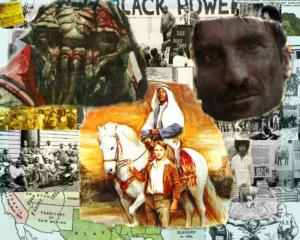
Instead of standing still as our pasts consume us, we must commit to a philosophy of going from here: as oppressed people, we acknowledge and honor past harm but do not allow it to cloud the future; as oppressors, we embrace being accountable but do not allow accountability to stagnate into guilt; together, we allow our experience to inform and guide us as we work towards a world without oppressive structures.

In Walking Awakethe main character, Sadie, is complicit in a system that raises human hosts for parasitic beings we later learn were created by humanity in the distant past.  She is also a victim of that system, as the only reason she holds the position she does is because her bipolar diagnosis rendered her unfit for "service"---the Masters, as the parasitic beings are called, only want to occupy the best specimens humanity can produce. Her position entails raising children for the use of the Masters, and she becomes particularly fond of a child she names Enri, who is taken by a Master early on in the story. On the night Enri is taken, he comes to Sadie in her dreams. During their conversation, she discovers that all the humans that have ever been taken over by the Masters still exist and can communicate with each other in another plane. Their consciousness is just suppressed under the consciousness of the Masters.

When Enri first sees Sadie, he tells he that he felt anger towards her after he learned that she was complicit in a system that was raising him simply to be harvested. The children in this system are not aware of the true nature of their sacrifice until a moment before; they are raised to believe the Masters are benevolent aliens and being their vessel is the highest possible purpose a human can have, but they are never told what the Masters truly look like (scary crab things), and they are never told how violent the process is. The betrayal Enri must have felt upon learning that his caretaker, who lovingly called him Enri instead of Five-47, was actually an instrument of his demise, is a version of the betrayal we feel when a supposed "ally" or accomplice sides with white supremacy or patriarchy. Yet instead of discarding Sadie, instead of succumbing to his desire to demonize, he decides to view her through the lens of transformative justice: he tells her he realizes how the system worked to harm her as well by forcing her to turn over the children she had grown to love, and he offers her the opportunity to be accountable through dismantling the framework that facilitated her harming him. And Sadie, to her credit, does not attempt to argue with him about her complicity, she simply goes from here, accepts her role as both oppressed and oppressor, and allows Enri to educate her about the true history of the world: a world where the Masters are not aliens at all, but the genetically engineered creations of a class of humans interested in control and domination. This new knowledge compels Sadie to work with Enri and the others whose consciousness is subjugated by the Masters towards destroying the system.

Sadie does not turn away from the truth of the world, nor does she attempt to deny how she has benefited from the current system. Enri does not allow his anger towards Sadie and his knowledge of her complicity to cloud his vision of her as a complete human being worthy of an opportunity at redemption. Because they approach each other with open hearts and minds, they are able to work together to destroy the system that subjugates them both. Together, they free future generations of humanity, although it requires them to sacrifice themselves in the end. Like Sadie, we are called to sacrifice our delusions about the nature of our world in the hopes a clear view of reality will compel us to change it; we must sacrifice our placid acceptance of the status quo in favor of radical resistance against dehumanizing ideologies, and we must sacrifice our comfortable numbness in favor of revolutionary awareness. Oppressors can render psychic reparations for past harm via ongoing acceptance of complicity, and ongoing efforts to foment change: If we are oppressors, every day we act towards undoing the framework that perpetuates that oppression, and through these acts we embody our redemption.

As oppressed people, we hold our oppressors accountable in a space of love: we do not excuse harm, or ignore it, but we also do not allow it to prevent us from seeing the potential for transformation coiled up in each of us, cowering behind our socialization into white supremacist imperialist capitalist patriarchy. Like Enri, we have to move away from the comfort and surety of anger and blame and move into the discomfort and precarity of imagining and building new futures with the same people whose ancestors inflicted harm on us in the past, or who themselves have inflicted harm on us in the present. We forgive but never forget, because forgetting does not benefit us, but forgiveness can.

The future must be built on a foundation that allows each of us to fully realize our humanity; our revolution must contain a mechanism for providing reparations to those harmed and an opportunity for redemption to those who have done the harming. We will only find permanent relief from the trauma of being oppressed and the burden* of being an oppressor when we transform our world so that no one has to be either.


* "Absolute power for patriarchs is not freeing. The nature of fascism is such that it controls, limits, and restricts leaders as well as the people fascists oppress." bell hooks, Ain't I a Woman: Black Women and Feminism, 1981

Their past is not our future: Afrofuturism and the colonizer's gaze

"In Context" by Tasha Fierce collage by me

When I interact with people in my day-to-day life, I try my best to consider them as whole human beings with a lifetime of distinctive experiences up to and including the moment before I began my interaction with them. I balance their mannerisms and reactions against the knowledge that they might be having a stressful day, or they might have had a stressful life. I'm not gonna lie and say I've perfected this practice---I have particular difficulty being graceful while driving---but I do practice.

I want the films I watch and the books I read to have this same consideration for their characters. I want characters that are whole beings, not flat caricatures and cutouts leveraged to further a plot. Homogenizing diverse experience is a tactic of oppressors, and I intensely dislike hearing echoes of the colonizer in the art I consume.

In District 9, the audience is locked into the colonizer's mindset with no option of seeing reality any other way. Although we are presented with a number of interviews from social scientists and other talking heads speculating as to the structure of the aliens' society and the nature of their distress, we only get brief dialogue from the perspective of the alien Christopher Johnson that references their home. We never learn what the aliens call themselves, instead being forced to either refer to them as the depersonalizing "aliens" or the derogatory "prawns".

The movie's treatment of the Nigerians is similarly dismissive. There are, again, interviews with white sociologists and talking heads who attempt to explain why the Nigerians are eating alien body parts and such. We never really see the lives of the Nigerians in this world from their perspective, so their actions seem completely irrational since we can only judge them from our context and that of the fictional documentarians.  Nearly everyone is treated as disposable by MNU, in particular the aliens, the Nigerians, and Wikus after his transformation. This speaks not just to capitalism's prioritization of profit, but also to Whiteness' perpetual concern with purity, its fundamental need to posit itself opposite an Other, and its need to punish those who transgress racial boundaries---although I'm unsure if that's what the filmmaker was going for.

All I know is, once the initial novelty of an alien-invasion story that begins with us subjugating the aliens wore off, I just had this discomfiting feeling. I'm not a fan of the violence, both physical and psychic, and it just seems like the movie captures the worst of humanity. The cutout aliens were better people than most of the humans in the film, aside from the brother who got arrested for exposing MNU's alien experimentation program. As Tananarive Due remarked, District 9 is less Afrofuturism than science fiction set in Africa; it is certainly lensed through the colonizer's gaze.

After watching District 9, I began to appreciate Steven Barnes' Lion's Blood even more. It depicts an alternate history where Africans colonized Turtle Island using enslaved European labor---which, I admit, also makes me uncomfortable. But Barnes constructs his characters to be so multifaceted that I don't feel like I'm forced into one viewpoint. He gives us both perspectives, the enslaved and the slaveowner, and in each perspective right and wrong are formulated slightly differently relative to the context the character is living in. I'm uncomfortable while reading because I hate to see my people doing wrong---I think colonialism and chattel slavery are wrong no matter who engages in them---and I'm uncomfortable because Barnes is forcing me to empathize with slaveholders: not just because they now look like me, but because they are portrayed as complete human beings. I'm not uncomfortable because I feel locked into a colonizing gaze.

Lion's Blood illustrates how we can avoid reproducing the past of our oppressor in our futures. Even as it revisits our traumatic past and recasts its players, it portrays that past in a way that cherishes an essential and shared humanity. It stays true to what I know of the spirit of Afrofuturism: honoring the past and allowing it to inform the present and future, divesting from colonial and white supremacist rationalistic frameworks of understanding, and constructing narratives of our experience as Black people in fantastic realms that maintain our integrity as whole beings. Our history; our bodies; our beings are flawed yet magical. To reject the harmful dichotomies of white supremacist imperialist capitalist patriarchy, we must extend grace and the freedom to be self-actualized to all our constructions---whether they're futures or characters.

Your future is not your past: embodied nostalgia in Tananarive Due's Like Daughter

When I was eight years old, I was raped by an older classmate. When I was eighteen, I was raped by the brother of my friend's boyfriend while we were on a double date. Sprinkled in between those traumas are numerous microtraumas*: racism, bullying, sexual harassment, my first suicide attempt at age 14, my first hospitalization, forced medication, an ensuing period of psychological instability, more hospitalization, more drugs, both legal and recreational.

Much of my life I can only remember through a diaphanous veil of neuroleptics. Of course I have wondered what I would be---who I would be---if I had never had these experiences, if I had a childhood and adolescence unblemished by agony. I have even been preoccupied with recovering that lost girl, convinced that once I had excavated her from underneath the pile-on of medication, she might re-emerge as me. In some ways, she has. I see remnants of her in my creativity, my passion for learning, my relentless belief that humanity can create a world without oppression, and my enduring soft spot for whales. But I know now that I do not want to create a self absent my struggles, absent my traumas. I have shaped myself into a marvel.

In Like Daughter, the narrator's friend Denise experienced a childhood filled with physical and sexual abuse. When cloning technology becomes widely available, she decides to create a clone of herself, intending to right the wrongs her parents inflicted on her. After she's impregnated with the clone, she starts a search for a suitable father and ends up marrying a rich guy who has no idea what he's getting himself into. By the time Neecy, her daughter, is six, the man she baited into being the dad has left them. Denise, unable to handle seeing herself broken again, calls up the narrator---who is also the child's godmother---and asks her to take Neecy away. Instead of trying to soothe herself as she was, instead of healing her wounds in the present, Denise exhausts her minimal energy on a time travel project that ends in heartbreak.
It seems reality, or time, or whatever, does not allow do-overs. We are meant to be the people we are, and we will be shaped into that, one way or another. I have come to realize this over the past few years, and I no longer waste energy trying to resurrect my ancestral self. I remain in conversation with my past; I draw on it to provide context for my present, but I do not wish for a retake. So many things had to go right for me to be here that might not recur the second time around. Everything can always be worse.

I see so many of us walking around like Denise, longing for a chance to right the bygone wrongs of our life, unable to move forward, unable to imagine anything different. Some people are so entrenched in their nostalgia that it extends beyond the personal, into the political. I have made the decision to accept what was, and now I struggle daily towards embracing the present as a gift to the past. I return in triumph, not regret. Look at what I made from this.


* not in any way saying these are less traumatic generally, just saying that in the context of my life, they were slightly less so.

Your future, not ours: lessons on liberation from The Girl with All the Gifts

Adorably deadly.putting the cut in cute


What is liberation if it requires the enslavement of others? How can we prioritize our freedom while holding space for empathy? 

Imagining new futures means we do not have to accept the compromises made in the past. We can discard the colonizer mindset and adopt one that does not require the sacrifice of one for the sake of another; that negotiates paths wide enough for all. Under existential threat, we will defend ourselves---with whatever means necessary. When we have the advantage, we can be magnanimous---in fact, power demands magnanimity. Absolutes, either/or dichotomies, the idea that one group must sacrifice itself for another: these are all tools of the master.

In The Girl with All the Gifts, Sennia Nanua plays Melanie, an adorable Black girl who is infected with a symbiotic fungus. She's incarcerated along with a bunch of other children---all white---who get up every day, get strapped into a chair, and get educated by a woman called Miss Justineau (also white). In the book, Miss Justineau is Black, and Melanie is white, and this makes more sense to me given the ending. But, I'll get to that later.

Melanie is obviously bright, caring, and inquisitive. She cares about the well-being of all the adults around her, even though the soldiers whom she interacts with most frequently call her "it", refer to all the children as "friggin' abortions", and berate Miss Justineau for showing empathy to what they consider fungus in human form. Other than Miss Justineau, whom Melanie adores, Dr. Caldwell, the head scientist, is the only other adult who is remotely warm towards her---and she is cold as ice. She is using all the children as test subjects for a potential vaccine, the production of which, we learn, requires Melanie's brain and spinal cord.

We see Melanie get wheeled from the detention facility she lives in to a medical complex, and during this transition we glimpse humanity's world as it is now: a sea of zombie-looking things trying to break down the fence that encloses Melanie's world to this point---a military base on the outskirts of London. She has apparently been raised in the detention facility, because she seems to be heretofore unaware of the condition of the outside world. This is the apocalypse Dr. Caldwell is seeking to avert, and this scene impresses upon us the understanding that humanity is no longer dominant on this planet.

In the medical complex, Dr. Caldwell briefly tries to convince Melanie to sacrifice herself willingly by telling her she'll be giving Miss Justineau a gift, but hedges her bets by drugging Melanie at the same time. While she has her strapped down, the base is overrun by "hungries", the zombie-like things we saw chomping at the gates on Melanie's trip to the complex. Dr. Caldwell's assistant gets bitten and turns, giving Melanie an up-close glimpse of her people. Eventually she gets away, finds Miss Justineau and is picked up by a van containing Sergeant Parks, the man who took Melanie to the medical complex, along with some other military types. Also inside the van is Dr. Caldwell, who is still chomping at the bit to get to Melanie's spinal cord.

They travel throughout the city trying to get to some mobile labs Dr. Caldwell knows about, so she can start making the vaccine. Throughout their journey, Melanie proves invaluable because she can negotiate the hungries without them coming for her. They're guided by smell---as is Melanie---and sound. Dr. Caldwell invented some gel that blocks the smell, so the humans can move amongst them as long as they don't make too much noise. Once someone gets loud, it's over. But Melanie, being part fungus, isn't food to them.

During this time we also find out more about the fungus and how it's spread. It takes over the nervous system (its real-life analog is Cordyceps) and eventually directs the host to congregate with others so it can construct a tree-like structure and create seed pods. Melanie and the adults come across a giant forest Dr. Caldwell deems the potential "end of the world", as if the seed pods ever burn or become saturated with water, they will open and the fungus will become airborne.

After they find the mobile labs, Melanie comes across some feral hybrid children and realizes that there is hope in this world even if humanity dies. However, those kids end up killing one of the humans she likes the most (and probably not coincidentally the only Black person left on the squad). She defends the rest of the adults against the feral children and kills their leader so they might escape.

Eventually, Dr. Caldwell, who is dying of sepsis, drugs everyone so she can kidnap Melanie and try to make the vaccine. She again attempts to convince Melanie that sacrificing herself for humanity is the altruistic and correct thing to do. Melanie at first agrees, then asks Dr. Caldwell if she's changed her opinion of her sentience. Dr. Caldwell admits that she thinks Melanie is genuinely alive and self-aware, and at this point Melanie delivers one of the realest lines of the movie: “Then why should it be us who die for you?” She tells Dr. Caldwell to stay in the mobile lab, and she runs outside. 

Melanie has decided the best course of action is to ignite the giant seed pod forest and usher in her vision of a new world. After torching it, she comes across Sergeant Parks, who left the mobile lab looking for Melanie. Melanie ends up shooting him, at his request, because he doesn't want to become a hungry. Dr. Caldwell gets eaten by the feral children, so Miss Justineau is the only human left. The movie ends with her in the mobile lab, unable to leave because of the airborne fungus, teaching the formerly incarcerated hybrid children along with the feral hybrid children Melanie has rounded up, through the glass.

Melanie needed Miss Justineau. The world she wanted to build required her in it to educate the children, lest they all end up feral. Miss Justineau’s life was going to be miserable in this new world, but Melanie forged ahead without giving her a choice, effectively enslaving her since she cannot leave that mobile lab without succumbing to the fungus. This is why I don't like the reversal of the races from book to movie: Melanie executes a profoundly unloving act of creation/destruction and I prefer to see my people do better. I love the idea of a Black girl being the future, and I appreciate the power of lines like “It’s not over, it’s just not yours anymore” being spoken by a Black girl to a white man. But the movie's hierarchies are not representative of reality.

At first Melanie seems to be the oppressed in the situation, because she is caged. But once the hungries invade the base, things change. And by the time she tells Dr. Caldwell “Then why should it be us who die for you?” we’ve seen a world turned over to the fungus, we’ve seen the feral hybrid children, and we’ve seen the seed pods that portend humanity’s eventual doom. Humanity is the oppressed in this world, the fungus is the oppressor. I don’t think Melanie was in a position where releasing those spores was an act of self-defense. She could have killed Dr. Caldwell and that would have pretty much ended the threat to her. She could have run away and lived in the wild and just waited for humanity to either die off on their own or actually pose a threat to her. Time, probability, and all the forces of nature were on her side. 


I believe we need to gain our freedom by any means necessary. But I question the ability of The Girl with All the Gifts to be a real metaphor for Black liberation without glossing over the power dynamics of the post-apocalyptic landscape Melanie exists in. There exist free hybrid children in Melanie’s world. Even if Dr. Caldwell found a vaccine, a vaccine can only save the uninfected. At best, humanity might continue on as a minority species---until some giant pod tree somewhere bursts open.  Melanie is certainly oppressed in her individual circumstance---like working-class white folks, for example---but overall, her people are running things out there. The actress playing Melanie is Black; the character is not. 

Yet there are still lessons to be learned from The Girl with All the Gifts, because the choice Melanie makes is a choice given to us all, and because Nanua's casting now makes the character a cinematic representation of us. We are all challenged to reject the values we were inculcated with by society; to reject ways of living that require the subjugation of others. Melanie's action illustrates how transformative love is not just ensuring the safety of the ones you love but allowing them to make choices about their own safety. Keeping someone "safe" against their will while you build a better world off their labor looks a lot like incarceration and slavery. Our future does not have to follow the same model as our past. We do not have to accept the zero-sum mentality of white supremacist imperialist capitalist patriarchy. No one has to die for anyone.


To get to the future, you will need a map: the importance of vision and ideology in Parable of the Sower (and real life)

The white male founders of the United States lived in a world that was not at all one where all men were equal, or where all men had the same access to life, liberty, and the pursuit of happiness---and for the most part, they were perfectly happy with this reality. Their idealized vision of themselves as egalitarian, liberal, and enlightened is evident in the language of documents like the Declaration of Independence:
We hold these truths to be self-evident: that all men are created equal; that they are endowed by their Creator with certain unalienable rights; that among these are life, liberty, and the pursuit of happiness.

The descendants of groups of people the founders never meant to be included in their definition of men have internalized their vision to such an extent that in a struggle to embody it, they again and again force the country further towards its ideal self. Liberalism and other Enlightenment ideologies were not meant to advocate for the equality of anyone other than rich white cisgender men, yet there are enough threads of inspiration and liberation within them that, to this day, oppressed people involved in all types of resistance struggles invoke the words of the founders to inspire their fellow citizens to do a little better. This is the impact of vision and ideology on the future. Vision provides the destination, and ideology is the road map. In the case of the U.S.' founders, of course, the vision was more of a delusion, and the road map guided us into a laissez-faire hellscape. But delusion is important in creating a vision of the future. We must, in some sense, disregard the state of the world today and envision the best version of our selves and our societies.

Lauren Olamina, Parable of the Sower's protagonist, is creating an ideology---a religion, actually, but religions are like ritualized ideologies (or ideologies in their final form). She sees humanity's lack of foresight and stubborn refusal to let go of the past, and understands the urgent need for a vision of the future that can force productive action in the present. In Earthseed, the religion Lauren founds, God is Change and Heaven is the Destiny, which is for humanity to take root amongst the stars. Earthseed: The Books of the Livincontain her ideology, the road map she constructs to guide humanity to the Destiny. Rather than base her ideology on where an individual stands in a cosmic order, Lauren bases her ideology on an understanding of the cosmic order itself---change is the only constant. Once this nature is understood, action flows from the understanding. "Unenlightened self-interest" becomes a betrayal not only of one's self and community, but of the laws of nature. Diligent work towards a goal like taking root amongst the stars becomes a form of worship. The ideology becomes internalized, the map memorized.

By setting Parable of the Sower at a point in time when the United States is on its last legs, and old ideologies are seeming inadequate to meet the challenges of the future, Octavia Butler asks us to consider what happens when we must throw out our maps and draw new ones. She also asks us to reconsider who can be a cartographer. Lauren is a teenaged black girl, in a suburb of Los Angeles, with no formal education or training. And yet she observes the world around her, and she has some knowledge of history. With these tools, she is able to divine an ideology that guides her and others through a chaotic moment in history, and ultimately to her vision of interstellar colonization.

Our world now is at a similar point as Lauren's. The ideologies that propelled us to this moment---capitalism, individualism, materialism---are being rejected by future-minded folk desperate to see humanity do better. Like Lauren, we are called to chart a new path, and like Lauren, most of us have no idea what we're doing. But Butler speaks to that place of quiet knowing in each of us, reassuring us that our observation and experience is valid. Despite our apparent insignificance, we can know the nature of reality, and we can harness it to shape the future. We can call into existence a better world: by creating art, literature and music that plants a vision of a just and equitable society in our collective minds, and by articulating principles that will help manifest in real life the worlds we fantasize about. We can create a new road map for our descendants to follow in striving for freedom.

In case you didn't notice: hidden characters on this site

There is a new-ish section on this site I wanted to point out. I added it late last year but never really announced it; the link just appeared in the navigation menu quietly. This was purposeful on my part, because it is a vulnerable act for me to create space on this site for pure creation and unfiltered emotion, and I suppose I felt more comfortable stealthily uploading such work to pages than I did publicizing it on the blog. It's been a few months and I have a few less fucks to give, so now I think it's time to give a proper introduction.

elsewhere, writing

I have poetry here, as well as some writing I imported from my old (secret) blog water in my cereal, which I used during the worst days of my withdrawal from psych meds. I'm also linking here to the category for blog posts I'm doing for Tananarive Due's Afrofuturism course at UCLA---I think we will have 6 or 7 in all, and I'm not linking to these on the main blog other than in the featured slider.

The main thing is the poetry, since in the past few months I've been updating that instead of writing essays/blog posts sometimes. I don't plan on updating the water in my cereal section. I hope that I've moved to a place in my life and my process where I can express some of that here, or if it's too thorny to air publicly, just leave it in my journal.

I'll continue to add more subsections to this part of the site as time goes on. I'm working on some fiction that I will likely end up sharing in a month or so. For now, what's there is enough.


Peace,

Peace, Tasha


The future will set you free: themes of regression and progression in Octavia Butler's work

Human societies are constantly struggling between the past and the future, rarely fully inhabiting the present. We see evidence of this conflict today more plainly than ever, as climate change threatens humanity's long-term survival while U.S. politics is preoccupied with the fallout of loss of white male status. The slogans of populist politicians of today are the same as those of yesterday: Make _______ great again, implying we must turn around to recapture our glory. In my own lifetime, I have observed that in the face of diverse threats to humanity's survival, instead of confronting our destiny with clear eyes and purpose and shaping it into its best form, many would rather cling desperately to an idealized vision of what we once were. There is, of course, comfort in the familiar, and the past is infinitely more familiar than the future will ever be---although as Parable of the Sower's Lauren Olamina would point out, with an understanding of the past, the future becomes more knowable. I would imagine that during her own life Octavia Butler noticed a similar pattern of nostalgic avoidance as I have; there is much in her work to indicate that she did. She certainly identified a clear need for us let the past go in order to enable the future.

Much of Butler's work features a tension between past and future playing out in the present. The main character in Kindred is supernaturally tied to the past, being violently jolted to slave times against her will. In Mind of My Mind, the past is embodied in Doro, the heroine's father, whom she must battle to pave the way for a new form of society. But in the Lilith's Brood trilogy, as well as in the Earthseed series, the main character is fighting regressive forces within humanity who cannot accept that change has occurred, is occurring, and that things will never be the same again. Both Lilith (the heroine of Dawn, Adulthood Rites, and Imago), and Lauren Olamina (the heroine of Parable of the Sower and Parable of the Talents), are reluctant pioneers who, despite their reservations about the struggles ahead and what they will be required to do in order to survive, have determined that humanity's collective survival lies in the future, not the past. Lilith, one of only a handful of survivors of humanity's last nuclear war, must convince her fellow humans to accept an interbreeding program with a physically revolting species in exchange for the chance to perpetuate some of humanity's genetic legacy and live on a restored Earth for a time. Lauren Olamina must build a multiethnic, collectivist movement that believes humanity's destiny lies among the stars---in the midst of of a hypernationalist and religious fundamentalist revival in a United States reduced to developing country status by climate change.

Lilith is herself resistant to the idea of interbreeding with the Oankali, the alien species who have rescued her from the dying remains of Earth. The Oankali are masters of genetic manipulation, and have sustained their civilization for much longer than humanity. They survive through trading their genetic material with other species, changing both participants in the process and birthing a new species. The situation with the Oankali is admittedly coercive, in the sense that Lilith is basically captive for quite a while and denied reading and writing material. Eventually more information is provided to Lilith, and it becomes less of a captive situation. She comes to accept that humanity had pretty much destroyed the planet, and that without the remediation of the Oankali, it would not have supported life anymore. Reluctantly, she agrees to act as the mother to a new species, and to try to persuade as many humans as she can to engage in the gene trade with the Oankali. Having overcome her own resistance to letting go of the past, she must now surmount that of forty other humans. This is, predictably, where the majority of the conflict lies.

Once released on the remediated Earth, many humans form resister colonies and refuse to participate in the interbreeding program. The Oankali have sterilized humans to ensure that they can only breed the Oankali way (in a threesome with a human male, a human female, and an ooloi---genderless Oankali that are especially adept at genetic manipulation and can excrete substances that promote euphoric highs). The Oankali are also much stronger than humans, so the resisters had no hope of overpowering them. And in Adulthood Rites, we find out the Oankali's living ships will eventually consume all of the renewed Earth's resources, leaving a lifeless, uninhabitable husk behind---in response to this discovery, Lilith's first half Oankali/half human son convinced the Oankali to offer the resisters a settlement on Mars, along with restored fertility. Yet by Imago some of them were still refusing, particularly a group of interbred humans with a genetic tendency to grow tumors and develop other ailments, descended from a human woman who discovered she was fertile. These humans built up an ideology around the Oankali as devils and Lilith as a supernatural La Malinche-type figure, preferring to breed family members with each other and suffer than accept that the past they were trying to preserve was destroying their future.

Lauren Olamina is a teenager forming ideas about the world that are contradictory to those she's being taught. She rejects her Baptist father's religion, instead developing her own philosophy based on Change as deity. As her world is in upheaval, she identifies change as the primary constant in the universe. The adults around her seem, in some respects, to be waiting for good times to come again; seem like they don't actually believe that this is now and that was then, and although we can understand, honor, and draw power from the past, then will never be now again. Lamenting and preparing for the return of the past occupies space that belongs to the future, and Olamina understands this intrinsically. Instead of allowing adults' nostalgia to make her complacent, she prepares for the future spiritually and materially: She develops her Earthseed philosophy that identifies God as Change and humanity's Destiny as colonizing other planets, and she packs an emergency "go bag" she can grab at a moment's notice in case she needs to abandon her home.

The United States in Parable of the Sower is presented with a similar choice as we had in 2016, a choice between a presidential candidate who at least paid lip service to being forward-looking and one who was proudly regressive. Reality mirrors fiction; faced with fiscal collapse due to climate change, Butler's U.S. decides to turn back towards the past and assents to a rollback of their civil rights. Slavery is revived in pockets of the country. Company towns return, embraced by many people seeking refuge from increasing violence who do not know, or do not believe, their exploitative history. Olamina identifies a knowledge of the past, a consideration of consequences, as vital to survival---one of her Earthseed verses suggests considering the consequences of one's behavior as a method of getting along with God. She identifies considering the future as similarly crucial in this verse:

A victim of God may,
Through forethought and planning,
Become a shaper of God.
Or a victim of God may,
Through shortsightedness and fear,
Remain God's victim,
God's plaything,
God's prey.


(Parable of the Sower 31)

For societies, understanding the consequences of behavior entails understanding history. Shortsightedness and fear are embodied in regressive politics that emphasize denial over futurist problem-solving, precluding the ability to plan successfully. Occupying one's mind with the past crowds out room for forethought.

The past and the future each have their place in our present. Blind nostalgia is useless, but an appreciation of the past is essential; likewise, paralyzing apprehension is not helpful, but envisioning ideal futures and potential paths towards them is key to ensuring best outcomes. Butler had a keen understanding of the mental balancing act required to successfully navigate pasts and futures while in the present, and she imbued her characters with this knowledge. Their experiences point to one conclusion: If we are to build better futures, humanity must let go of the past---before it is too late.

Considering ways of instantiating freedom in an unfree world

I made a decision recently to extricate myself from a couple projects that I took on while I was on an upswing, and no longer have the energy to be a part of. When I did this, I knew I was doing what was necessary given my recent struggles. Still, I've been ruminating over the decision, flogging myself for having not lived up to some external ideal of productivity, and for having let people down in some way with my departures. Depression feeds off rumination, especially rumination over the manifold ways in which I am not free---and by indulging this rumination, I realized I am allowing myself to get uncomfortably close to the abyss. I decided that I needed to shift my focus away from society and consider my role as personal master, jailer, and oppressor.

This is not to say that I'm now dismissing the ways in which society binds me; rather, I want to embrace the ways in which I can free myself. I want to live as freely as possible, within the scope of my current ability, and I want to reject ideas that stifle freedom. I can't ask more of the Universe than I'm willing to do. If I can't cultivate freedom within myself, how can I help birth it into the world?

This is a proclamation of my intention to work towards self-emancipation. These statements counter messages I am told by society; messages I have internalized and let take residence in my psyche, that now manifest as insecurities. Now I bring those messages into the light, refute them, and start the slow process of rooting out my subconscious acceptance of them. In this process I'm speaking mainly to myself, but I also want to reach out to anyone else who might need a nudge towards freedom in one of these areas.

I am free to be wrong

Even if I should know the answer, sometimes I don't. That's fine. It's fine to forget in the moment, to remember five minutes later, to never remember. It's fine to have never known. Only by being wrong can I test the limits of my knowledge and expand them. It's also fine to be wrong in my actions or speech towards someone else or towards myself, as long as I recognize my wrongness and make amends. Just avoid being loud and wrong if at all possible. No one is free to be loud and wrong.

Our/my fear of being wrong is probably ableist, anyway. Subconsciously I'm probably recoiling from looking foolish, or feeble, or intellectually weak. Freedom is a place where being wrong---but being honest about it and open to learning within your capabilities---is encouraged.

I am free to fuck up

Of course I'm going to try not to make mistakes, but I will. If I didn't, that would mean I was habitually doing things I had done way too many times before. I am human. I make mistakes. I just try to learn from them. Sometimes I don't, and that's valid too. I enact and embody my freedom by rejecting our individualistic, achievement-obsessed culture's devaluation of "stupid questions", mistakes, and failure.

I am free to take too long

This is more on nonlinear time; I'm also thinking about nonlinear/nontraditional life trajectories and "nontraditional" brains here. I might take too long to get out of the house because I was crazy in the morning and so I'm late to school. I might take too long to get through school because I was crazy for a decade and so I'm late to graduation.

I am free to say no

By saying no to opportunities I feel lukewarm about, I dodge roadblocks that might impede my ability to make room within time to accomplish things I feel passionate about. By saying no to participating in actions I'd rather not, I reinforce my boundaries and solidify my sense of purpose. Too many of us do not have the ability to say "no" in manifold arenas of our lives. Where we can, we must. "No" is a freedom word. The word "no", when propelled from the mouth at a right angle, vibrates at the exact same frequency as Harriet Tubman's soul. Or so I've heard.

I am free to change my mind

Yes, I said "yes." But I'm saying "no" now. Absent guilt. This, too, is an embodiment of freedom.

I am free to define my own values, and I am free to reject values that aren't mine

I no longer have to play enforcer of societal standards and values. I can keep the values I agree with, discard those I don't, and adopt a multitude that aren't important to the society I live in. Because it's in the interest of white supremacy and capitalism and patriarchy that I flog myself---

for not living up to an ideal of financial stability and respectability,

not being hyper-productive,

not being ashamed of my fatness, my queerness, my craziness, and my blackness,

not being willing to work twice as hard to get half as much,

not being willing to perpetually starve myself to obtain a socially acceptable body,

not being willing to humble my desire for a collectivist world at the feet of my need for long-term security,

not being willing to transfer the pain of seeing the world as it is into a misguided defense of the status quo

---and that is precisely why I can't engage in it. Values derived from a white supremacist imperialist capitalist patriarchy have traceable ties to my bondage, past present and future.

I am free to think of myself first as long as that doesn't result in irreparable harm to someone else

Discomfort is going to occur for other people when I insist on firm boundaries or when I reclaim my energy and time. Discomfort is not irreparable harm, though. I have to recognize that although it is uncomfortable for both myself and whoever is on the other end of my self-protective act, ultimately I have to power through our discomfort and take the action that is best for me in the moment. No one is served by a miserable martyr.

I am free to survive thrive by whatever means are available to me in the current system

I want to live my best life, by any means necessary, and avoid hurting others in the process (at least as much as is possible in this world). Since I've rejected cultural values that aren't mine, that also means I've rejected cultural values about what I am allowed to have access to as an oppressed person and how I'm expected to obtain material items. Corporations are now people, right?---and corporations are allowed to be financially irresponsible with no moral penalty. So I'm appropriating the right to financial amorality corporations enjoy.

I am free to make art that is shit

Without stabbing myself in the gut every time I look at it. Without wishing I had never made it. If I don't make shit I'll never make anything worthwhile, because I won't know worthwhile from shit.

I am free to do something that someone else has already done as long as what I make is mine

Derivativity has to be authorized. My fear of retreading ground has killed so much inspiration. I know I have already written about things hundreds of people have written about, yet I use potential derivativity as an excuse to shoot down ideas. I should allow ideas to live their lives, give them shape, and see how they evolve. I can't judge their originality until after they have matured. And even if I did make something completely derivative, that doesn't discount its worth as an expression of creativity, only as an embodiment of originality. In my view, as long as what I create has honestly been synthesized in my own head, then it is creative, it is art. It might not be good, but I'm already free on that axis.

I am free to meander through life and not have a clear plan at all times

"Meander" isn't necessarily a good way to describe why my life trajectory is skewed, but I feel like it's describing my behavior recently. I made a shift in my plans for after I finish at UCLA, and I've been shaming myself for it occasionally, even though I know it's in my best interest. The shift is further away from a guaranteed source of high income, and so I find myself reinforcing capitalist ideas about my self-worth being tied to my ability to generate profit for someone else (and in turn, generate some level of financial security for myself). Carving out a way to follow my passion is necessary for me to continue to exist in this world on any meaningful level---this I know. And I know the guilt I feel for taking so long to find my path is not intrinsic to me. It has wormed its way into my subconscious, but it isn't my own.

I am free to be a "late bloomer"

Our culture, my culture at least, is obsessed with early achievement. We laud child prodigies and the "30 under 30" types. This has to be connected in some way with our culture's inability to think long-term, our attitude towards our survival that sees burning out as preferable to fading away---or to constraining our consumption so that neither occurs. Briefly, I had a glimpse of prodigiousness as a child, and then it was gone, and it was just darkness for years. I'm coming back into the light, wary of its power but eager to take in its warmth. I cannot allow the sweetness of this moment to be soured by social expectations of age-appropriate achievement that aren't even based in reality.


In these small ways

I am making space for abundance in my life,

I am cultivating a dialogue with my demons

that acknowledges my role in nursing them,

and I am instantiating freedom in small plots

where otherwise it did not grow.

Using the master's tools to build a shack outside so you can be alone (aka navigating disability gatekeeping in the educational system)

Even before I stopped taking medication, I stopped going to therapy. I didn't have a therapist through most of the withdrawal process; only at the very beginning did I seek out a psychologist because I thought it would be safe. But I just found myself arguing with her, as we had such different worldviews and experiences. I could never get her to understand that given my history and my positionality, my extreme emotions were rational and evidence-based. I know there are radical therapists out there, but I just don't have the time to find one by trial and error, and my insurance situation is such that I can only go to Medi-Cal approved providers or UCLA doctors. I did go to a psychiatrist and a psychiatric nurse practitioner while I was going through withdrawal because I still needed that script and because I figured they might have some knowledge worth sharing. Once I was done with the meds, though, I found no help in continuing to visit a mental health provider. I know therapy is, maybe, supposed to be a place to have your views challenged, but I don't think therapy should be a place where your essential humanity is challenged. Most therapists are viewing me through the medical model or a similar paradigm, and likely have varying degrees of allegiance to the status quo. This is evident in their disbelief of my experience.

Before I went back to school, my desire to disengage from the mental health enterprise was not an issue. I didn't see myself needing to verify for anyone that I've got the crazy. I figured that in a work scenario, I would continue to---like most people--use clever little white lies to get the breathing room I needed for myself. When I first started back at community college, I dodged needing to request accommodations for my crazy when it came to assignments, accessing services, and the like by leaning on financial and temporal support from my mom and my boyfriend. Their help allowed me to arrange my life as such that I could focus solely on school. That combined with my school being on the semester system rather than the quarter system (meaning we had 16 weeks to complete one course rather than 10) provided me enough cushion time to perform my self-care activities and fall apart when necessary, but still do the homework, meet deadlines, and get high marks.

the master's tools will never dismantle the master's house, but they WILL build a kick ass shed miles away, in the woods. the master's tools will never dismantle the master's house, but they WILL build a kick ass shack miles away, in the woods.
I first realized I would have to notify the system that I was, indeed, a person who has historically been labeled "mentally ill" by practitioners at the end of last spring, when I was investigating how to get to UCLA. For some reason, simply living off-campus doesn't entitle you to the ability to buy a parking permit. You have to go through this bureaucratic process that involves applying for the permit several months prior to the start of the quarter---with the potential to not be approved---and paying for it regardless of whether or not financial aid has disbursed. At community college, permits were cheap and plentiful; they issued them without regard for lot capacity. I spent a lot of time circling, but at least I didn't feel like I had to fight to get a permit at all.

To get a permit the "normal" way for fall quarter last year, I would have had to apply for the permit in May or June and pay for it in August. I didn't even know for sure that I would be driving there alone (rather than carpooling or using the vanpool) until August, because I wasn't able to register for classes and thus couldn't know what my schedule would be. And I sure didn't have almost $300 in August, since that's the month Rob doesn't get paid and I don't get any financial aid until the end of September. For a couple months, I was wracked with anxiety over the prospect of having no way to get to school, and I realized that I shouldn't have to deal with this. No one should have to deal with this. No one should be going through this big step, going from community college to university---a step notorious for being a stumbling block for many students---and also having to deal with uncertainty on such a huge issue as transportation. Living 30 miles away should get you access to a permit, period. So, I decided to use the fact that my anxiety has been labeled pathological to make my life a bit easier. I got a letter from my last doctor vouching for my disability, and I applied for a permit via the Center for Accessible Education (CAE). CAE allows you to get a pre-approved application pretty much anytime during the quarter, so as long as you can get the money together, you can get a permit. But, I had to consent to be labeled in order to secure this luxury for myself. I had to admit on paper that I couldn't navigate the obstacles the school erected in my path without an unacceptable level of suffering.

CAE also offers other services---and professors will grant you accommodations like more assignment time---if you submit to their more in-depth application process. At first, I thought I would just need the parking, but lately, I'm wondering if I shouldn't make it easier on myself and just allow my diagnosis to serve me. UCLA is on the quarter system, so everything is accelerated, and it's far, so getting there and back drains my soul. I've found that here, circumstances are such that I need to leverage my diagnosis to secure breathing room and refuge from unrealistic demands. The idea of expending valuable energy on the application process and potentially having to defend my choice not to take medication is intensely unappealing, however. What I really wish is that universities would stop simply accepting the inequality in society and perpetuating it, and start modeling what a better world could look like. Part of this might involve not forcing differently abled/neurodivergent/neuroatypical etc. people to engage with or submit to the medical system in order to prove their suffering would be increased without accommodations, especially when doctors are the source of that suffering for so many. A better path would be to simply disengage from capitalism and the culture of individual achievement and hyper-productivity it has produced. But since universities themselves are metamorphosing into profit-making enterprises, I suppose that might be asking too much. What's really frustrating, and borders on gaslighting, is that the rhetoric the administration and faculty deploy around being more inclusive and supportive of nontraditional and historically underrepresented students does not reflect the structural reality. From jump, I have noticed obstacles that make it more difficult for students who don't live on campus, who have jobs or kids or just the desire to not completely destroy their health over trying to meet the extracurricular and academic demands of being a "successful student".

Part of me wants to try to change this system while I'm in it, to help whoever comes after me. I realize, though, that I just don't have the energy to expend changing an institution I'm not even sure needs to exist in the first place. I don't know that these sites of formal education are the best way of disseminating knowledge through a populace. I don't think they are; I don't feel like they are, but I'm willing to be wrong. As mechanisms for producing more individuals to fill socially acceptable occupations, universities don't have a place in my ideal world. In my experience, formalized education processes out creativity and true contemplation in favor of a kind of diversified groupthink that passes for critical thinking. I would like to see a much more individualized educational system that allows learning to happen naturally. I don't think we all need to know the same things. I do think we should all know certain things---a true history of world societies, economics, and exploitation for example---but I don't think we're currently teaching those things in school when we need to be, which is at the elementary level. In any case, my survival strategy for the remainder of my stay in the educational system has to be conservation of energy. I will leverage my diagnosis when need be to counter any structural obstacles both at the institutional and the social level that cause me unneeded suffering, but I won't seek to transform the institution itself.

These are the trade-offs we make every day as revolutionary-minded crazy folk. We consciously choose when we engage with labeling and when we disengage; we decide when to deploy it in order to mitigate some of the harm structural inequality and access barriers cause, and when to reject it when it degrades our humanity. Hell, these are the trade-offs we make every day as black women, as queer and trans people, as people of color and other oppressed folks. Systems of oppression all have release spouts, features that allow oppressed people within them to use the system against itself in small ways. For example, as a queer femme cis woman, I could potentially leverage sexism and patriarchy to get a free meal on a first date if I was broke and starving (and single!). But no one should be starving in a world of abundance. My pseudo-privilege doesn't negate the immense and disproportionate harm patriarchy does to cis women versus cis men, and it doesn't negate the fact that the harm I would be attempting to mitigate was inflicted by an unjust social structure. I see the "accommodations" I can access similarly, in that I am addressing a harm that derives from our society's embrace of hyper-productivity and white supremacist capitalism. It doesn't negate that harm, but it makes it just a little bit easier to live with.

In this moment, that has to be enough.

Letting go of linear time as a strategy for coexisting with anxiety and maybe transforming society

Time is a major fuel for my crazy---I worry about how much I have left in my life, how much we have left as a society, and how much we have left on this earth. Most often, though, my anxiety around time is centered on how little of it I have in each day that I can truly call my own. Being in school means my time is fragmented; although I only have to commute to campus two days out of the week, the rest of my time is primarily occupied with reading, writing, and adulting*. a Black woman bares her teeth at a frowning clock and a calendar giving her the middle finger I have these competing demands for my "free time" at home, and it generates anxiety because I feel like I can't get everything done, like there's not enough time.

One day, I was doing dishes late, past my bedtime. I felt that familiar temporal anxiety creeping up my sternum, into my throat. I failed at time management yet again, it was 11:30 pm or whenever and I still hadn't finished these damn dishes.

I said to myself,


I know, right? No, actually, I said:

I never have enough time

And I realized two things.

1. Time is not mine to possess; and
2. Time is infinite, I merely move within it.

Since then, I have tried to use "time is infinite; I move within it" as a mantra when I feel the temporal anxiety rising up again. I also connected this concept to my experience of time as nonlinear in some ways, how I often live in past/present/future simultaneously and how that shapes my perception and interaction with the world. Often this manifests via my crazy. When I recall past events, if I remove the protective filter I have learned to construct around my memories, I feel acutely, as if the events were occurring in the present. I feel events I imagine will happen in the future similarly. So I believe time is not actually linear, it is only consciously perceived to be by many people.

I think our society's ideas about linear time---about what activities are worth our time and what aren't, about whose time is worth more than others and who is worth our time, about what free time is and who deserves it, and the classist/sexist/racist/colonialist/capitalist/etc. nature of those ideas---are oppressive. I want to reclaim time for all of us, since it ultimately belongs to none of us. Linearity is associated with scarcity, in my mind. Living in nonlinear time is living in abundance.

This is all fine and good, but in the society I'm at, they still use linear time and the 24 hour clock and all that racket.
- Me, 2018

Yeah, I know. I know this is abstract. But it helps me, honestly, to think of myself as moving through time fluidly, choosing what I want to experience and making space for those experiences within time, rather than thinking of myself as a temporal miser, a fourth dimensional Scrooge always worried about how much time she has, greedily trying to grub up enough to watch Deep Space 9. This is part of being kind to myself and others, trying to live in the future now by modeling what I think future social relations could look like. I think a remodeled conception of time might have an impact on our conception of the world. What if time was determined subjectively? What if you went in to your "job" (I put this in quotes because in my ideal world every day you would spend the majority of it doing whatever you felt called to do, so I don't think it could be considered an actual job) not at the start of business hours, but whenever you felt ready enough in the morning to face the day with a clear head and open heart? What if your ability to be present---or your need to be absent---dictated what time it was?

These are the possibilities I think a world without linearity has to offer, honestly. But, I'm just dreaming and using that dream as a salve for my crazy. I've added this tool, this vision of a world without linear time, to my repertoire. I'm on an upswing now, so it's hard to say how it will work when I'm in the dark. So far, though, I'm finding it soothing. I like the idea of swimming through time, like a temporal mermaid, so I try to envision that along with saying the mantra.

Hopefully, I can learn to permanently drop the scarcity complex when it comes to time, and live in the abundance.


*housecleaning/groceryshopping/tryingtokeepbillspaid/
reflectingonthestateoftheworld

More on being crazy and off meds (my journey away from psychiatric medicine, part 2)

I'm about to head into my third quarter at UCLA and I wanted to make time to write an update on how things are going with my mental health. This is a conversation with my past self—I'm quoting my previous essay on withdrawing from psych meds in order to note where my experience so far has now proven my beliefs to be either true or false. On the whole, my mental health has declined over the last 11 months, and I realize the theory I hatched about my crazy being limited to depression and anxiety was wrong. But I'm still relatively stable, and although I go through it sometimes (all of the time), I always come back out (I exist simultaneously in it and outside it).

Let's get into dialogue with my ancestral self, shall we?

After a re-read, my previous post seems glossy. I'm talking like I've got rose colored glasses on, like this is the actual end of the journey (even though I seem to recognize that it isn't by appending a "part 1" to the title) and I'm eulogizing my dead crazy. I mean, I lead with
For the last 5 weeks, I have been psych med free. I’m kind of ecstatic.

and I wax poetic about all the good I want to do in the world like I'm riding off into the sunset. Looking back on this particular period (last spring), I realize I was not a normal level of happy. I hate to use medical/biopsychiatric terminology, but I was varying degrees of manic, basically. It was that way for a while, and then I evened out. During the summer, I had a weird feverish depression/anxiety complex. The world seemed irreparably fucked, I was about to start UCLA, I was suspicious that my crazy was winding up for a knockout, and I was absolutely terrified that I would spiral out of control and be forced back onto meds. But I couldn't be vulnerable enough to share all that publicly at that time. I was wrapped up in the idea of myself as triumphant conqueror of demons, and admitting that I still felt distressingly at their mercy was too raw. I had the sense that I was holding something wild and ferocious at bay, and if I acknowledged its presence, I risked lending it the energy it needed to overtake me.

In early autumn, I went without sleep for four nights in a row because I was so wound up over how things were going to go at school. I wasn't enjoyably manic, it was more like a "mixed episode", which manifested as a few of the worst aspects of both depression and mania. I had quit smoking weed over the summer to get ready for school, but on the 5th day with no sleep, after a reluctant but desperate visit to the campus psychological clinic, and facing the specter of being hospitalized and put on benzodiazepines or worse, I decided I needed to just get high. I slept like an absolute baby that night (and I haven't slept that well since). I also haven't stopped smoking weed every night (and sometimes afternoon). I still have a high GPA, so I'm now less worried about what smoking weed might do to my intellectual ability. But because I realize that 1) that worry was tied to my concern over being competitive with other students and getting into grad school, the former being part of a useless capitalist ideal and the latter potentially not being conducive to my health or future goals; and 2) grades are just an arbitrary measure of academic performance that is not reflective of whether or not I possess a deep understanding of the material, I am willing to sacrifice my GPA to preserve my health and facilitate my future goals if necessary. Perfection is overrated, anyway. So far, though, my self-care practices haven't really affected my grades.


CHAOS!

My origin story explaining why my crazy is situated the way it is has changed a bit as a result of my experience over the past 11 months. Previously, I attributed my "mania" entirely to the introduction of SSRIs into my neurochemistry:
I no longer put much stock in psychiatric diagnoses, but for context, mine at the time I started withdrawal was bipolar I with psychotic features and an anxiety disorder not otherwise specified. Although personally, I think I was probably just clinically depressed rather than bipolar, and that the symptoms I exhibited which led to my expanded diagnosis were triggered by SSRIs.

I took a sociology of mental illness course last quarter (the worthless A+, naturally), so I now put even less stock in psychiatric diagnoses than I did when I wrote that. But by revealing the limits of sociological theories of mental illness, the course also furthered the process that my ongoing decline in mental health initiated—forcing me to confront the fact that it is partially some kind of flaw in my psychological functioning that causes the chaos, and that flaw hasn't gone away. My moods do fluctuate beyond the range of "normal", and whether or not this would have manifested in me without external stimuli in the form of SSRIs, I will never be able to say. But this madness is here, now, and although it is sometimes debilitating, it is actually manageable without the pharmaceuticals I was on previously. That is the one constant so far, that I do not feel the need to go back on any form of psychiatric medication. Weed has much milder side effects, in my opinion, and the worst side effects are usually controllable if I just don't smoke so damn much, and take detox breaks. I also use other herbs like passionflower, scullcap, and lemon balm, but I'm just barely standing at the precipice of knowledge on plant magic tailored to my crazy. More on that later (briefly!).

The sociology of mental illness course awakened me to the reality that symptoms resembling what Western societies call "mental illness" occur in all societies, both precapitalist and capitalist. This had a twofold effect on my thinking regarding my crazy: one, it tied me to a group of "mad people" that span time and space but are linked by their response to human societies, and two, it illuminated the role my own psyche plays in generating extreme emotional states. I had kind of been operating on the assumption that if I could somehow be transported back to a precapitalist time, my crazy might be assuaged. Now, I've come to believe there are probably just certain people who are sensitive to the dysfunctions inherent in all human societies due to some vulnerability (gift?) they possess. I mention the "gift" concept because if there was a mainstream social role in U.S. society for empaths, psychics, mystics, etc., I do believe certain people who are currently labeled "mentally ill" in societies dominated by the biopsychiatric model of mental illness might escape that label. I don't intend to invoke the culturally appropriative and simplistic idea that all crazy folks in Western societies are just shamans in disguise. But I do want to point out that in our highly rationalized, sexist society, mysticism is gendered, stigmatized and marginalized. Feeling in general is gendered, stigmatized, and marginalized—and those of us who feel humans' inhumanity to humans' so deeply that it impacts our functioning, who sometimes speak to those who are not there, who see things others cannot see, and who sometimes cannot function in this society because of it, are popularly characterized as lazy, weak, and incompetent.

But I digress. This isn't a rant about structural theories of mental illness, it's a conversation with myself. So let's get back to it. Not everything has been proven wrong:
I’ll never be able to prove that my so-called mental illness was induced by drugs, but given that I’ve come off them successfully, I definitely think I’ve proven that the severity of my illness was greatly exaggerated.

I agree; this is still objectively true. I'm able to function relatively successfully in society, despite constantly questioning and railing against the metrics for success. Even if I were to use the same normative metrics that my adolescent psychiatrist was likely operating off of when he deemed me destined for institutionalization by 18, I would say that I've done okay. I held down several jobs, I went back to school, and I haven't descended into unremitting psychosis without neuroleptics. Yes, I do have some extreme emotional states that are similar to symptoms doctors described as psychosis when I was a teen. But I have learned to live with them, sit with them, and to some extent appreciate them and harness them as coping tools. I think with time, my ability to harness them will improve and I will gain new insight into why I have these capabilities.

Probably the most debilitating aspect of my crazy remains the depression/anxiety complex. I've started calling it a complex because the symptoms are inseparable from each other much of the time—one too often precipitates or girds the other. Of course, this is the case with so many physical and psychic maladies.


Part of my recognizing that I really do bear some of the responsibility for my crazy, in that it is not wholly a product of being forced to live in capitalist society, is recognizing that I need to nurture my spiritual self. It is this self that I have neglected in favor of pursuing financial and intellectual gain, and I have deep-rooted spiritual pain that manifests through my crazy. By strengthening this self, I know I will not cure my crazy, as it is not an illness. But I will learn to successfully navigate this world (and the next) with an open heart, while also protecting its tenderness. To accomplish this, I'm partially utilizing magickal practices and herbalism. I turned to my experience with herbs when I began withdrawing from psych meds and started that drift towards health I talked about:
But that drift towards health was permanent. The mindset change — from accepting a lifelong identity as a permanently mentally ill individual, to actively shedding that identity and embracing a new identity as someone who might have some mental challenges but has learned to work around them — was permanent.

I have realized that it was definitely only a drift towards health. It is a course correction that requires constant maintenance. Over the past 3 years I've lost a bit of the health I gained due to shifting socioeconomic circumstances in my life, and the effect of coming off the psych meds. I realize that I was impacted by being on them more than I initially allowed myself to consider. Many of the health complaints I've developed over the past few years could, in hindsight, be related to the withdrawal process (the story of the person behind Beyond Meds should have taught me this, but I chose to ignore it until now, apparently). I've only gone 11 months without any psych meds in my system, but I was on so many, for such a long time (almost 20 years), and during such a formative time in my life (adolescence/early adulthood), that it would be arrogant to think that I have been completely reconstructed in their absence. The healing and restructuring of my body/psyche will take years, I'm sure. I have a lot of mourning and growing and struggling and eventually some healing to do, and that process has to continue with as little obstruction as possible. But I have definitely shed the "mentally ill" label that I was given, and in turn gained a new reverence for its power to shape subjectivities.

All parts crazy.

In my growth process, I am using the traits and tools I described previously, in a judicious manner:
My tendency to analyze, my love of thinking, and my deep concern for the environment and human society are traits that led to my being diagnosed as mentally ill. Not because the psychiatric establishment is out to suppress free thought or something, but because those traits, left untrained and unchecked, can lead you to depression.

I say in a judicious manner because that statement remains true, too much thinking about the state of both yourself and society, as an empath, can make you depressed. And I am not as trained as I thought I was when I made that statement. I felt pretty trained at the time, because I was higher than high on life, and I was in denial about how effective these tools had been. Honestly, I am pretty sure my "mania" was partially a response to political/social events (I'm looking at you, 2016 U.S. election and its aftermath), and partially a response to personal events. And that brings me to the last comment I have for my ancestral self:
The withdrawal process forced me to create a framework where those traits that led to my diagnosis could also get me out of it. My love of thinking was employed in the service of self-reflection and improvement.

It turns out using "my love of thinking...in the service of self-reflection and improvement" was only so effective while I felt like the world was generally on a positive trajectory. When Obama was in office—despite such contrary evidence as the furthering of U.S. imperialist activities abroad, the promotion of neoliberal capitalist economic policies, the continued deportation of U.S. migrants, and the continued extrajudicial state-sponsored killings of black folks by police—I was able to convince myself that society was at least getting incrementally better, that working within the system held value beyond its use in a palliative, harm-reduction model to relieve immediate suffering for oppressed folks. After November 2016, my lack of a framework to deal with the emotional burden of living in society was starkly revealed.

This is not to say that the dude from The Apprentice is necessarily more of a clear and present danger to the future of the world than some past presidents. I have come to realize that it is so much more important to imagine and build futures today than it is to worry about partisan politics. What I mean by that is that as long as a political party or candidate is supporting the current system, they are supporting white supremacist imperialist capitalist patriarchy and I'm not going to vote for them. Democrat, Republican, whatever. I no longer feel the need to use voting as a palliative because I understand the system is not designed for voting to be a mechanism to initiate transformative change. I am no longer interested in working within the system except where needed to survive and ensure the survival of those who I love and those who are oppressed. Similarly, I am not interested in using the metrics for success, happiness, and personal value that institutions and individuals within the current system have centered. I am, however, interested in sharing knowledge on how to exploit and subvert the system to secure resources, breathing room, etc. for myself and other oppressed people—and I want to talk about that, but later, like maybe in a post about navigating gatekeepers in the educational system who demand you present medical proof of your crazy to be able to use it as an excuse to get accommodations like more time on assignments (note please that I don't think being crazy means you should get special treatment in an ideal world because honestly if you are noncrazy and just have a really bad day I think you should just get an extra day to turn things in, but that's related to my feelings about hyper-productivity and capitalism and academic knowledge production requirements in general so therefore tangential).

The theme of the past 11 months has definitely been one of upheaval, ideologically and spiritually. I have been forced to confront my assumptions about myself, society, and the nature of the universe (so, I mean, basically everything).  Some of my previous beliefs endured and were strengthened, while some of them were discarded in the face of new experience or evidence. My beliefs surrounding my crazy turned out to be no different. It's been enlightening—for me at least, I can't speak for y'all— to have this conversation with my ancestral self, to see where our ideas about our self diverge, and consider where new growth occurred in the space between their divergence, as I (we) prepare to move forward with the next year.

Winter Solstice Concert and Fundraiser @ Solidarity House of the South

Greetings folks,

I'll be performing some of my work at the Winter Solstice Concert and Fundraiser for the Solidarity House of the South on Saturday, December 23. If you're in the Los Angeles area, come on by from 6-10 pm and support this organization! For more information, check out their Facebook page and flyers below.

Peace,
Peace, Tasha


FYI: I don't know ish.

Sometimes the magnitude of my lack of knowledge leaves me wordless.

I wonder how it is to be so sure you have all the answers that you're willing to write about basically any topic with little to no knowledge -- confidently. How it is to write about, say, the experience of people of color when you're white, or queer people when you're straight, or cultural appropriation when you don't even know what the fuck it means, and demand that people respect your opinion. It couldn't be me.

So many awful things are going on in the world right now, and I want to weigh in, but I bite my tongue. I'm tired of writing gingerly, unsure. I tell myself, maybe I should wait until I'm done with school. Or maybe I should wait until I've done a ton of research on whatever underlying structural issues are enabling ____. I feel the expectation of expertise weighing on my shoulders, the demand for confident, final language that reflects an illusory ultimate knowledge. I have no idea, about so much. I know this, viscerally, and it hangs like a spectre over my head whenever I sit down to write. I balk at the idea of contributing my own to the masses of garbage opinions on the Internet. What if I'm wrong? Worse, what if I'm loud and wrong?

I used to give myself permission to only be an expert in my own experience, to write self-indulgently in a way that doesn't necessarily have to resonate with anyone else. Now I keep trying to find ways to expand whatever ruminations I have into some far-reaching critique of systems of oppression or pop culture or something. I just redid this blog to allow myself the freedom to write about anything, but here I go boxing myself in again. Myself. I have to be real about who's zooming who here. And yeah, there's probably some kind of social pressure at play too, something about how marginalized peoples have to be twice as good to get half as much, but who's counting?

At what point do I stop second-guessing and start just writing?

The thing is, I recognize the harm it can to others when writers just write without considering who their words might hurt. When writers co-opt experiences and lives to get clicks, further their career, and bolster their brand. I don't want to participate in that. I don't want to just carelessly run my mouth, get the publicity and deal with the angry mobs later. Getting paid & getting famous isn't worth running roughshod over other people. But I struggle to find a happy medium between recognizing that and still expressing my ideas about why things are the way they are. I know a degree doesn't actually mean shit, that lived experience is equally if not more valuable, & that society overhypes the necessity/utility of traditional education. Still, in these restless & ever-changing times, I'm so uncertain of what I actually know for sure that it's easier just to stay silent. Easier, but maybe not best.

Fuck it, I'm posting this as it is. In all its waffling, ambivalent glory.


"Change from within" is a myth: revolutionary movements and the incrementalist trap

Source: NewsOne
Representation and participation in the existing political and economic system, for oppressed peoples, will not produce lasting change no matter how many of us manage to infiltrate it.

In struggles for liberation of oppressed people, some of us choose to do a portion of our work within existing systems, such as academia or government. Those who subscribe to the gradualist/incrementalist school of thought view work inside the system as the best way to ensure equity for oppressed groups. For me, that kind of work is a temporary fix aimed at protecting the most vulnerable among us from institutional harm, rather than a long-term strategy for getting free. Since the institutions that we're working in weren't designed to serve Black folks and other oppressed people, attempting to reform them is a Sisyphean task. Political gains are short-lived and transient, and oppressive systems are shape-shifters. Too often, the system will corrupt those who work within it for its own ends, turning folks into weapons against their own communities. Either directly or indirectly, gradualists attempting to effect change from within are usually required to participate in the oppression of minority groups. The system tends to change who works inside it more than we change the system.

A certain degree of assimilation, of course, is needed to work within any institution successfully. Gaining access to positions of power requires that you behave in a certain way, that you use a certain type of language, and that you moderate how you express your beliefs so you're more palatable to the gatekeepers you're attempting to woo. Once you gain power and access, there's an increase in freedom, but you still must work within the confines of the institution to stay in its good graces. Certain institutions demand you surrender more of yourself than others---government or law enforcement, for example, are going to force folks to embrace the status quo more than academia or science. Politics in particular runs on compromise, so politicians often find themselves in situations where they have to support policies that hurt one marginalized group in order to advance policies that benefit another.

Being "in charge" of the system also does not prevent you from perpetuating its harm. Keeping an institution running smoothly as is means making choices that will contribute to marginalization and violence against oppressed groups in order to preserve the status of the institution. In the case of President Obama, while his educational background and experience in community organizing indicated he would be more conscious of the the dynamics of colonialism and imperialism than your average President, he still supported policies that harmed brown people worldwide. Drone strikes and deportations both escalated under his administration. We could spend hours debating the reasons why this is---and it likely would have still occurred under any of our other choices---but the point is, him being Black and conscious didn't change the manifest function of American government. It did not transform American democracy from a force for domination and subjugation into a force for equity and equality.

This is because institutions themselves have internal philosophies that are derived in part from the circumstances under which they were formed. These philosophies drive them and define their function in society, and while that function might evolve over time, it is unlikely to stray too far from its origin point. No matter how an individual might feel about an institution or its function within the status quo, that institutional philosophy has a powerful effect. For example, law enforcement has a history of terroristic behavior towards Black communities and sees itself as adversarial to them; the institutional bias within law enforcement that Blackness is synonymous with crime can and will infect nonwhite officers. The tragedy of Philando Castile is an example of this---Castile was killed by a Latino officer who had clearly bought into the white supremacist philosophy of the system in which he worked. Whether or not Officer Yanez consciously considered Black people's lives to be worthless, when under duress, he fell back on an institutional philosophy rooted in Whiteness that prioritizes the comfort of white and white-adjacent people over the lives of Black people. An assimilationist, conformist mentality is both encouraged and required to successfully function as an agent of an oppressive institution. As long as you are harming the right people---in other words, nonwhite people and preferably Black people---the institution will have your back. When oppressed people working within systems fail to recognize that institutional support is only maintained as long as they're working to uphold the status quo, they will be sacrificed.

Working within the existing system can only ever be a palliative measure. Legislative and legal change is easily undone, because the underlying problem is that our political system was designed to serve white, wealthy, straight, able-bodied, cisgender men. It's pretty simple, if painful, to rip off a band-aid, and all our interventions, from the 13th amendment to the Voting Rights Act, are band-aids attempting to cover the gaping wound that is a Constitution written to the exclusion of a majority of the individuals living in the country at the time (and resting on the genocide of those individuals who held the land before its founding). Band-aids over that wound are useful, however, for preventing vulnerable populations from bleeding out. Legislative and legal change can provide comfort, keeping us alive and able to work towards transformative change.

Participation in the political system is a way of making sure we stay relatively protected in the current paradigm while we scheme on what's going to replace it. Any revolution has to have both short-term and long-term aspects. Working within the system to achieve short-term goals makes sense. Voting, running for office, and other status quo political activities do have a direct impact on the lives of oppressed and marginalized people. Despite the perceived futility of it, I vote, because who holds office can greatly affect the ease of existing as an oppressed person. Doing work within systems that we know are not designed to work for us also has educational potential---learning what structural features of the current system enable inequity instructs us on what to avoid when creating a new one.

So what can we, liberation-minded folk who choose to engage with systems that can perpetuate oppression, do to avoid losing ourselves to the machine? Keeping goals clear is crucial. Long-term goals should be transformative, short-term goals palliative. Visualizing the desired outcome of our interactions with institutions, and utilizing harm reduction principles when planning the steps we take to reach that desired outcome, will ensure we're doing as much as we can to avoid being used in service of maintaining the status quo. Of course, listening to the most vulnerable among us and triaging their pressing concerns should always be a priority when we attempt to use institutional resources and knowledge to improve social conditions. No matter what knowledge we think we've gleaned during our time in the system, it will be misapplied unless we pair it with knowledge gained through lived experience---whether ours or others'. Reconnecting with our communities and families as a form of self-care can be invaluable both for staying centered and embodied as well as for reminding us what and who we're fighting for.

It is also vital to remember that work within systems has to be paired with work outside systems. Demeaning the work of activists who seek to disrupt the functioning of institutions, as some gradualists tend to, is counterproductive. Disruptive, even violent activism is needed to provide a pressure point that emphasizes the existential necessity of transformative change, as the status quo will not change unless under duress. We have to stay focused on why we decided to work within these institutions in the first place---liberation. Liberation cannot be gained via incrementalism, because white supremacist imperialist capitalist patriarchy will always adapt and reimagine itself no matter what superficial systems we modify in an attempt to approximate equality. Slavery became mass incarceration; colonialism became globalization under an American hegemon. To bypass white fragility and preserve a false sense of class-based unity, incrementalist strategies also tend to avoid addressing white supremacy as foundational to the American political system. Without addressing why the system is structured the way it is, without a critical interrogation of the role Whiteness plays in how the system operates, an egalitarian society will remain an unattainable goal.

Representation and participation in the existing political and economic system, for oppressed peoples, will not produce lasting change no matter how many of us manage to infiltrate it. The myth of "change from within" is a mirage sold to us in order to secure our compliance with the status quo by giving us a buy-in to the system. It is a distraction that allows our leaders to continue kicking the can down the road, claiming progress is being made towards "diversity" and equal opportunity, while avoiding the eventual and necessary revolutionary change that must take place. Ultimately, dismantling the current paradigm, and creating a new one based on equity, is our only path to liberation.

Why I don't use social media (that much)

I am a child of the Internet: I first started using my dad's Apple IIe when I was about 6, and two years later I was firing up ye olde 2600 baud modem on my mom's new Packard Bell 386 to try out Prodigy for DOS. It was 1988, before the WWW was even invented, so my Internet usage was initially limited to the aforementioned Prodigy service, BBSes, and other janky services like AOL and Compuserve. I've been an online creature ever since. This bout of mild nostalgia is meant to provide some context so you know I'm not a complete Luddite. My beef with social media is more a matter of preserving my mental health than a problem with technology in general.

But I do have kind of a beef with social media, at least when it comes to its effect on my mindstate and productivity. I became heavily engaged in social media in late 2009-early 2010 while my marriage was kind of crumbling. My nascent blogging career was just beginning, and everything I read about being a writer online said building a brand was crucial to success. Did I mention I had also just been laid off? Oh yeah, I just lost my job, so I had a ton of free time. Excessive amounts of free time combined with what amounted to a directive to use social media led to to my being on Twitter and Facebook like, all the time. Was I using them effectively? No, not at all, bruh. But I told myself I was Promoting My Brand and launching a career as a freelance writer. The problem was, I ended up spending my time using social media way more than I spent it actually writing anything, which is, of course, absolutely essential to actually having a career as a writer. At the time, I was going through a lot of deep emotions, so I just kind of ultimately didn't give a fuck. Being a freelance writer wasn't as fun and distracting as being a freelance social media user, and although the latter paid exactly $0, the former wasn't a guaranteed paycheck either (especially when you're not writing/pitching regularly). So I was really whatever about the productivity hit I took from using social media. My writing career was more of an ill-conceived-and-executed pipe dream at the time anyway (which is another post in and of itself).

I ended up getting a regular job after a couple years of being on unemployment and unsuccessfully trying to support myself via writing. Having less free time definitely curtailed my social media use, but I was still on Twitter every night when I got home. And yeah, I was sometimes a bit extra salty after a night spent frequently checking my feeds, but I didn't think anything of it. After all, I met my current boo in these tweets, so Twitter can't be all bad. Later, though, when I started to come off my psych meds and closely monitoring my mindstate became a matter of survival, I began to consider that social media could be affecting my mood significantly.

While I was in the throes of withdrawal, I noticed that when my usage of social media was the heaviest, my mood took a similarly heavy nosedive. Without knowing the exact reasons behind its effect on me, I decided to basically abstain from social media for an extended period of time. My absence allowed me the space to consider why I was on social media in the first place, and whether or not it was really crucial for me to participate in the online milieu on a regular basis. It also spurred me to look at the deeper reasons why social media had such a negative impact on my mood.
DISCLAIMER: These are my reasons for limiting my social media engagement, and are not intended to be a large-scale indictment of social media as a technological tool. I'm not trying to shade any particular platform (except Facebook, which is a total trash fire to me) or its users. I just gotta be honest about my own weaknesses and how social media preys on them. So, here we go.

1. Social media quickly devolves into social comparison for me.


Because social media promotes a kind of interaction that's based on superficialities, it's easier for me to see people as abstract entities rather than multifaceted individuals that have good days and bad days. Everyone seems perfect because we're interacting virtually, so I don't get to experience the mutual awkwardness that occurs during in-person interactions. I don't see any humanizing flaws that can reassure me that I'm speaking with an average human being and not some kind of god of self-confidence. I also tend to be easily fooled by curation, and what's available of people online tends to be either really amazing or really horrible. These extremes kind of encourage my tendency to black-and-white thinking, which is a depression/anxiety trigger. Although I can tell myself that @insertrandomhere doesn't necessarily have a better life than I do, and that they might not even be truly happy, it's astonishingly easy for me to fall into the pit of comparing myself to other people. Since I live with myself every minute of every day, I can't measure up. I've seen/experienced myself at all my worst moments, but I probably haven't seen these people at even 1/256th their worst.

And I'm not innocent of the desire to curate. I know I feel uncomfortable being vulnerable on social media, which leads to my own curation efforts. I would rather not lock all my content, but I am very much conscious of the "public square" aspect of social media and the fact that the Internet is forever.

2. Social media becomes a huge time suck for me when I get too involved in it.


Like I said, social media basically offers the ability to be the best version of yourself at all times, and interact with others from that basis. That makes it super tempting for me to ignore my "real life" in favor of an online life. It's not that I'm compelled to spend ALL my time online, but when I should be doing things like homework or chores or writing or pretty much anything that's constructive but requires a bit of effort, social media is a distraction. I don't have a lot of energy after I'm done with school, homework, and whatever housework I have to do. Any energy I do have would optimally be put towards doing something that actually improves my life. I can't afford to expend too much of it on something that could potentially lead to a bout of depression or anxiety that then shrinks the pool of energy available for the task of living.

I also easily fall into the outrage cycle online, which saps my energy further. There's a whole lot of injustice out there, and you will find almost all of it on social media. For some people, this is energizing and inspiring and they do a lot with social media activism. For me, it's just draining in large doses. I tend to become obsessed with following developments in every horrible event that occurs, so I have to engage with social media in a somewhat removed way in order to maintain my sanity--especially during periods where Black death is being shared incessantly or some political fuckshit is going down.  I know the injustice is still there when I put down the phone, but becoming overloaded and depressed isn't helping me combat it at all.

3. Social media brings out the worst in me.


Because social media adds a layer of abstraction over interpersonal interactions, it tends to bring out the best and the worst in people. Strangers on social media care about other strangers and even help them financially and emotionally during a hard time. The organizing that folks do on various platforms is impressive, and so much of the current agitation around police violence was greatly assisted by connections made on social media. This is the best of humanity, for sure. But for me, social media is more likely to bring out the worst. I hear the siren song of allowing one's vanity and hypocrisy to run free and it sounds like sweet relief, because I work daily on quarantining those qualities in my own personality. For the reasons I mentioned earlier, both vanity and hypocrisy blossom and are rewarded on social media, and I don't particularly want to make myself feel like that's ever okay.

There's also this mob justice mentality for some on social media that is unappealing to me. Right now I have a pretty low follower count on my platforms of choice (Twitter & Instagram), so that limits the liability associated with engagement. Still, there are always those who just have to try to find something wrong with any tweet that gets some RTs. Although I prefer it to Facebook, the brevity of Twitter unfortunately leads to a lot of people making statements that initially lack nuance but are later clarified after the first tweet gets RTed a million times and their mentions are in shambles. Facebook, of course, with its lack of character limit, is just rife with long-form unchecked ignorance. I guess I picked my poison, and I chose lack of nuance over manifestos of ignorance.


My solution to all this is to engage in a limited way with social media. I don't use the platforms that I hate--although I have been informed that when I get to UCLA in the fall I'm going to have to start using Facebook because that's where everyone posts pertinent info, which sucks. But yeah, I don't use Facebook; I mainly just stick to Twitter, Instagram, and the occasional journey down a Pinterest hole. During school, I rarely check my feeds because I'm so busy, but on breaks I tend to spend more time engaging. I don't care too much about follower count; although having more followers means more interaction and more people to amplify your work (which may or may not be a good thing), it comes with a set of tradeoffs that I understand can really complicate and degrade your experience, and I'm not sure I'm ready for all that. There's a lot I love about social media, but for me, it's kind of like smoking weed: I can't just do it all day if I hope to get anything productive done. For some folks, using social media is productive in and of itself, but I ain't reached that level yet. Here's hoping one day I do.

My journey away from psychiatric medication, part 1

For the last 5 weeks, I have been psych med free. I'm kind of ecstatic.

The only pills I take daily now - cod liver oil, cal/mag+D, and vitamin K.

I've been on some kind of psychiatric medication since I was 14 years old. I'm 37 now. For nearly 23 years of my life - the majority - I've lived under a kind of haze. At one point, I was on 13 different medications. When I started this withdrawal process almost 6 years ago, I was down to 6. I was told by various doctors throughout the time I was on meds that I wouldn't be able to live without even one of my medications, that I would surely spiral out of control and become depressed or manic and have to be permanently hospitalized. Yet the last 5 years have contained some of the most objectively stressful events of my life, and I've managed to maintain my stability with a decreasing amount of meds in my system. One of the things that helped me greatly was to read sites about the withdrawal experience, like Beyond Meds and Surviving Antidepressants. So, I wanted to talk about my withdrawal process here, in the hopes that my story can help someone else, too.

First, though, I want to give a bit of background to why I was on meds in the first place. I no longer put much stock in psychiatric diagnoses, but for context, mine at the time I started withdrawal was bipolar I with psychotic features and an anxiety disorder not otherwise specified. Although personally, I think I was probably just clinically depressed rather than bipolar, and that the symptoms I exhibited which led to my expanded diagnosis were triggered by SSRIs. I am a sexual assault survivor, and due to unresolved trauma, when I was 14 I attempted suicide. This led to my entry into the psychiatric system, and it led to the introduction of psychotropic drugs into my brain chemistry. I developed both manic symptoms and psychotic symptoms after being put on Zoloft as an inpatient. However, rather than discontinue the medication, my doctor put me on additional medication because he saw the symptoms as an endogenous illness rather than an iatrogenic effect. I'll never be able to prove that my so-called mental illness was induced by drugs, but given that I've come off them successfully, I definitely think I've proven that the severity of my illness was greatly exaggerated.

Fast forward to September of 2011. After an adjustment to one of my medications, I started having mixed episodes. For those who haven't had the pleasure of becoming intimately acquainted with the psychiatric descriptors for various emotional states, a "mixed episode" is symptoms of mania mixed with symptoms of depression. Me having a mixed episode wouldn't be that big of a deal if it hadn't occurred right after the med adjustment, and if it hadn't been followed by my psychiatrist recommending we add yet another med to my regimen to counter this new side effect. With that recommendation, something clicked in me. Maybe I was primed to be open to change because I was going through a divorce and I had been underemployed for 2 years and shit was pretty hard right then. Who knows. But I knew it was utterly ridiculous to take another medication to counteract side effects from raising a dosage, rather than just lowering the dosage. And after a bit of reflection, I recalled that every medication I was put on, besides the Zoloft, was basically prescribed according to the same logic. Therefore, the only way to figure out what my actual problem was would be to completely withdraw from all the medication I was on. So I told my doctor this, basically, because I was cool with him and I always spoke plainly to him. I told him I wanted to come off my medication, I told him why, and I asked for his advice on tapering. I knew you shouldn't just cold turkey psych meds, and I knew the longer you were on a med, the longer you should take to withdraw. I wanted to start with the Geodon I was on, because tardive dyskinesia terrifies me, and I was sure I was a ticking time bomb what with having been on neuroleptics for over 20 years. His suggestion? Switch to Seroquel, then taper over a period of a month.

I was shocked. Seriously, bruh? Do you want me to get TD?

At that point, I knew I needed to find another doctor, because he wasn't going to be able to give me any real guidance through the process. I figured I'd be doing a lot of the research myself on what was best, but I wanted to work with someone who at least understood that slower is better. After shopping around (and encountering one naysayer who refused to take me as a patient and said he doubted I'd be able to come off the meds successfully), I found a doctor who was willing to help. He gave me a special compounding pharmacy prescription for liquid Geodon so I could taper with tiny doses. I felt that going very slowly would give my brain time to recover and not develop a dopamine hypersensitivity. I had reduced my Geodon on my own while I was looking for a new doctor, and I eventually developed some neurological symptoms (twitching, tremors, muscle spasms) that fall under the broad umbrella of tardive dyskinesia. I was scared shitless. I was so sure that it would eventually progress into something obvious, that my life would be ruined. And I had to deal with that very real depression and anxiety while my neurotransmitters were going absolutely haywire.

The panic I experienced over the possibility of being disfigured forced me to develop strategies for dealing with anxiety about the future, and learn how to avoid catastrophizing. Those strategies helped me deal with later crises in a productive way, when I had even less medication to bolster me. I never ended up getting full-blown TD, but I still have twitches and tremors and various mild neurological problems. I have to avoid things like coffee and excess sugar (tea is okay for me, presumably because of the l-theanine), because the twitching is exacerbated by stimulants. I also have to wear a sleep mask at night because my eyes have trouble staying closed if they can sense any light.

I'm not going to go into a ton of detail about what I did to support my withdrawal because it lasted for like, 5 years, and a bunch of other stuff happened in my life that's somewhat unrelated. Maybe a post dedicated to all the minutia of withdrawal will materialize in time, but until then, here's the meat of my survival strategy. In the beginning, I journaled every day so I had a record of any slow descent into madness. I ate well, slept for at least 7 hours a night, exercised, and managed my stress. In addition to quitting coffee and excess sugar, I quit smoking weed. I didn't start smoking weed again until I had been free of Geodon for almost a year. I already didn't like drinking, so I had no problem avoiding alcohol. In general, I tried to give my brain the tools it needed to repair itself, and abstain from any additional chemical interference. Eventually I felt comfortable making periodic exceptions, particularly after the Geodon withdrawal was over and it was clear I wasn't going to be permanently disfigured or disabled. But that drift towards health was permanent. The mindset change -- from accepting a lifelong identity as a permanently mentally ill individual, to actively shedding that identity and embracing a new identity as someone who might have some mental challenges but has learned to work around them -- was permanent.

My tendency to analyze, my love of thinking, and my deep concern for the environment and human society are traits that led to my being diagnosed as mentally ill. Not because the psychiatric establishment is out to suppress free thought or something, but because those traits, left untrained and unchecked, can lead you to depression. Combined with the trauma of being sexually assaulted as a child and the intellectually oppressive nature of the Christian school I attended for elementary, I was doomed without some kind of intervention. The withdrawal process forced me to create a framework where those traits that led to my diagnosis could also get me out of it. My love of thinking was employed in the service of self-reflection and improvement. My tendency to analyze was focused on analyzing my habits and actions and deciding what needed to be changed or eliminated to improve my mental health. And I realized that in order to support my mental health, I needed to take actions that were in sync with my deep concern for the environment and human society. I needed to live in accordance with my values, because when I did things that were counter to them, I felt discontent.

So, I set about determining what my values were and how I could best live up to them. I started a vegetable garden because I found that a connection with nature and the food I eat is essential to my psychological and physical well-being. Gardening led me to consider how learning to work with nature to feed yourself could improve the lives of oppressed people who have so often been forcefully disconnected from nature. I became passionate about food justice, access to green space, agricultural self-sufficiency for minority neighborhoods, and other issues that combine environmental preservation and conservation with social justice. And I changed my major to sociology because I decided that I wanted to get a degree that would help me further my dream of a better society rather than just help me make more money.

Despite the detour my life took as a result of having been put on psych meds, I don't advocate the abolition of psychiatry, and I'm not evangelizing against all meds. I think pharmaceuticals have a place, and that sometimes people might need meds to help them out of a tough situation. I just think that choice should be an informed one, and I think meds should probably be a last resort. Kids and adolescents should not be put on drugs if at all possible because their bodies and minds are still developing. I'm lucky I was able to emerge from the other side of my experience relatively unscathed, against the odds. Not everyone is so fortunate. Now, I'm looking forward to living the rest of my life unencumbered by meds, rediscovering my mind and experimenting with different ways of managing difficult emotions without pharmaceuticals.

Holistic healthcare reform and the last days of the ACA

Source: NESRI.org

As a Western society, we here in the U.S. are prone to viewing health in a compartmental manner. Even most religious folks buy into the Western model of medicine, save for a few who turn to prayer when disease strikes rather than accept medical interventions. Allopathic medicine is deemed to be rational and science based. Other systems of medicine, because the why of how they produce results cannot be scientifically explained, are viewed dubiously, and assigned a niche status. Allopathic medicine treats symptoms, it does not necessarily treat the underlying cause. For example, when a patient receives cancer treatment, the cancerous cells are removed, but the circumstances that led to their overgrowth -- a stressful marriage, lack of nourishing food, poverty, exposure to chemicals in a dangerous job -- may not be addressed. The person is pronounced in remission when the cells are gone. Depending on whether or not the confounding factors are removed, the individual may remain cancer free, or it may recur.

Healthcare policy in the U.S. is reminiscent of how allopathic medicine approaches cancer. We tend to focus on the symptoms of our broken healthcare system -- coverage gaps, high premiums, etc. -- and not on the sociopolitical forces, such as hypercapitalism and economic inequality, that have shaped the system into the hot mess it is. I was reminded of this similarity while reading an article on Humana, an insurer, pulling out of the ACA healthcare exchanges for 2018. Their reason for withdrawing: Too many sick people in the marketplace and not enough healthy people. And I thought, of course there are more sick people than healthy people in the marketplace. Your friends in the food, agriculture, chemical, financial services and assorted industries are making money hand over fist sowing the seeds of their illness! Like, you can't be "pro-business" and support deregulation and privatization, and then be mad when that leads to people getting sick because they're eating poorly, stressed out, broke, and toxic. The parameters for good health are myriad. Your social status affects your health greatly, and the amount of free time and expendable income you have determines what food you can access, whether or not you can make your own, whether or not you can participate in activities, and, of course, whether or not you can afford and access medical treatment. Besides the latter, these are issues that aren't always considered in the popular healthcare debate, and the solutions our government has come up with don't seem to address them effectively. It's pointless to overhaul the healthcare system in order to save money when we're not addressing the social ills that lead to individuals' ills.

The fact that the healthcare exchange plans are serving individuals who may not have been able to access health insurance prior to the ACA plays a role in how many sick people are in them, as well. If people have been without healthcare, they're going to be sicker than people who have been seeing a doctor regularly. The solution is not to deny them options by pulling out of the markets, and kicking them off their insurance plans. Give them an opportunity to improve their health. It might not be cost effective in the beginning, but I think it's optimistic to think that a 100% coverage goal is ever going to be profitable in the short run. Possibly in the long run, but really, for-profit healthcare and the medical industrial complex are kind of monuments to why we're so sick as a society. In general, we need to focus more on long-term social and quality-of-life gains rather than short-term economic gains.

The capitalist argument is that businesses should be profitable, not charitable, and since it's not profitable to insure sick people, health insurance companies shouldn't be forced to participate in markets that are lopsided towards the sick. This follows the popular argument that businesses should be free to do basically whatever they want, with minimal regulation or oversight, because they are "job creators" and and therefore precious to the U.S. economy. The fear seems to be that in a global economy, the businesses will just move to a country that's less protective of their populace if we demand they be responsible citizens. But businesses adapt to different regulations and restrictions all the time. Tech companies modify their products to meet Chinese standards for government access. Companies like Johnson & Johnson have had to reformulate products for sale in the EU because certain hazardous ingredients were banned. And hell, look at what they've done to keep selling cars here in California. They've created cars with much lower emissions levels than they ever would have on their own, because it's not in their interest to innovate on emissions. Too many people forget that corporations have a primary responsibility to make money for their shareholders. They don't possess a conscience, and unfortunately a lot of CEOs appear to share that trait. Without any government oversight, corporations will run roughshod over a populace if that is where the profit lies. To believe anything else is naive.

It's precisely because of corporations' lack of conscience and lack of accountability to anyone but their stockholders that it's irresponsible to entrust them with something as important as healthcare. The government is supposed to represent the people, is accountable by election, and therefore should, in theory, be invested in acting in the best interests of the people. To me, I would much rather trust my health to an entity that I have some leverage over regardless of how much money I have, rather than an entity that could really care less about me unless I own an impressive share of its stock. But some people are so distrustful of government that anything seems like a better option, which I will probably never understand. RIP single payer, 2009.

I wish I could say I'm optimistic about the eventual replacement for the ACA, but that would be far from the truth. As long as the GOP is obsessed with privatization, and centering corporations' interests over the public's while pretending they're the party of morality, any solution they come up with will be woefully, almost maliciously inadequate. Only an approach that takes into consideration the holistic nature of health, both physical and social, will ultimately be effective in the long-term, and the current administration doesn't show any signs of acknowledging that fact. Republicans in general seem less interested in making sure the 20-odd million citizens currently enrolled in ACA plans can continue to access affordable healthcare and more interested in kicking as many people as possible off the expansion of Medicaid to show they're serious about entitlement reform. And of course, poor people are easy targets with little political, social and economic capital with which to fight back.

The next four to eight years are going to be rough for the oppressed and disadvantaged in our society as we are scapegoated to soothe the anxieties of a dominant group who fears their loss of majority status (among other things, it is of course not that simple). As someone who currently benefits from the expansion of Medicaid, I'm hopeful that the surge of popularity the ACA is currently experiencing will give Republicans pause before they completely gut it. But I'm keeping my expectations low.